




If tan A and tan B are the roots of the quadratic equation $ ab{x^2} - {c^2}x + ab = 0 $ , where a, b, c are the sides of the triangle ABC, then prove $ {\sin ^2}A + {\sin ^2}B + {\sin ^2}C = 2 $
Answer
 Verified
604.5k+ views
Hint: We can use the sum and product of roots, identity for sum of tan of angles and calculate the various angles of triangle ABC. We can then find the sine for these angles and add their squares to prove the given equation.
Formulas to be used:
$
S = \dfrac{{Coeff.{\text{ }}of{\text{ }}x}}{{const.}} \\
P = \dfrac{{Coeff.{\text{ }}of{\text{ }}{x^2}}}{{const.}} \\
$ where, S and P are sum and products of the roots of a quadratic equation
$ \tan (A + B) = \dfrac{{\tan A + \tan B}}{{1 - \tan A \times \tan B}} $
$ \sin \theta = \dfrac{{perpendicular}}{{hypotenuse}} $
According to Pythagoras theorem:
$ {H^2} = {P^2} + {B^2} $ where, H is hypotenuse, P is perpendicular and B is the base for the right angled triangle.
Complete step-by-step answer:
It is given that tan A and tan B are the roots of the quadratic equation $ ab{x^2} - {c^2}x + ab = 0 $ .
The sum of and product of the roots of a quadratic equation are given as:
$
S = \dfrac{{Coeff.{\text{ }}of{\text{ }}x}}{{const.}} \\
P = \dfrac{{Coeff.{\text{ }}of{\text{ }}{x^2}}}{{const.}} \;
$
For the given quadratic equation:
$
\tan A + \tan B = \dfrac{{{c^2}}}{{ab}} \\
\tan A \times \tan B = \dfrac{{ab}}{{ab}} = 1 \\
$
From the identity of sum of angles of tan:
$ \tan (A + B) = \dfrac{{\tan A + \tan B}}{{1 - \tan A \times \tan B}} $
Substituting the values, we get:
$
\tan (A + B) = \dfrac{{\dfrac{{{c^2}}}{{ab}}}}{{1 - 1}} \\
\tan (A + B) = \dfrac{{\dfrac{{{c^2}}}{{ab}}}}{0} \\
\Rightarrow \tan (A + B) = \infty \\
\Rightarrow \tan (A + B) = \tan \dfrac{\pi }{2}\left( {\because \tan \dfrac{\pi }{2} = \infty } \right) \;
$
We can now get the value of the angles of the triangle ABC.
$ A + B = \dfrac{\pi }{2} $
Sum of all the three angles in a triangle is 180°.
$
A + B + C = {180^\circ } \\
\Rightarrow \dfrac{\pi }{2} + C = {180^\circ } \\
\Rightarrow C = {180^\circ } - {90^\circ }\left( {\because \dfrac{\pi }{2} = {{90}^\circ }} \right) \\
\Rightarrow C = {90^\circ } \;
$
So the triangle can be drawn as:
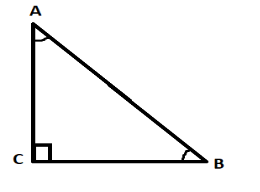
We can calculate the sine of respective angles using the formula for sine.
$ \sin \theta = \dfrac{{perpendicular}}{{hypotenuse}} $
$
\Rightarrow \sin A = \dfrac{{BC}}{{AB}} \\
\Rightarrow \sin B = \dfrac{{AC}}{{AB}} \\
\Rightarrow \sin C = 1\left( {\because \sin 90 = 1} \right) \;
$
Now, according to the question we have to prove that $ {\sin ^2}A + {\sin ^2}B + {\sin ^2}C = 2 $ , so:
$
{\sin ^2}A + {\sin ^2}B + {\sin ^2}C = \dfrac{{B{C^2}}}{{A{B^2}}} + \dfrac{{A{C^2}}}{{A{B^2}}} + 1 \\
{\sin ^2}A + {\sin ^2}B + {\sin ^2}C = \dfrac{{B{C^2} + A{C^2}}}{{A{B^2}}} + 1 \;
$
From Pythagoras theorem:
$ {H^2} = {P^2} + {B^2} $ , here,
Hypotenuse (H) = AB
Perpendicular = AC
Base (B) = BC
$ \Rightarrow A{B^2} = A{C^2} + B{C^2} $
Substituting this, we get:
$
{\sin ^2}A + {\sin ^2}B + {\sin ^2}C = \dfrac{{A{B^2}}}{{A{B^2}}} + 1 \\
{\sin ^2}A + {\sin ^2}B + {\sin ^2}C = 1 + 1 \\
{\sin ^2}A + {\sin ^2}B + {\sin ^2}C = 2 \;
$
Hence, the given statement is proved.
Note: We can apply Pythagoras theorems only on right-angled triangles where one of the angles is of 90°.In a quadratic equation, the maximum degree of a variable is 2, that is how we identify the given equation as quadratic.We can write the angle of 90° or $ \dfrac{\pi }{2} $ according to the needs, both representing the same measure of angle.
The perpendicular side for an angle is the side opposite to it.
Formulas to be used:
$
S = \dfrac{{Coeff.{\text{ }}of{\text{ }}x}}{{const.}} \\
P = \dfrac{{Coeff.{\text{ }}of{\text{ }}{x^2}}}{{const.}} \\
$ where, S and P are sum and products of the roots of a quadratic equation
$ \tan (A + B) = \dfrac{{\tan A + \tan B}}{{1 - \tan A \times \tan B}} $
$ \sin \theta = \dfrac{{perpendicular}}{{hypotenuse}} $
According to Pythagoras theorem:
$ {H^2} = {P^2} + {B^2} $ where, H is hypotenuse, P is perpendicular and B is the base for the right angled triangle.
Complete step-by-step answer:
It is given that tan A and tan B are the roots of the quadratic equation $ ab{x^2} - {c^2}x + ab = 0 $ .
The sum of and product of the roots of a quadratic equation are given as:
$
S = \dfrac{{Coeff.{\text{ }}of{\text{ }}x}}{{const.}} \\
P = \dfrac{{Coeff.{\text{ }}of{\text{ }}{x^2}}}{{const.}} \;
$
For the given quadratic equation:
$
\tan A + \tan B = \dfrac{{{c^2}}}{{ab}} \\
\tan A \times \tan B = \dfrac{{ab}}{{ab}} = 1 \\
$
From the identity of sum of angles of tan:
$ \tan (A + B) = \dfrac{{\tan A + \tan B}}{{1 - \tan A \times \tan B}} $
Substituting the values, we get:
$
\tan (A + B) = \dfrac{{\dfrac{{{c^2}}}{{ab}}}}{{1 - 1}} \\
\tan (A + B) = \dfrac{{\dfrac{{{c^2}}}{{ab}}}}{0} \\
\Rightarrow \tan (A + B) = \infty \\
\Rightarrow \tan (A + B) = \tan \dfrac{\pi }{2}\left( {\because \tan \dfrac{\pi }{2} = \infty } \right) \;
$
We can now get the value of the angles of the triangle ABC.
$ A + B = \dfrac{\pi }{2} $
Sum of all the three angles in a triangle is 180°.
$
A + B + C = {180^\circ } \\
\Rightarrow \dfrac{\pi }{2} + C = {180^\circ } \\
\Rightarrow C = {180^\circ } - {90^\circ }\left( {\because \dfrac{\pi }{2} = {{90}^\circ }} \right) \\
\Rightarrow C = {90^\circ } \;
$
So the triangle can be drawn as:
We can calculate the sine of respective angles using the formula for sine.
$ \sin \theta = \dfrac{{perpendicular}}{{hypotenuse}} $
$
\Rightarrow \sin A = \dfrac{{BC}}{{AB}} \\
\Rightarrow \sin B = \dfrac{{AC}}{{AB}} \\
\Rightarrow \sin C = 1\left( {\because \sin 90 = 1} \right) \;
$
Now, according to the question we have to prove that $ {\sin ^2}A + {\sin ^2}B + {\sin ^2}C = 2 $ , so:
$
{\sin ^2}A + {\sin ^2}B + {\sin ^2}C = \dfrac{{B{C^2}}}{{A{B^2}}} + \dfrac{{A{C^2}}}{{A{B^2}}} + 1 \\
{\sin ^2}A + {\sin ^2}B + {\sin ^2}C = \dfrac{{B{C^2} + A{C^2}}}{{A{B^2}}} + 1 \;
$
From Pythagoras theorem:
$ {H^2} = {P^2} + {B^2} $ , here,
Hypotenuse (H) = AB
Perpendicular = AC
Base (B) = BC
$ \Rightarrow A{B^2} = A{C^2} + B{C^2} $
Substituting this, we get:
$
{\sin ^2}A + {\sin ^2}B + {\sin ^2}C = \dfrac{{A{B^2}}}{{A{B^2}}} + 1 \\
{\sin ^2}A + {\sin ^2}B + {\sin ^2}C = 1 + 1 \\
{\sin ^2}A + {\sin ^2}B + {\sin ^2}C = 2 \;
$
Hence, the given statement is proved.
Note: We can apply Pythagoras theorems only on right-angled triangles where one of the angles is of 90°.In a quadratic equation, the maximum degree of a variable is 2, that is how we identify the given equation as quadratic.We can write the angle of 90° or $ \dfrac{\pi }{2} $ according to the needs, both representing the same measure of angle.
The perpendicular side for an angle is the side opposite to it.
Recently Updated Pages
Master Class 11 Social Science: Engaging Questions & Answers for Success

Master Class 11 Chemistry: Engaging Questions & Answers for Success
Master Class 12 Business Studies: Engaging Questions & Answers for Success
Master Class 12 Chemistry: Engaging Questions & Answers for Success
Master Class 12 Biology: Engaging Questions & Answers for Success
Class 12 Question and Answer - Your Ultimate Solutions Guide
Trending doubts
One Metric ton is equal to kg A 10000 B 1000 C 100 class 11 physics CBSE
Difference Between Prokaryotic Cells and Eukaryotic Cells
How many of the following diseases can be studied with class 11 biology CBSE
Two of the body parts which do not appear in MRI are class 11 biology CBSE
Which of the following enzymes is used for carboxylation class 11 biology CBSE
Explain zero factorial class 11 maths CBSE