




If ‘T’ be any point on a tangent at any point ‘P’ of a parabola, and if TL is perpendicular to focal radius SP and TN is perpendicular to directrix, prove that \[SL=TN\]
Answer
 Verified
627.6k+ views
Hint: We solve this problem first by drawing the figure of given data as follows
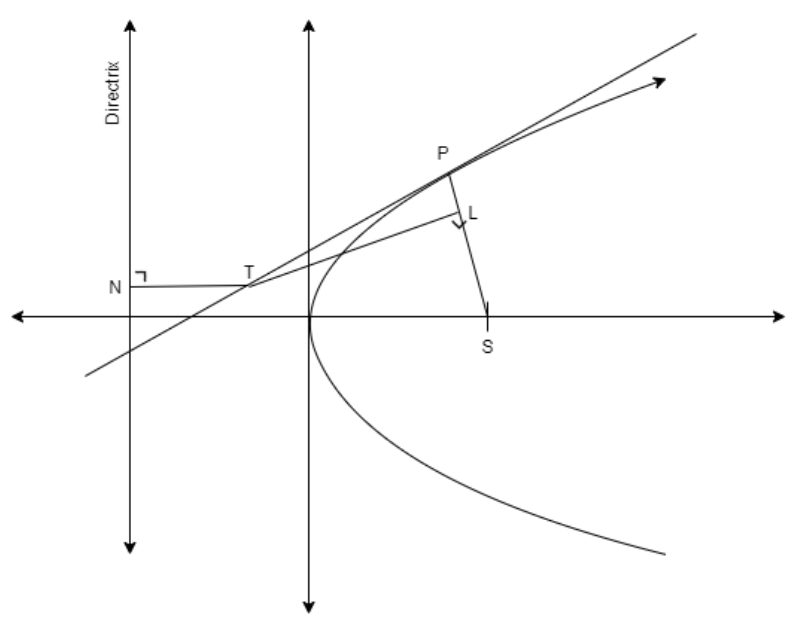
Here, we assume the parabola equation as \[{{y}^{2}}=4ax\] and the point ‘T’ as \[\left( h,k \right)\] also we use the parametric point form of P as \[\left( 2at,a{{t}^{2}} \right)\] then we find the equations of lines ‘TL’ and directrix to find the perpendicular distances SL and TN to show that both are equal.
Complete step-by-step solution:
Let us assume that the equation of parabola as
\[\Rightarrow {{y}^{2}}=4ax\]
We know that the parametric point of a parabola is given as \[\left( 2at,a{{t}^{2}} \right)\]
Let us assume that the point P as
\[\Rightarrow P=\left( 2at,a{{t}^{2}} \right)\]
We know that the focus point of parabola is \[S\left( a,0 \right)\]
Now, let us find the slope of line SP
We know that the slope of two points \[\left( {{x}_{1}},{{y}_{1}} \right),\left( {{x}_{2}},{{y}_{2}} \right)\] is given as
\[\Rightarrow m=\dfrac{{{y}_{2}}-{{y}_{1}}}{{{x}_{2}}-{{x}_{1}}}\]
By using the above formula we get the slope of SP as
\[\begin{align}
& \Rightarrow {{m}_{1}}=\dfrac{2at-0}{a{{t}^{2}}-a} \\
& \Rightarrow {{m}_{1}}=\dfrac{2t}{{{t}^{2}}-1} \\
\end{align}\]
Now, let us find the slope of line TL
We are given that \[TL\bot SP\]
We know that when two lines are perpendicular then the product of slopes equal to -1
So, is the slope of TL is \[{{m}_{2}}\] then we can write
\[\begin{align}
& \Rightarrow {{m}_{1}}\times {{m}_{2}}=-1 \\
& \Rightarrow {{m}_{2}}=-\dfrac{1}{{{m}_{1}}} \\
\end{align}\]
By substituting the slope of SP we get
\[\begin{align}
& \Rightarrow {{m}_{2}}=-\left( \dfrac{{{t}^{2}}-1}{2t} \right) \\
& \Rightarrow {{m}_{2}}=\dfrac{1-{{t}^{2}}}{2t} \\
\end{align}\]
Now, let us assume that the point T as \[\left( h,k \right)\]
Here, we have the slope of line TL and one point T then by using the slope point form the equation of line TL can be written as
\[\Rightarrow y-k={{m}_{2}}\left( x-h \right)\]
By substituting the slope in the above equation we get
\[\Rightarrow y-k=\dfrac{1-{{t}^{2}}}{2t}\left( x-h \right)\]
By cross multiplying the above equation we get
\[\begin{align}
& \Rightarrow 2ty-2tk=x\left( 1-{{t}^{2}} \right)-h\left( 1-{{t}^{2}} \right) \\
& \Rightarrow x\left( 1-{{t}^{2}} \right)-2yt+2tk-h\left( 1-{{t}^{2}} \right)=0........equation(i) \\
\end{align}\]
Now, let us find the length of SL
We know that the perpendicular distance from point \[\left( {{x}_{1}},{{y}_{1}} \right)\] to the line \[ax+by+c=0\] is given as
\[\Rightarrow D=\dfrac{\left| a{{x}_{1}}+b{{y}_{1}}+c \right|}{\sqrt{{{a}^{2}}+{{b}^{2}}}}\]
Here, we know that the length SL is perpendicular distance from focus \[S\left( a,0 \right)\] to line TL
By using the above perpendicular distance formula we get
\[\Rightarrow SL=\dfrac{\left| a\left( 1-{{t}^{2}} \right)+2tk-h\left( 1-{{t}^{2}} \right) \right|}{\sqrt{{{\left( 1-{{t}^{2}} \right)}^{2}}+{{\left( 2t \right)}^{2}}}}\]
We know that the equation of tangent at a parametric point \[P\left( a{{t}^{2}},2at \right)\] is given as
\[\Rightarrow ty=x+a{{t}^{2}}\]
We are given that this equation of tangent passes through point \[T\left( h,k \right)\] then we get
\[\Rightarrow tk=h+a{{t}^{2}}\]
Now, by substituting the above result in the distance of SL we get
\[\begin{align}
& \Rightarrow SL=\dfrac{\left| a-a{{t}^{2}}+2h+2a{{t}^{2}}-h+h{{t}^{2}} \right|}{\sqrt{{{\left( 1+{{t}^{2}} \right)}^{2}}}} \\
& \Rightarrow SL=\dfrac{\left( a+h \right)\left( 1+{{t}^{2}} \right)}{\left( 1+{{t}^{2}} \right)} \\
& \Rightarrow SL=a+h......equation(ii) \\
\end{align}\]
Now, let us find the length of TN
We know that the equation of directrix of parabola \[{{y}^{2}}=4ax\] is given as
\[\Rightarrow x+a=0\]
Here, we can see that the length TN is the perpendicular distance from point \[T\left( h,k \right)\] to directrix because we are given that TN is perpendicular to directrix.
Now, by using the perpendicular distance formula we get
\[\begin{align}
& \Rightarrow TN=\dfrac{\left| h+a \right|}{\sqrt{{{1}^{2}}+{{0}^{2}}}} \\
& \Rightarrow TN=h+a.......equation(iii) \\
\end{align}\]
Now, from the equation (ii) and equation (iii) we get
\[\Rightarrow SL=TN\]
Therefore, the required result has been proved.
Note: Here we used the general type of parabola but we can use any type of parabola to get the required result. For the parabola \[{{y}^{2}}=4ax\] we used some standard formulas such as
(i) Parametric point is given as \[\left( 2at,a{{t}^{2}} \right)\]
(ii) Equation of tangent at any point \[\left( 2at,a{{t}^{2}} \right)\] is given as
\[\Rightarrow ty=x+a{{t}^{2}}\]
(iii) Directrix is given as
\[\Rightarrow x+a=0\]
(iv) The perpendicular distance from point \[\left( {{x}_{1}},{{y}_{1}} \right)\] to the line \[ax+by+c=0\] is given as
\[\Rightarrow D=\dfrac{\left| a{{x}_{1}}+b{{y}_{1}}+c \right|}{\sqrt{{{a}^{2}}+{{b}^{2}}}}\]
These are important results to be remembered while solving this problem.
Here, we assume the parabola equation as \[{{y}^{2}}=4ax\] and the point ‘T’ as \[\left( h,k \right)\] also we use the parametric point form of P as \[\left( 2at,a{{t}^{2}} \right)\] then we find the equations of lines ‘TL’ and directrix to find the perpendicular distances SL and TN to show that both are equal.
Complete step-by-step solution:
Let us assume that the equation of parabola as
\[\Rightarrow {{y}^{2}}=4ax\]
We know that the parametric point of a parabola is given as \[\left( 2at,a{{t}^{2}} \right)\]
Let us assume that the point P as
\[\Rightarrow P=\left( 2at,a{{t}^{2}} \right)\]
We know that the focus point of parabola is \[S\left( a,0 \right)\]
Now, let us find the slope of line SP
We know that the slope of two points \[\left( {{x}_{1}},{{y}_{1}} \right),\left( {{x}_{2}},{{y}_{2}} \right)\] is given as
\[\Rightarrow m=\dfrac{{{y}_{2}}-{{y}_{1}}}{{{x}_{2}}-{{x}_{1}}}\]
By using the above formula we get the slope of SP as
\[\begin{align}
& \Rightarrow {{m}_{1}}=\dfrac{2at-0}{a{{t}^{2}}-a} \\
& \Rightarrow {{m}_{1}}=\dfrac{2t}{{{t}^{2}}-1} \\
\end{align}\]
Now, let us find the slope of line TL
We are given that \[TL\bot SP\]
We know that when two lines are perpendicular then the product of slopes equal to -1
So, is the slope of TL is \[{{m}_{2}}\] then we can write
\[\begin{align}
& \Rightarrow {{m}_{1}}\times {{m}_{2}}=-1 \\
& \Rightarrow {{m}_{2}}=-\dfrac{1}{{{m}_{1}}} \\
\end{align}\]
By substituting the slope of SP we get
\[\begin{align}
& \Rightarrow {{m}_{2}}=-\left( \dfrac{{{t}^{2}}-1}{2t} \right) \\
& \Rightarrow {{m}_{2}}=\dfrac{1-{{t}^{2}}}{2t} \\
\end{align}\]
Now, let us assume that the point T as \[\left( h,k \right)\]
Here, we have the slope of line TL and one point T then by using the slope point form the equation of line TL can be written as
\[\Rightarrow y-k={{m}_{2}}\left( x-h \right)\]
By substituting the slope in the above equation we get
\[\Rightarrow y-k=\dfrac{1-{{t}^{2}}}{2t}\left( x-h \right)\]
By cross multiplying the above equation we get
\[\begin{align}
& \Rightarrow 2ty-2tk=x\left( 1-{{t}^{2}} \right)-h\left( 1-{{t}^{2}} \right) \\
& \Rightarrow x\left( 1-{{t}^{2}} \right)-2yt+2tk-h\left( 1-{{t}^{2}} \right)=0........equation(i) \\
\end{align}\]
Now, let us find the length of SL
We know that the perpendicular distance from point \[\left( {{x}_{1}},{{y}_{1}} \right)\] to the line \[ax+by+c=0\] is given as
\[\Rightarrow D=\dfrac{\left| a{{x}_{1}}+b{{y}_{1}}+c \right|}{\sqrt{{{a}^{2}}+{{b}^{2}}}}\]
Here, we know that the length SL is perpendicular distance from focus \[S\left( a,0 \right)\] to line TL
By using the above perpendicular distance formula we get
\[\Rightarrow SL=\dfrac{\left| a\left( 1-{{t}^{2}} \right)+2tk-h\left( 1-{{t}^{2}} \right) \right|}{\sqrt{{{\left( 1-{{t}^{2}} \right)}^{2}}+{{\left( 2t \right)}^{2}}}}\]
We know that the equation of tangent at a parametric point \[P\left( a{{t}^{2}},2at \right)\] is given as
\[\Rightarrow ty=x+a{{t}^{2}}\]
We are given that this equation of tangent passes through point \[T\left( h,k \right)\] then we get
\[\Rightarrow tk=h+a{{t}^{2}}\]
Now, by substituting the above result in the distance of SL we get
\[\begin{align}
& \Rightarrow SL=\dfrac{\left| a-a{{t}^{2}}+2h+2a{{t}^{2}}-h+h{{t}^{2}} \right|}{\sqrt{{{\left( 1+{{t}^{2}} \right)}^{2}}}} \\
& \Rightarrow SL=\dfrac{\left( a+h \right)\left( 1+{{t}^{2}} \right)}{\left( 1+{{t}^{2}} \right)} \\
& \Rightarrow SL=a+h......equation(ii) \\
\end{align}\]
Now, let us find the length of TN
We know that the equation of directrix of parabola \[{{y}^{2}}=4ax\] is given as
\[\Rightarrow x+a=0\]
Here, we can see that the length TN is the perpendicular distance from point \[T\left( h,k \right)\] to directrix because we are given that TN is perpendicular to directrix.
Now, by using the perpendicular distance formula we get
\[\begin{align}
& \Rightarrow TN=\dfrac{\left| h+a \right|}{\sqrt{{{1}^{2}}+{{0}^{2}}}} \\
& \Rightarrow TN=h+a.......equation(iii) \\
\end{align}\]
Now, from the equation (ii) and equation (iii) we get
\[\Rightarrow SL=TN\]
Therefore, the required result has been proved.
Note: Here we used the general type of parabola but we can use any type of parabola to get the required result. For the parabola \[{{y}^{2}}=4ax\] we used some standard formulas such as
(i) Parametric point is given as \[\left( 2at,a{{t}^{2}} \right)\]
(ii) Equation of tangent at any point \[\left( 2at,a{{t}^{2}} \right)\] is given as
\[\Rightarrow ty=x+a{{t}^{2}}\]
(iii) Directrix is given as
\[\Rightarrow x+a=0\]
(iv) The perpendicular distance from point \[\left( {{x}_{1}},{{y}_{1}} \right)\] to the line \[ax+by+c=0\] is given as
\[\Rightarrow D=\dfrac{\left| a{{x}_{1}}+b{{y}_{1}}+c \right|}{\sqrt{{{a}^{2}}+{{b}^{2}}}}\]
These are important results to be remembered while solving this problem.
Recently Updated Pages
Basicity of sulphurous acid and sulphuric acid are

Master Class 11 English: Engaging Questions & Answers for Success
Master Class 11 Physics: Engaging Questions & Answers for Success
Master Class 11 Computer Science: Engaging Questions & Answers for Success
Master Class 11 Chemistry: Engaging Questions & Answers for Success
Master Class 11 Social Science: Engaging Questions & Answers for Success
Trending doubts
Difference Between Prokaryotic Cells and Eukaryotic Cells
Two of the body parts which do not appear in MRI are class 11 biology CBSE
One Metric ton is equal to kg A 10000 B 1000 C 100 class 11 physics CBSE
10 examples of friction in our daily life
Draw a diagram of nephron and explain its structur class 11 biology CBSE
What will happen if the mucus is not secreted by the class 11 biology CBSE