




If $\sin x+\cos x=0$ and x lies in the fourth quadrant, find sinx and cosx.
\[\begin{align}
& A.\dfrac{1}{\sqrt{2}},\dfrac{-1}{\sqrt{3}} \\
& B.\dfrac{-1}{\sqrt{2}},\dfrac{1}{\sqrt{2}} \\
& C.\dfrac{1}{\sqrt{3}},\dfrac{1}{\sqrt{2}} \\
& D.\text{None of these} \\
\end{align}\]
Answer
 Verified
603.6k+ views
Hint: In this question, we are given a trigonometric equation and we need to find the value of sinx and cosx. For this, we will first find the value of x by simplifying the given equation. After that, using the value of x, we will find the values of sinx and cosx. We will use the trigonometric property that $\dfrac{\sin x}{\cos x}=\tan x$ signs of different functions in different quadrants.
Complete step by step answer:
Here we are given the equation that $\sin x+\cos x=0$.
Taking cosx to the other side, we get: $\sin x=-\cos x$.
Now dividing both sides by cosx, we get: $\dfrac{\sin x}{\cos x}=-\dfrac{\cos x}{\cos x}$.
Cancelling cosx on the right side of the equation we get: $\dfrac{\sin x}{\cos x}=-1$.
We know that, $\dfrac{\sin x}{\cos x}=\tan x$ so we get $\tan x=-1$.
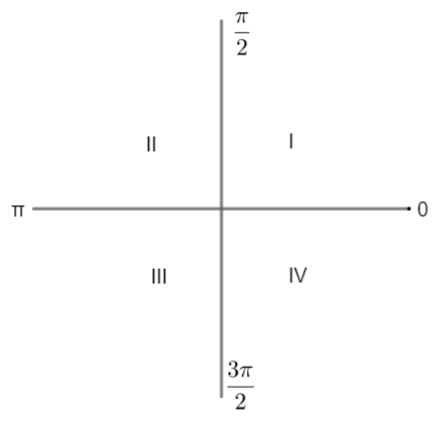
Now we need the value in the fourth quadrant, therefore our value should be greater than $\dfrac{3\pi }{2}$ and less than $2\pi $. We know that, $\tan \dfrac{\pi }{4}=1$ but to make it into negative in fourth quadrant, we can say that,
$-\tan \dfrac{\pi }{4}=\tan \left( 2\pi -\dfrac{\pi }{4} \right)$ ($2\pi -\dfrac{\pi }{4}$ will lie in fourth quadrant) so we get $-1=\tan \left( \dfrac{7\pi }{4} \right)$.
Comparing $\tan x=-1$ we get $x=\dfrac{7\pi }{4}$.
Now let us find the values of sinx and cosx.
$\sin \dfrac{7\pi }{4}=\sin \left( 2\pi -\dfrac{\pi }{4} \right)$.
As sinx function is negative in the fourth quadrant so we get,
$\sin \dfrac{7\pi }{4}=-\sin \dfrac{\pi }{4}$.
We know that, $\sin \dfrac{\pi }{4}=-\dfrac{1}{\sqrt{2}}$ so we get:
$\sin \dfrac{7\pi }{4}=-\dfrac{1}{\sqrt{2}}$.
Or we can say $\sin x=-\dfrac{1}{\sqrt{2}}$.
$\cos \dfrac{7\pi }{4}=\cos \left( 2\pi -\dfrac{\pi }{4} \right)$.
Cosine function is positive in the fourth quadrant, so we get:
$\cos \dfrac{7\pi }{4}=\cos \dfrac{\pi }{4}$.
We know that $\cos \dfrac{\pi }{4}=\dfrac{1}{\sqrt{2}}$ so we get,
$\cos \dfrac{7\pi }{4}=\dfrac{1}{\sqrt{2}}$.
Or we can say that $\cos x=\dfrac{1}{\sqrt{2}}$.
So, the correct answer is “Option B”.
Note: Students should note that all functions are positive in first quadrant, sine function is positive in second quadrant, tangent function is positive in third quadrant and cosine function is positive in fourth quadrant. Take care of signs while solving this sum. We can also solve it in the following way,
$\sin x+\cos x=0\Rightarrow \sin x=-\cos x$.
We know that only the cosine function is positive in the fourth quadrant, so sine function will be negative.
So $-\sin x=\cos x$.
The only value which is equal for both sine and cosine is $\dfrac{1}{\sqrt{2}}$ so we get that,
$\begin{align}
& -\sin x=\cos x\Rightarrow \sin x=-\dfrac{1}{\sqrt{2}},\cos x=\dfrac{1}{\sqrt{2}} \\
& \Rightarrow \left( -\dfrac{1}{\sqrt{2}}+\dfrac{1}{\sqrt{2}}=0 \right) \\
\end{align}$.
Complete step by step answer:
Here we are given the equation that $\sin x+\cos x=0$.
Taking cosx to the other side, we get: $\sin x=-\cos x$.
Now dividing both sides by cosx, we get: $\dfrac{\sin x}{\cos x}=-\dfrac{\cos x}{\cos x}$.
Cancelling cosx on the right side of the equation we get: $\dfrac{\sin x}{\cos x}=-1$.
We know that, $\dfrac{\sin x}{\cos x}=\tan x$ so we get $\tan x=-1$.
Now we need the value in the fourth quadrant, therefore our value should be greater than $\dfrac{3\pi }{2}$ and less than $2\pi $. We know that, $\tan \dfrac{\pi }{4}=1$ but to make it into negative in fourth quadrant, we can say that,
$-\tan \dfrac{\pi }{4}=\tan \left( 2\pi -\dfrac{\pi }{4} \right)$ ($2\pi -\dfrac{\pi }{4}$ will lie in fourth quadrant) so we get $-1=\tan \left( \dfrac{7\pi }{4} \right)$.
Comparing $\tan x=-1$ we get $x=\dfrac{7\pi }{4}$.
Now let us find the values of sinx and cosx.
$\sin \dfrac{7\pi }{4}=\sin \left( 2\pi -\dfrac{\pi }{4} \right)$.
As sinx function is negative in the fourth quadrant so we get,
$\sin \dfrac{7\pi }{4}=-\sin \dfrac{\pi }{4}$.
We know that, $\sin \dfrac{\pi }{4}=-\dfrac{1}{\sqrt{2}}$ so we get:
$\sin \dfrac{7\pi }{4}=-\dfrac{1}{\sqrt{2}}$.
Or we can say $\sin x=-\dfrac{1}{\sqrt{2}}$.
$\cos \dfrac{7\pi }{4}=\cos \left( 2\pi -\dfrac{\pi }{4} \right)$.
Cosine function is positive in the fourth quadrant, so we get:
$\cos \dfrac{7\pi }{4}=\cos \dfrac{\pi }{4}$.
We know that $\cos \dfrac{\pi }{4}=\dfrac{1}{\sqrt{2}}$ so we get,
$\cos \dfrac{7\pi }{4}=\dfrac{1}{\sqrt{2}}$.
Or we can say that $\cos x=\dfrac{1}{\sqrt{2}}$.
So, the correct answer is “Option B”.
Note: Students should note that all functions are positive in first quadrant, sine function is positive in second quadrant, tangent function is positive in third quadrant and cosine function is positive in fourth quadrant. Take care of signs while solving this sum. We can also solve it in the following way,
$\sin x+\cos x=0\Rightarrow \sin x=-\cos x$.
We know that only the cosine function is positive in the fourth quadrant, so sine function will be negative.
So $-\sin x=\cos x$.
The only value which is equal for both sine and cosine is $\dfrac{1}{\sqrt{2}}$ so we get that,
$\begin{align}
& -\sin x=\cos x\Rightarrow \sin x=-\dfrac{1}{\sqrt{2}},\cos x=\dfrac{1}{\sqrt{2}} \\
& \Rightarrow \left( -\dfrac{1}{\sqrt{2}}+\dfrac{1}{\sqrt{2}}=0 \right) \\
\end{align}$.
Recently Updated Pages
Master Class 12 Economics: Engaging Questions & Answers for Success

Master Class 12 English: Engaging Questions & Answers for Success
Master Class 12 Social Science: Engaging Questions & Answers for Success
Master Class 12 Maths: Engaging Questions & Answers for Success
Master Class 12 Physics: Engaging Questions & Answers for Success
Master Class 10 English: Engaging Questions & Answers for Success
Trending doubts
Explain the Treaty of Vienna of 1815 class 10 social science CBSE
Why is it 530 pm in india when it is 1200 afternoon class 10 social science CBSE
What is the full form of POSCO class 10 social science CBSE
Define Potential, Developed, Stock and Reserved resources
Which Country Has the Largest Border with India?
Choose the feminine form of the given noun Fox AFoxess class 10 english CBSE