




If $\sin \theta =\dfrac{8}{17}$, find other trigonometric ratios.
Answer
 Verified
607.8k+ views
Hint:Assume that in the given function: $\sin \theta =\dfrac{8}{17}$, 8 is the length of perpendicular and 17 is the length of hypotenuse of a right angle triangle. Use Pythagoras theorem given by: $\text{hypotenuse}{{\text{e}}^{\text{2}}}=\text{bas}{{\text{e}}^{\text{2}}}+\text{perpendicular}{{\text{r}}^{\text{2}}}$, to determine the length of the base of the right angle triangle. Now, find $\cos \theta $ by taking the ratio of base and hypotenuse. To find $\tan \theta $ take the ratio of $\sin \theta $ and $\cos \theta $. Take the reciprocal of $\sin \theta $, $\cos \theta $ and $\tan \theta $ to find the value of $\sec \theta $, $\cos ec\theta $ and $\cot \theta $ respectively.
Complete step-by-step answer:
We have been provided with the trigonometric ratio, $\sin \theta =\dfrac{8}{17}$.
We know that, $\sin \theta =\dfrac{\text{Perpendicular}}{\text{Hypotenuse}}$. Therefore, on comparing it with the above provided ratio, we have, 8 as the length of perpendicular and 17 as the length of hypotenuse of a right angle triangle.
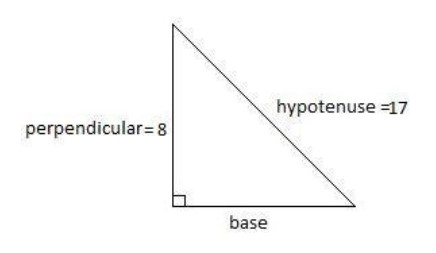
Now, using Pythagoras theorem: $\text{hypotenus}{{\text{e}}^{\text{2}}}=\text{bas}{{\text{e}}^{\text{2}}}+\text{perpendicula}{{\text{r}}^{\text{2}}}$, we get,
\[\begin{align}
& \text{bas}{{\text{e}}^{\text{2}}}=\text{hypotenus}{{\text{e}}^{\text{2}}}-\text{perpendicula}{{\text{r}}^{\text{2}}} \\
& \Rightarrow \text{base}=\sqrt{\text{hypotenus}{{\text{e}}^{\text{2}}}-\text{perpendicula}{{\text{r}}^{\text{2}}}} \\
& \Rightarrow \text{base}=\sqrt{{{17}^{\text{2}}}-{{8}^{\text{2}}}} \\
& \Rightarrow \text{base}=\sqrt{289-64} \\
& \Rightarrow \text{base}=\sqrt{225} \\
& \Rightarrow \text{base}=15 \\
\end{align}\]
We know that, $\cos \theta =\dfrac{\text{Base}}{\text{Hypotenuse}}$.
\[\Rightarrow \cos \theta =\dfrac{15}{17}\]
Also, $\tan \theta =\dfrac{\text{Perpendicular}}{\text{Base}}$
$\Rightarrow \tan \theta =\dfrac{8}{15}$
Now, take the reciprocal of $\sin \theta $, $\cos \theta $ and $\tan \theta $ to find the value of $\sec \theta $, $\cos ec\theta $ and $\cot \theta $ respectively.
$\begin{align}
& \sec \theta =\dfrac{1}{\cos \theta } \\
& \Rightarrow \sec \theta =\dfrac{17}{15} \\
\end{align}$
$\begin{align}
& \cos ec\theta =\dfrac{1}{\sin \theta } \\
& \Rightarrow \cos ec\theta =\dfrac{17}{8} \\
\end{align}$
$\begin{align}
& \cot \theta =\dfrac{1}{\tan \theta } \\
& \Rightarrow \cot \theta =\dfrac{15}{8} \\
\end{align}$
Note: Here, we have used Pythagoras theorem to determine the base of the triangle to find other trigonometric ratios. One may note that, $\sec \theta $ is the ratio of length of hypotenuse and base, $\cos ec\theta $ is the ratio of length of perpendicular and base, and $\cot \theta $ is the ratio of length of base and hypotenuse. So, these ratios can also be found without taking the reciprocals.We can solve the question by using trigonometric identities $\sin^2\theta+\cos^2\theta=1$, $1+\tan^2\theta=\sec^2\theta$ to find all other trigonometric ratios.
Complete step-by-step answer:
We have been provided with the trigonometric ratio, $\sin \theta =\dfrac{8}{17}$.
We know that, $\sin \theta =\dfrac{\text{Perpendicular}}{\text{Hypotenuse}}$. Therefore, on comparing it with the above provided ratio, we have, 8 as the length of perpendicular and 17 as the length of hypotenuse of a right angle triangle.
Now, using Pythagoras theorem: $\text{hypotenus}{{\text{e}}^{\text{2}}}=\text{bas}{{\text{e}}^{\text{2}}}+\text{perpendicula}{{\text{r}}^{\text{2}}}$, we get,
\[\begin{align}
& \text{bas}{{\text{e}}^{\text{2}}}=\text{hypotenus}{{\text{e}}^{\text{2}}}-\text{perpendicula}{{\text{r}}^{\text{2}}} \\
& \Rightarrow \text{base}=\sqrt{\text{hypotenus}{{\text{e}}^{\text{2}}}-\text{perpendicula}{{\text{r}}^{\text{2}}}} \\
& \Rightarrow \text{base}=\sqrt{{{17}^{\text{2}}}-{{8}^{\text{2}}}} \\
& \Rightarrow \text{base}=\sqrt{289-64} \\
& \Rightarrow \text{base}=\sqrt{225} \\
& \Rightarrow \text{base}=15 \\
\end{align}\]
We know that, $\cos \theta =\dfrac{\text{Base}}{\text{Hypotenuse}}$.
\[\Rightarrow \cos \theta =\dfrac{15}{17}\]
Also, $\tan \theta =\dfrac{\text{Perpendicular}}{\text{Base}}$
$\Rightarrow \tan \theta =\dfrac{8}{15}$
Now, take the reciprocal of $\sin \theta $, $\cos \theta $ and $\tan \theta $ to find the value of $\sec \theta $, $\cos ec\theta $ and $\cot \theta $ respectively.
$\begin{align}
& \sec \theta =\dfrac{1}{\cos \theta } \\
& \Rightarrow \sec \theta =\dfrac{17}{15} \\
\end{align}$
$\begin{align}
& \cos ec\theta =\dfrac{1}{\sin \theta } \\
& \Rightarrow \cos ec\theta =\dfrac{17}{8} \\
\end{align}$
$\begin{align}
& \cot \theta =\dfrac{1}{\tan \theta } \\
& \Rightarrow \cot \theta =\dfrac{15}{8} \\
\end{align}$
Note: Here, we have used Pythagoras theorem to determine the base of the triangle to find other trigonometric ratios. One may note that, $\sec \theta $ is the ratio of length of hypotenuse and base, $\cos ec\theta $ is the ratio of length of perpendicular and base, and $\cot \theta $ is the ratio of length of base and hypotenuse. So, these ratios can also be found without taking the reciprocals.We can solve the question by using trigonometric identities $\sin^2\theta+\cos^2\theta=1$, $1+\tan^2\theta=\sec^2\theta$ to find all other trigonometric ratios.
Recently Updated Pages
Master Class 11 Computer Science: Engaging Questions & Answers for Success

Master Class 11 Business Studies: Engaging Questions & Answers for Success
Master Class 11 Economics: Engaging Questions & Answers for Success
Master Class 11 English: Engaging Questions & Answers for Success
Master Class 11 Maths: Engaging Questions & Answers for Success
Master Class 11 Biology: Engaging Questions & Answers for Success
Trending doubts
One Metric ton is equal to kg A 10000 B 1000 C 100 class 11 physics CBSE
There are 720 permutations of the digits 1 2 3 4 5 class 11 maths CBSE
Discuss the various forms of bacteria class 11 biology CBSE
Draw a diagram of a plant cell and label at least eight class 11 biology CBSE
State the laws of reflection of light
Explain zero factorial class 11 maths CBSE