




If $\sin \theta = \dfrac{1}{2}$ and$\tan \theta = \dfrac{1}{{\sqrt 3 }}$ ,$\forall n \in I$, the most general value of $\theta $ is
A.$2n\pi + \dfrac{\pi }{6},\forall n \in I$
B.$2n\pi + \dfrac{\pi }{4},\forall n \in I$
C.$2n\pi + \dfrac{\pi }{3},\forall n \in I$
D.$2n\pi + \dfrac{\pi }{5},\forall n \in I$
Answer
 Verified
475.2k+ views
Hint: First, we need to analyze the given information so that we can solve the problem. Here we are given $\sin \theta = \dfrac{1}{2}$ and $\tan \theta = \dfrac{1}{{\sqrt 3 }}$ need to find the general value of $\theta $
When we express a trigonometric equation in a generalized form, in terms of $n$ , the obtained solution is called a general solution.
Complete step by step answer:
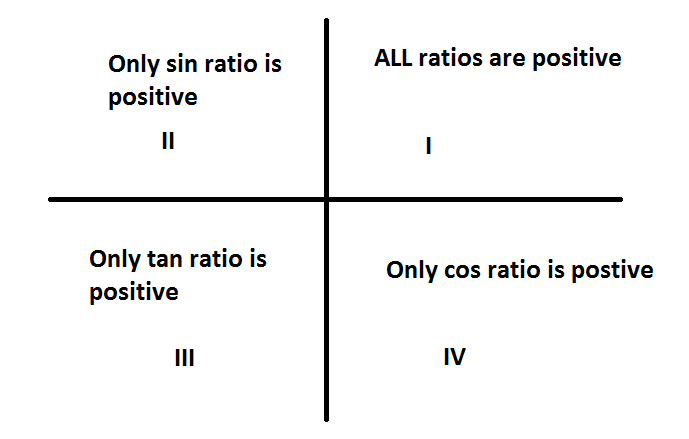
We shall analyze the given graph first.
Here in the first quadrant, all ratios are positive. In the second quadrant, only sine is positive, and in the third quadrant, only the tangent ratio is positive; in the fourth quadrant, only the cosine ratio is positive.
We are given $\sin \theta = \dfrac{1}{2}$
The given sine ratio is positive. So the given ratio lies in the first quadrant or second quadrant.
Thus $\theta $ lies in the first or second quadrant.
Similarly, we are given $\tan \theta = \dfrac{1}{{\sqrt 3 }}$
Since the given ratio is positive, the possible quadrants it will lie in are the third quadrant or the first quadrant.
Thus $\theta $ lies in the first or third quadrant.
While analyzing the given sine ratio, we got the idea that $\theta $ lies in the first or second quadrant. Similarly, for the tangent ratio, we got the idea that $\theta $ lies in the first or third quadrant.
Hence from the above statements, we can note that $\theta $ lies in the first quadrant.
Given that $\sin \theta = \dfrac{1}{2}$ and $\tan \theta = \dfrac{1}{{\sqrt 3 }}$
$\sin \theta = \dfrac{1}{2} \Rightarrow \sin \theta = \sin \dfrac{\pi }{6}$
$ \Rightarrow \theta = \dfrac{\pi }{6}$
$\tan \theta = \dfrac{1}{{\sqrt 3 }} \Rightarrow \tan \theta = \tan \dfrac{\pi }{6}$
$ \Rightarrow \theta = \dfrac{\pi }{6}$
Hence we get $\theta = \dfrac{\pi }{6}$
Whenever $\sin \theta = k,\tan \theta = k$ are given equations, then the general value of $\theta $ is $\theta = 2n\pi + \alpha $ where $\alpha $ is the obtained solution lying between $0$ and $2\pi $.
Hence, the general value is $\theta = 2n\pi + \dfrac{\pi }{6}$, $\forall n \in I$
Thus the option A is the correct answer.
Note: The solutions that are lying between $0and2\pi $ are known as principal solutions. Here in this problem, the obtained principal solution is $\theta = \dfrac{\pi }{6}$. The general solution is obtained from the principal solution. Whenever $\sin \theta = k,\tan \theta = k$ are given equations, then the general value of $\theta $ is $\theta = 2n\pi + \alpha $ where $\alpha $ is the obtained solution lying between$0and2\pi $.
Hence, the general value is $\theta = 2n\pi + \dfrac{\pi }{6}$, $\forall n \in I$
When we express a trigonometric equation in a generalized form, in terms of $n$ , the obtained solution is called a general solution.
Complete step by step answer:
We shall analyze the given graph first.
Here in the first quadrant, all ratios are positive. In the second quadrant, only sine is positive, and in the third quadrant, only the tangent ratio is positive; in the fourth quadrant, only the cosine ratio is positive.
We are given $\sin \theta = \dfrac{1}{2}$
The given sine ratio is positive. So the given ratio lies in the first quadrant or second quadrant.
Thus $\theta $ lies in the first or second quadrant.
Similarly, we are given $\tan \theta = \dfrac{1}{{\sqrt 3 }}$
Since the given ratio is positive, the possible quadrants it will lie in are the third quadrant or the first quadrant.
Thus $\theta $ lies in the first or third quadrant.
While analyzing the given sine ratio, we got the idea that $\theta $ lies in the first or second quadrant. Similarly, for the tangent ratio, we got the idea that $\theta $ lies in the first or third quadrant.
Hence from the above statements, we can note that $\theta $ lies in the first quadrant.
Given that $\sin \theta = \dfrac{1}{2}$ and $\tan \theta = \dfrac{1}{{\sqrt 3 }}$
$\sin \theta = \dfrac{1}{2} \Rightarrow \sin \theta = \sin \dfrac{\pi }{6}$
$ \Rightarrow \theta = \dfrac{\pi }{6}$
$\tan \theta = \dfrac{1}{{\sqrt 3 }} \Rightarrow \tan \theta = \tan \dfrac{\pi }{6}$
$ \Rightarrow \theta = \dfrac{\pi }{6}$
Hence we get $\theta = \dfrac{\pi }{6}$
Whenever $\sin \theta = k,\tan \theta = k$ are given equations, then the general value of $\theta $ is $\theta = 2n\pi + \alpha $ where $\alpha $ is the obtained solution lying between $0$ and $2\pi $.
Hence, the general value is $\theta = 2n\pi + \dfrac{\pi }{6}$, $\forall n \in I$
Thus the option A is the correct answer.
Note: The solutions that are lying between $0and2\pi $ are known as principal solutions. Here in this problem, the obtained principal solution is $\theta = \dfrac{\pi }{6}$. The general solution is obtained from the principal solution. Whenever $\sin \theta = k,\tan \theta = k$ are given equations, then the general value of $\theta $ is $\theta = 2n\pi + \alpha $ where $\alpha $ is the obtained solution lying between$0and2\pi $.
Hence, the general value is $\theta = 2n\pi + \dfrac{\pi }{6}$, $\forall n \in I$
Recently Updated Pages
Master Class 11 English: Engaging Questions & Answers for Success

Master Class 11 Maths: Engaging Questions & Answers for Success
Master Class 11 Biology: Engaging Questions & Answers for Success
Master Class 11 Physics: Engaging Questions & Answers for Success
Master Class 11 Accountancy: Engaging Questions & Answers for Success
Class 11 Question and Answer - Your Ultimate Solutions Guide
Trending doubts
One Metric ton is equal to kg A 10000 B 1000 C 100 class 11 physics CBSE
Discuss the various forms of bacteria class 11 biology CBSE
Draw a diagram of a plant cell and label at least eight class 11 biology CBSE
State the laws of reflection of light
Explain zero factorial class 11 maths CBSE
10 examples of friction in our daily life