




If \[\sin A = \dfrac{3}{4},\,\] find all other Trigonometric-ratios.
Answer
 Verified
644.7k+ views
Hint: In this we have one Trigonometric-ratio equal to value that does not belong to the standard angle table.
∴ We apply triangle concept in it.
Formula used: \[\cos A = \dfrac{{base}}{{hyp}},\,\tan A = \dfrac{{perp}}{{base}},\operatorname {cotA} = \dfrac{{base}}{{perp}}, \sec A = \dfrac{{hyp}}{{base}}, cosecA = \dfrac{{hyp}}{{perp}}\]
By Pythagoras theorem: \[{(hyp)^2} = {(perp)^2} + {(base)^2}\]
Complete step by step answer:
(1) Given: Trigonometric-ratio, \[sinA = \dfrac{3}{4}\,\]
Also, we know that \[sinA = \dfrac{{perp}}{{hyp}}\]
∴ On comparing, we have
Perpendicular $ = 3$ and hypotenuse $ = 4$
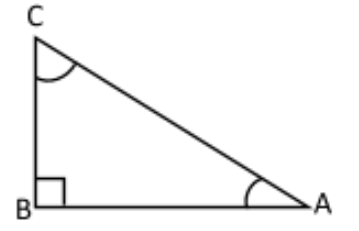
(2) Draw a right angle ΔABC, right angle at B \[(A \ne 90^\circ )\]
(3) Mention two sides \[AC = 4,{\text{ }}BC = 3\]
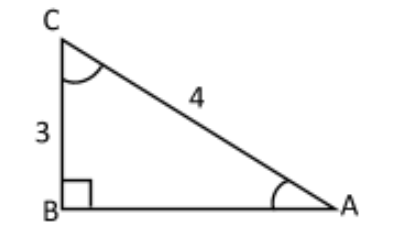
(4) To get the third side in the right angle triangle, we apply Pythagoras theorem.
(5) Using Pythagoras, we calculate base
\[{\left( {hyp} \right)^2} = {(perp)^2} + {(base)^2}\]
\[ \Rightarrow {(4)^2} = {(3)^2} + {(base)^2}\]
$ \Rightarrow 16 = 9 + {(base)^2}$
\[ \Rightarrow 16 - 9 = {(base)^2}\]
\[ \Rightarrow {(base)^2} = 7\]
\[ \Rightarrow base = \sqrt 7 \]
(6) As from above, we got all three sides of the right angle triangle ABC.
(7) Using formula to find various Trigonometric-ratios,
\[
\cos A = \dfrac{{base}}{{hyp.}} \Rightarrow \dfrac{{\sqrt 7 }}{4}\,\,\, \\
\tan A = \dfrac{{perp}}{{base}} = \dfrac{3}{{\sqrt 7 }} \\
\cot A = \dfrac{{base}}{{perp}} = \dfrac{{\sqrt 7 }}{3} \\
\sec A = \dfrac{{hyp}}{{base}} = \dfrac{4}{{\sqrt 7 }}\,\, \\
\operatorname{cosec} A = \dfrac{{hyp}}{{perp}} = \dfrac{4}{3} \\
\]
Note: In trigonometry, there are six functions of an angle commonly used. Their names and abbreviations are sine (sin), cosine (cos), tangent (tan), cotangent (cot), secant (sec), and cosecant (cosec). These six trigonometric functions are in relation to a right triangle displayed in the figure.
Use trigonometric ratios. Here, cosecA is a reciprocal of sinA and in the same way secA is a reciprocal of cosA, cotA is a reciprocal of tanA.
∴ We apply triangle concept in it.
Formula used: \[\cos A = \dfrac{{base}}{{hyp}},\,\tan A = \dfrac{{perp}}{{base}},\operatorname {cotA} = \dfrac{{base}}{{perp}}, \sec A = \dfrac{{hyp}}{{base}}, cosecA = \dfrac{{hyp}}{{perp}}\]
By Pythagoras theorem: \[{(hyp)^2} = {(perp)^2} + {(base)^2}\]
Complete step by step answer:
(1) Given: Trigonometric-ratio, \[sinA = \dfrac{3}{4}\,\]
Also, we know that \[sinA = \dfrac{{perp}}{{hyp}}\]
∴ On comparing, we have
Perpendicular $ = 3$ and hypotenuse $ = 4$
(2) Draw a right angle ΔABC, right angle at B \[(A \ne 90^\circ )\]
(3) Mention two sides \[AC = 4,{\text{ }}BC = 3\]
(4) To get the third side in the right angle triangle, we apply Pythagoras theorem.
(5) Using Pythagoras, we calculate base
\[{\left( {hyp} \right)^2} = {(perp)^2} + {(base)^2}\]
\[ \Rightarrow {(4)^2} = {(3)^2} + {(base)^2}\]
$ \Rightarrow 16 = 9 + {(base)^2}$
\[ \Rightarrow 16 - 9 = {(base)^2}\]
\[ \Rightarrow {(base)^2} = 7\]
\[ \Rightarrow base = \sqrt 7 \]
(6) As from above, we got all three sides of the right angle triangle ABC.
(7) Using formula to find various Trigonometric-ratios,
\[
\cos A = \dfrac{{base}}{{hyp.}} \Rightarrow \dfrac{{\sqrt 7 }}{4}\,\,\, \\
\tan A = \dfrac{{perp}}{{base}} = \dfrac{3}{{\sqrt 7 }} \\
\cot A = \dfrac{{base}}{{perp}} = \dfrac{{\sqrt 7 }}{3} \\
\sec A = \dfrac{{hyp}}{{base}} = \dfrac{4}{{\sqrt 7 }}\,\, \\
\operatorname{cosec} A = \dfrac{{hyp}}{{perp}} = \dfrac{4}{3} \\
\]
Note: In trigonometry, there are six functions of an angle commonly used. Their names and abbreviations are sine (sin), cosine (cos), tangent (tan), cotangent (cot), secant (sec), and cosecant (cosec). These six trigonometric functions are in relation to a right triangle displayed in the figure.
Use trigonometric ratios. Here, cosecA is a reciprocal of sinA and in the same way secA is a reciprocal of cosA, cotA is a reciprocal of tanA.
Recently Updated Pages
Basicity of sulphurous acid and sulphuric acid are

Master Class 11 English: Engaging Questions & Answers for Success
Master Class 11 Physics: Engaging Questions & Answers for Success
Master Class 11 Computer Science: Engaging Questions & Answers for Success
Master Class 11 Chemistry: Engaging Questions & Answers for Success
Master Class 11 Social Science: Engaging Questions & Answers for Success
Trending doubts
Difference Between Prokaryotic Cells and Eukaryotic Cells
Two of the body parts which do not appear in MRI are class 11 biology CBSE
One Metric ton is equal to kg A 10000 B 1000 C 100 class 11 physics CBSE
10 examples of friction in our daily life
Draw a diagram of nephron and explain its structur class 11 biology CBSE
What will happen if the mucus is not secreted by the class 11 biology CBSE