




If \[\sec \theta = \dfrac{5}{4}\], show that \[\left( {\dfrac{{\sin \theta - 2\cos \theta }}{{\tan \theta - \cos \theta }}} \right) = \dfrac{{12}}{7}\]?
Answer
 Verified
492.9k+ views
Hint:In order to solve this question we have given a trigonometry relation and from that function, we are going to use the relation of sides of a right-angle triangle and then find perpendicular by using Pythagoras theorem. Then find all the required relations and put them on the left-hand side of the proof equation and solve that to get the final answer.
Complete step by step answer:
We have given the value of a trigonometric function \[\sec \theta = \dfrac{5}{4}\]. We have to prove \[\left( {\dfrac{{\sin \theta - 2\cos \theta }}{{\tan \theta - \cos \theta }}} \right) = \dfrac{{12}}{7}\].
On the left hand side of the equation.
\[ \Rightarrow \left( {\dfrac{{\sin \theta - 2\cos \theta }}{{\tan \theta - \cos \theta }}} \right)\]
To solve this side we must know all the values of the trigonometric function. So, now we are going to find all the values.
\[\sec \theta = \dfrac{5}{4}\]..........(given)
On writing the sec trigonometric function in terms of sides of a right-angle triangle.
Right angle triangle is as shown in the figure.
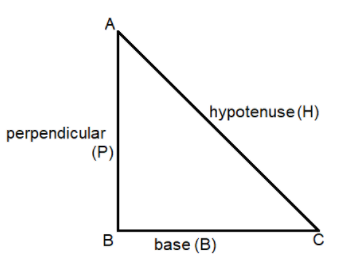
\[\dfrac{H}{B} = \dfrac{{12}}{7}\]
From this relation we use Pythagoras theorem and find the value of perpendicular.
\[{P^2} + {B^2} = {H^2}\]
On rearranging this theorem.
\[P = \sqrt {{H^2} - {B^2}} \]
On putting the value of base and hypotenuse.
\[P = \sqrt {25 - 16} \]
On further calculating
\[P = 3\]
Now we are going to find all the required values that are used in the left side of the proof part.
\[\sin \theta = \dfrac{3}{5}\]
\[\Rightarrow \cos \theta = \dfrac{4}{5}\]
\[\Rightarrow \tan \theta = \dfrac{3}{4}\]
\[ \Rightarrow \left( {\dfrac{{\sin \theta - 2\cos \theta }}{{\tan \theta - \cos \theta }}} \right)\]
On putting all these values in the left side of the proof part.
\[ \Rightarrow \left( {\dfrac{{\dfrac{3}{5} - 2\dfrac{4}{5}}}{{\dfrac{3}{4} - \dfrac{4}{5}}}} \right)\]
On calculating some of this equation.
\[ \Rightarrow \left( {\dfrac{{\dfrac{{3 - 8}}{5}}}{{\dfrac{{15 - 16}}{{20}}}}} \right)\]
On further simplifying this equation.
\[ \Rightarrow \left( {\dfrac{{\dfrac{{3 - 8}}{5}}}{{\dfrac{{15 - 16}}{{20}}}}} \right)\]
On further solving
\[ \Rightarrow \left( {\dfrac{{ - 5}}{5} \times \dfrac{{20}}{{ - 1}}} \right)\]
Negative is canceled by negative and 5 is canceled because this is a common factor.
\[ \Rightarrow 20\]
Hence, the left-hand side is not equal to the right-hand side.
So the proved relation is wrong.
Note:In order to solve this question, students must have a knowledge of all the trigonometric relations in terms of sides of the right-angle triangle and theorems related to the triangle. There is another way to solve this question that is changing all the trigonometric functions in only one but there is a higher probability of committing mistakes.
Complete step by step answer:
We have given the value of a trigonometric function \[\sec \theta = \dfrac{5}{4}\]. We have to prove \[\left( {\dfrac{{\sin \theta - 2\cos \theta }}{{\tan \theta - \cos \theta }}} \right) = \dfrac{{12}}{7}\].
On the left hand side of the equation.
\[ \Rightarrow \left( {\dfrac{{\sin \theta - 2\cos \theta }}{{\tan \theta - \cos \theta }}} \right)\]
To solve this side we must know all the values of the trigonometric function. So, now we are going to find all the values.
\[\sec \theta = \dfrac{5}{4}\]..........(given)
On writing the sec trigonometric function in terms of sides of a right-angle triangle.
Right angle triangle is as shown in the figure.
\[\dfrac{H}{B} = \dfrac{{12}}{7}\]
From this relation we use Pythagoras theorem and find the value of perpendicular.
\[{P^2} + {B^2} = {H^2}\]
On rearranging this theorem.
\[P = \sqrt {{H^2} - {B^2}} \]
On putting the value of base and hypotenuse.
\[P = \sqrt {25 - 16} \]
On further calculating
\[P = 3\]
Now we are going to find all the required values that are used in the left side of the proof part.
\[\sin \theta = \dfrac{3}{5}\]
\[\Rightarrow \cos \theta = \dfrac{4}{5}\]
\[\Rightarrow \tan \theta = \dfrac{3}{4}\]
\[ \Rightarrow \left( {\dfrac{{\sin \theta - 2\cos \theta }}{{\tan \theta - \cos \theta }}} \right)\]
On putting all these values in the left side of the proof part.
\[ \Rightarrow \left( {\dfrac{{\dfrac{3}{5} - 2\dfrac{4}{5}}}{{\dfrac{3}{4} - \dfrac{4}{5}}}} \right)\]
On calculating some of this equation.
\[ \Rightarrow \left( {\dfrac{{\dfrac{{3 - 8}}{5}}}{{\dfrac{{15 - 16}}{{20}}}}} \right)\]
On further simplifying this equation.
\[ \Rightarrow \left( {\dfrac{{\dfrac{{3 - 8}}{5}}}{{\dfrac{{15 - 16}}{{20}}}}} \right)\]
On further solving
\[ \Rightarrow \left( {\dfrac{{ - 5}}{5} \times \dfrac{{20}}{{ - 1}}} \right)\]
Negative is canceled by negative and 5 is canceled because this is a common factor.
\[ \Rightarrow 20\]
Hence, the left-hand side is not equal to the right-hand side.
So the proved relation is wrong.
Note:In order to solve this question, students must have a knowledge of all the trigonometric relations in terms of sides of the right-angle triangle and theorems related to the triangle. There is another way to solve this question that is changing all the trigonometric functions in only one but there is a higher probability of committing mistakes.
Recently Updated Pages
Master Class 11 Social Science: Engaging Questions & Answers for Success

Master Class 11 Physics: Engaging Questions & Answers for Success
Master Class 11 Maths: Engaging Questions & Answers for Success
Master Class 11 Economics: Engaging Questions & Answers for Success
Master Class 11 Computer Science: Engaging Questions & Answers for Success
Master Class 11 Chemistry: Engaging Questions & Answers for Success
Trending doubts
One Metric ton is equal to kg A 10000 B 1000 C 100 class 11 physics CBSE
There are 720 permutations of the digits 1 2 3 4 5 class 11 maths CBSE
1 Quintal is equal to a 110 kg b 10 kg c 100kg d 1000 class 11 physics CBSE
State and prove Bernoullis theorem class 11 physics CBSE
Difference Between Prokaryotic Cells and Eukaryotic Cells
Discuss the various forms of bacteria class 11 biology CBSE