



If r and R are respectively the radii of the inscribed and circumscribed circles of a regular polygon of n sides such that \[\dfrac{R}{r}=\sqrt{5}-1,\] then n is equal to:
(a) 5
(b) 6
(c) 10
(d) 18
Answer
 Verified
600.3k+ views
Hint: To solve the question given above, first we will assume that the regular polygon has side ‘a’. Then we will find the values of r and R in terms of angle ‘a’ and minimum of sides n. Then, we will take their ratio and we will eliminate ‘a’ from it. From the ratio, we will determine the value of n.
Complete step-by-step answer:
It is given in the question that a polygon is inscribed in a circle of radius R. Let the side of the polygon be ‘a’. Thus, we have the following figure.
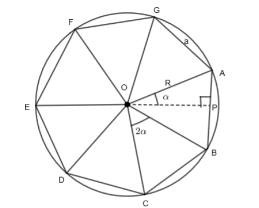
In the figure drawn, we can see that the polygon is divided into n isosceles triangles having equal dimensions. Now, the total length of AB = a. Now, we have drawn perpendicular to AB then OP will bisect AB (according to the perpendicular bisector theorem). So, we can say that,
\[AP=\dfrac{a}{2}\]
Now, we will consider the triangle APO. In triangle APO, we have,
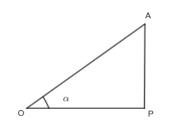
\[\sin \alpha =\dfrac{AP}{OA}\]
\[\Rightarrow \sin \alpha =\dfrac{\left( \dfrac{a}{2} \right)}{R}\]
\[\Rightarrow R=\dfrac{a}{2\sin \alpha }.....\left( i \right)\]
Now, the total angle inside the circle is \[2\pi .\] Now, it is divided into n triangles and each triangle subtends an angle \[2\alpha .\] So,
\[n\left( 2\alpha \right)=2\pi \]
\[\Rightarrow \alpha =\dfrac{\pi }{n}....\left( ii \right)\]
In another situation, we are given a polygon that circumscribes a circle of radius r. The side of the polygon is ‘a’. Thus, we have,
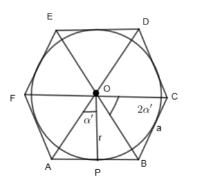
Here, we can see that the angle subtended by each triangle is \[2\alpha \] and there are n triangles. So, we have,
\[n\left( 2{{\alpha }^{'}} \right)=2\pi \]
\[\Rightarrow {{\alpha }^{'}}=\dfrac{\pi }{n}....\left( iii \right)\]
Also, OP will be perpendicular to AB because AB is tangent to the given circle. So,
\[\angle OPA={{90}^{o}}\]
Thus, we have,
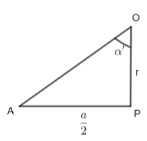
So, we can say that,
\[\tan {{\alpha }^{'}}=\dfrac{\left( \dfrac{a}{2} \right)}{r}\]
\[\Rightarrow r=\dfrac{a}{2\tan {{\alpha }^{'}}}....\left( iv \right)\]
Now, we will take the ratio of R and r. Thus, we have,
\[\dfrac{R}{r}=\dfrac{\dfrac{a}{2\sin \alpha }}{\dfrac{a}{2\tan {{\alpha }^{'}}}}\]
\[\Rightarrow \dfrac{R}{r}=\dfrac{\tan {{\alpha }^{'}}}{\sin \alpha }\]
Now, we will put the value of \[\alpha \text{ and }{{\alpha }^{'}}\] from (i) and (iii) to the above equation.
\[\Rightarrow \dfrac{R}{r}=\dfrac{\tan \left( \dfrac{\pi }{n} \right)}{\sin \left( \dfrac{\pi }{n} \right)}\]
\[\Rightarrow \dfrac{R}{r}=\dfrac{\dfrac{\sin \left( \dfrac{\pi }{n} \right)}{\cos \left( \dfrac{\pi }{n} \right)}}{\sin \left( \dfrac{\pi }{n} \right)}\]
\[\Rightarrow \dfrac{R}{r}=\dfrac{1}{\cos \left( \dfrac{\pi }{n} \right)}....\left( v \right)\]
It is given that,
\[\dfrac{R}{r}=\sqrt{5}-1.....\left( vi \right)\]
From (v) and (vi), we have,
\[\dfrac{1}{\cos \left( n \right)}=\sqrt{5}-1\]
\[\dfrac{1}{\cos \left( \dfrac{\pi }{n} \right)}=\dfrac{\sqrt{5}-1}{1}\times \dfrac{\sqrt{5}+1}{\sqrt{5}+1}\]
\[\dfrac{1}{\cos \left( \dfrac{\pi }{n} \right)}=\dfrac{5-1}{\sqrt{5}+1}\]
\[\Rightarrow \cos n=\dfrac{\sqrt{5}+1}{4}\]
\[\Rightarrow \cos \dfrac{\pi }{n}=\cos 36\]
\[\Rightarrow \dfrac{\pi }{n}=36\times \dfrac{\pi }{180}\]
\[\Rightarrow \dfrac{1}{n}=\dfrac{36}{180}\]
\[\Rightarrow n=5\]
Hence, option (a) is the right answer.
Note: In case, we do not know how we wrote \[\dfrac{\sqrt{5}+1}{4}\text{ as }\cos {{36}^{o}},\] we can calculate it as shown below,
\[\theta ={{36}^{o}}\]
\[\Rightarrow 5\theta =5\times {{36}^{o}}\]
\[\Rightarrow 5\theta ={{180}^{o}}\]
\[\Rightarrow \cos \left( 5\theta \right)=\cos {{180}^{o}}\]
\[\Rightarrow \cos 5\theta =0\]
\[\Rightarrow \cos \left( 2\theta +3\theta \right)=0\]
\[\Rightarrow \cos 2\theta \cos 3\theta -\sin 2\theta \sin 3\theta =0\]
\[\Rightarrow \left( 1-2{{\sin }^{2}}\theta \right)\left( 4{{\cos }^{3}}\theta -3\cos \theta \right)-\left( 2\sin \theta \right)\left( \cos \theta \right)\left( 3\sin \theta -4{{\sin }^{3}}\theta \right)=0\]
When we will solve this, we will get,
\[\cos \theta =\dfrac{\sqrt{5}+1}{4}\]
Complete step-by-step answer:
It is given in the question that a polygon is inscribed in a circle of radius R. Let the side of the polygon be ‘a’. Thus, we have the following figure.
In the figure drawn, we can see that the polygon is divided into n isosceles triangles having equal dimensions. Now, the total length of AB = a. Now, we have drawn perpendicular to AB then OP will bisect AB (according to the perpendicular bisector theorem). So, we can say that,
\[AP=\dfrac{a}{2}\]
Now, we will consider the triangle APO. In triangle APO, we have,
\[\sin \alpha =\dfrac{AP}{OA}\]
\[\Rightarrow \sin \alpha =\dfrac{\left( \dfrac{a}{2} \right)}{R}\]
\[\Rightarrow R=\dfrac{a}{2\sin \alpha }.....\left( i \right)\]
Now, the total angle inside the circle is \[2\pi .\] Now, it is divided into n triangles and each triangle subtends an angle \[2\alpha .\] So,
\[n\left( 2\alpha \right)=2\pi \]
\[\Rightarrow \alpha =\dfrac{\pi }{n}....\left( ii \right)\]
In another situation, we are given a polygon that circumscribes a circle of radius r. The side of the polygon is ‘a’. Thus, we have,
Here, we can see that the angle subtended by each triangle is \[2\alpha \] and there are n triangles. So, we have,
\[n\left( 2{{\alpha }^{'}} \right)=2\pi \]
\[\Rightarrow {{\alpha }^{'}}=\dfrac{\pi }{n}....\left( iii \right)\]
Also, OP will be perpendicular to AB because AB is tangent to the given circle. So,
\[\angle OPA={{90}^{o}}\]
Thus, we have,
So, we can say that,
\[\tan {{\alpha }^{'}}=\dfrac{\left( \dfrac{a}{2} \right)}{r}\]
\[\Rightarrow r=\dfrac{a}{2\tan {{\alpha }^{'}}}....\left( iv \right)\]
Now, we will take the ratio of R and r. Thus, we have,
\[\dfrac{R}{r}=\dfrac{\dfrac{a}{2\sin \alpha }}{\dfrac{a}{2\tan {{\alpha }^{'}}}}\]
\[\Rightarrow \dfrac{R}{r}=\dfrac{\tan {{\alpha }^{'}}}{\sin \alpha }\]
Now, we will put the value of \[\alpha \text{ and }{{\alpha }^{'}}\] from (i) and (iii) to the above equation.
\[\Rightarrow \dfrac{R}{r}=\dfrac{\tan \left( \dfrac{\pi }{n} \right)}{\sin \left( \dfrac{\pi }{n} \right)}\]
\[\Rightarrow \dfrac{R}{r}=\dfrac{\dfrac{\sin \left( \dfrac{\pi }{n} \right)}{\cos \left( \dfrac{\pi }{n} \right)}}{\sin \left( \dfrac{\pi }{n} \right)}\]
\[\Rightarrow \dfrac{R}{r}=\dfrac{1}{\cos \left( \dfrac{\pi }{n} \right)}....\left( v \right)\]
It is given that,
\[\dfrac{R}{r}=\sqrt{5}-1.....\left( vi \right)\]
From (v) and (vi), we have,
\[\dfrac{1}{\cos \left( n \right)}=\sqrt{5}-1\]
\[\dfrac{1}{\cos \left( \dfrac{\pi }{n} \right)}=\dfrac{\sqrt{5}-1}{1}\times \dfrac{\sqrt{5}+1}{\sqrt{5}+1}\]
\[\dfrac{1}{\cos \left( \dfrac{\pi }{n} \right)}=\dfrac{5-1}{\sqrt{5}+1}\]
\[\Rightarrow \cos n=\dfrac{\sqrt{5}+1}{4}\]
\[\Rightarrow \cos \dfrac{\pi }{n}=\cos 36\]
\[\Rightarrow \dfrac{\pi }{n}=36\times \dfrac{\pi }{180}\]
\[\Rightarrow \dfrac{1}{n}=\dfrac{36}{180}\]
\[\Rightarrow n=5\]
Hence, option (a) is the right answer.
Note: In case, we do not know how we wrote \[\dfrac{\sqrt{5}+1}{4}\text{ as }\cos {{36}^{o}},\] we can calculate it as shown below,
\[\theta ={{36}^{o}}\]
\[\Rightarrow 5\theta =5\times {{36}^{o}}\]
\[\Rightarrow 5\theta ={{180}^{o}}\]
\[\Rightarrow \cos \left( 5\theta \right)=\cos {{180}^{o}}\]
\[\Rightarrow \cos 5\theta =0\]
\[\Rightarrow \cos \left( 2\theta +3\theta \right)=0\]
\[\Rightarrow \cos 2\theta \cos 3\theta -\sin 2\theta \sin 3\theta =0\]
\[\Rightarrow \left( 1-2{{\sin }^{2}}\theta \right)\left( 4{{\cos }^{3}}\theta -3\cos \theta \right)-\left( 2\sin \theta \right)\left( \cos \theta \right)\left( 3\sin \theta -4{{\sin }^{3}}\theta \right)=0\]
When we will solve this, we will get,
\[\cos \theta =\dfrac{\sqrt{5}+1}{4}\]
Recently Updated Pages
Master Class 8 Social Science: Engaging Questions & Answers for Success

Master Class 8 English: Engaging Questions & Answers for Success
Class 8 Question and Answer - Your Ultimate Solutions Guide
Master Class 8 Maths: Engaging Questions & Answers for Success
Master Class 8 Science: Engaging Questions & Answers for Success
Master Class 7 English: Engaging Questions & Answers for Success
Trending doubts
Difference Between Plant Cell and Animal Cell
Fill the blanks with the suitable prepositions 1 The class 9 english CBSE
Who is eligible for RTE class 9 social science CBSE
Which places in India experience sunrise first and class 9 social science CBSE
What is pollution? How many types of pollution? Define it
Name 10 Living and Non living things class 9 biology CBSE