




If $P\left( n,r \right)=1680$ and $C\left( n,r \right)=70$ , then $69n+r!$ is equal to
A. $128$
B. $576$
C. $256$
D. $625$
E. $1152$
Answer
 Verified
506.7k+ views
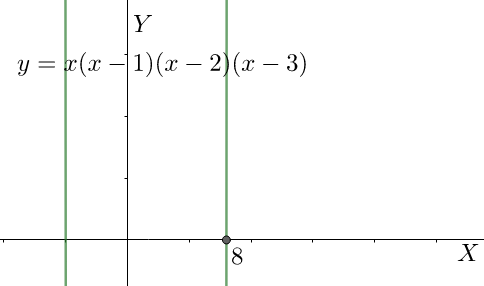
Hint: At first, we write the formula of permutation as $\dfrac{n!}{\left( n-r \right)!}$ and equate it to $1680$ . Then, we write the formula of the combination as $\dfrac{n!}{r!\left( n-r \right)!}$ and equate it to $70$ . Dividing the two equations will give us the value of r and then putting this value in one of the equations, gives a polynomial in n. Drawing the graph of the polynomial gives its roots.
Complete step-by-step solution:
In our academics, we have come across a chapter in maths, which was called arrangements. In that chapter, we had studied the number of ways to group and arrange some items or objects among themselves. The terms associated with them are called permutations and combinations. Permutation refers to selection and arranging the selection among themselves, whereas combination refers to selection alone.
The permutation of r objects out of n objects is denoted in two ways, which are ${}^{n}{{P}_{r}}$ and $P\left( n,r \right)$ . The corresponding formula for the number of permutations possible is given by,
$P\left( n,r \right)=\dfrac{n!}{\left( n-r \right)!}$
Similarly, the permutation of r objects out of n objects is denoted in two ways, which are ${}^{n}{{C}_{r}}$ and $C\left( n,r \right)$ . The corresponding formula for the number of permutations possible is given by,
$C\left( n,r \right)=\dfrac{n!}{r!\left( n-r \right)!}$
In this problem, we are given that,
$\begin{align}
& P\left( n,r \right)=1680 \\
& \Rightarrow \dfrac{n!}{\left( n-r \right)!}=1680....\left( i \right) \\
\end{align}$
Also,
$\begin{align}
& C\left( n,r \right)=70 \\
& \Rightarrow \dfrac{n!}{r!\left( n-r \right)!}=70....\left( ii \right) \\
\end{align}$
Dividing equation (i) by (ii), we get,
$\begin{align}
& \Rightarrow \dfrac{n!}{\left( n-r \right)!}\times \dfrac{r!\left( n-r \right)!}{n!}=\dfrac{1680}{70} \\
& \Rightarrow r!=24 \\
\end{align}$
Now, we know that the factorial of a number is unique and the factorial of $4$ is $24$ . So,
$\Rightarrow r=4$
Putting this value in equation (i),
$\begin{align}
& \Rightarrow \dfrac{n!}{\left( n-4 \right)!}=1680 \\
& \Rightarrow n\left( n-1 \right)\left( n-2 \right)\left( n-3 \right)=1680 \\
\end{align}$
We will now find the value of n by trial-and-error method and checking for which value, the expression gives $1680$ . By any means, n must be greater than r for the permutation to occur. So, taking $n=5$,
$\Rightarrow n\left( n-1 \right)\left( n-2 \right)\left( n-3 \right)=5\times 4\times 3\times 2=120$
Taking $n=6$ ,
$\Rightarrow n\left( n-1 \right)\left( n-2 \right)\left( n-3 \right)=6\times 5\times 4\times 3=360$
Taking $n=7$ ,
$\Rightarrow n\left( n-1 \right)\left( n-2 \right)\left( n-3 \right)=7\times 6\times 5\times 4=840$
Taking $n=8$ ,
$\Rightarrow n\left( n-1 \right)\left( n-2 \right)\left( n-3 \right)=8\times 7\times 6\times 5=1680$
Since we got $1680$, the value of $n$ is $8$.
Now,
$69n+r!=\left( 69\times 8 \right)+24=576$
Thus, we can conclude that the value of $69n+r!$ will be $576$ which is option B.
Note: We should know the factorial of some numbers at least up to $10$ . Solving problems will be easy then. Also, we can solve it in another way. We get an equation in n. The roots of the polynomial will be known from its graph, drawn in some online graphing calculator like Geogebra. It will take less time.
Complete step-by-step solution:
In our academics, we have come across a chapter in maths, which was called arrangements. In that chapter, we had studied the number of ways to group and arrange some items or objects among themselves. The terms associated with them are called permutations and combinations. Permutation refers to selection and arranging the selection among themselves, whereas combination refers to selection alone.
The permutation of r objects out of n objects is denoted in two ways, which are ${}^{n}{{P}_{r}}$ and $P\left( n,r \right)$ . The corresponding formula for the number of permutations possible is given by,
$P\left( n,r \right)=\dfrac{n!}{\left( n-r \right)!}$
Similarly, the permutation of r objects out of n objects is denoted in two ways, which are ${}^{n}{{C}_{r}}$ and $C\left( n,r \right)$ . The corresponding formula for the number of permutations possible is given by,
$C\left( n,r \right)=\dfrac{n!}{r!\left( n-r \right)!}$
In this problem, we are given that,
$\begin{align}
& P\left( n,r \right)=1680 \\
& \Rightarrow \dfrac{n!}{\left( n-r \right)!}=1680....\left( i \right) \\
\end{align}$
Also,
$\begin{align}
& C\left( n,r \right)=70 \\
& \Rightarrow \dfrac{n!}{r!\left( n-r \right)!}=70....\left( ii \right) \\
\end{align}$
Dividing equation (i) by (ii), we get,
$\begin{align}
& \Rightarrow \dfrac{n!}{\left( n-r \right)!}\times \dfrac{r!\left( n-r \right)!}{n!}=\dfrac{1680}{70} \\
& \Rightarrow r!=24 \\
\end{align}$
Now, we know that the factorial of a number is unique and the factorial of $4$ is $24$ . So,
$\Rightarrow r=4$
Putting this value in equation (i),
$\begin{align}
& \Rightarrow \dfrac{n!}{\left( n-4 \right)!}=1680 \\
& \Rightarrow n\left( n-1 \right)\left( n-2 \right)\left( n-3 \right)=1680 \\
\end{align}$
We will now find the value of n by trial-and-error method and checking for which value, the expression gives $1680$ . By any means, n must be greater than r for the permutation to occur. So, taking $n=5$,
$\Rightarrow n\left( n-1 \right)\left( n-2 \right)\left( n-3 \right)=5\times 4\times 3\times 2=120$
Taking $n=6$ ,
$\Rightarrow n\left( n-1 \right)\left( n-2 \right)\left( n-3 \right)=6\times 5\times 4\times 3=360$
Taking $n=7$ ,
$\Rightarrow n\left( n-1 \right)\left( n-2 \right)\left( n-3 \right)=7\times 6\times 5\times 4=840$
Taking $n=8$ ,
$\Rightarrow n\left( n-1 \right)\left( n-2 \right)\left( n-3 \right)=8\times 7\times 6\times 5=1680$
Since we got $1680$, the value of $n$ is $8$.
Now,
$69n+r!=\left( 69\times 8 \right)+24=576$
Thus, we can conclude that the value of $69n+r!$ will be $576$ which is option B.
Note: We should know the factorial of some numbers at least up to $10$ . Solving problems will be easy then. Also, we can solve it in another way. We get an equation in n. The roots of the polynomial will be known from its graph, drawn in some online graphing calculator like Geogebra. It will take less time.
Recently Updated Pages
Master Class 11 Business Studies: Engaging Questions & Answers for Success

Master Class 11 Economics: Engaging Questions & Answers for Success
Master Class 11 Computer Science: Engaging Questions & Answers for Success
Master Class 11 English: Engaging Questions & Answers for Success
Master Class 11 Maths: Engaging Questions & Answers for Success
Master Class 11 Biology: Engaging Questions & Answers for Success
Trending doubts
One Metric ton is equal to kg A 10000 B 1000 C 100 class 11 physics CBSE
Discuss the various forms of bacteria class 11 biology CBSE
Draw a diagram of a plant cell and label at least eight class 11 biology CBSE
State the laws of reflection of light
Explain zero factorial class 11 maths CBSE
10 examples of friction in our daily life