




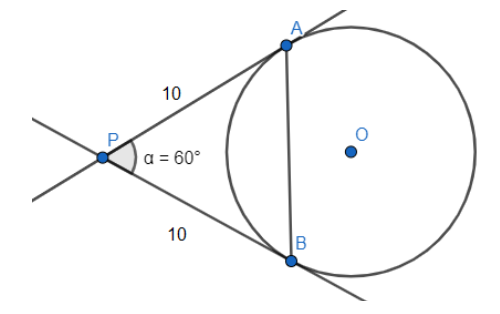
If PA and PB are tangents from an outside point P such that $PA=10$ cm and $\angle APB={{60}^{\circ }}$. Find the chord of length AB.
Answer
 Verified
532.8k+ views
Hint: We find the characteristics of the tangents and use that to find the angles of the $\Delta PAB$. The relation between sides and angles gives an equilateral triangle along with the remaining side’s length.
Complete step-by-step answer:
We know that two tangents drawn from an outside point on a circle are of equal length.
In the given picture there are two tangents PA and PB drawn from an outside point P.
Therefore, $PA=PB=10$.
We know that in an isosceles triangle, the opposite angles of the equal sides are equal.
The sum of three angles of any triangle is also ${{180}^{\circ }}$.
In $\Delta PAB$, we have $PA=PB$ and $\angle APB={{60}^{\circ }}$. We get $\angle PAB+\angle PBA+\angle APB={{180}^{\circ }}$.
Therefore, $\angle PAB+\angle PBA={{180}^{\circ }}-\angle APB={{180}^{\circ }}-{{60}^{\circ }}={{120}^{\circ }}$.
As $PA=PB$, we can say $\angle PAB=\angle PBA=\dfrac{{{120}^{\circ }}}{2}={{60}^{\circ }}$.
All the angles of $\Delta PAB$ are equal. Therefore, $\Delta PAB$ is equilateral.
We get $PA=PB=AB=10$ as all sides of an equilateral triangle are equal.
The length of AB is 10 cm.
Note: Geometrically we can prove that the tangents are equal. The connecting line between centre and the outside point breaks the main triangle into two congruent triangles. The sides and the angles all become equal to their corresponding counters.
Complete step-by-step answer:
We know that two tangents drawn from an outside point on a circle are of equal length.
In the given picture there are two tangents PA and PB drawn from an outside point P.
Therefore, $PA=PB=10$.
We know that in an isosceles triangle, the opposite angles of the equal sides are equal.
The sum of three angles of any triangle is also ${{180}^{\circ }}$.
In $\Delta PAB$, we have $PA=PB$ and $\angle APB={{60}^{\circ }}$. We get $\angle PAB+\angle PBA+\angle APB={{180}^{\circ }}$.
Therefore, $\angle PAB+\angle PBA={{180}^{\circ }}-\angle APB={{180}^{\circ }}-{{60}^{\circ }}={{120}^{\circ }}$.
As $PA=PB$, we can say $\angle PAB=\angle PBA=\dfrac{{{120}^{\circ }}}{2}={{60}^{\circ }}$.
All the angles of $\Delta PAB$ are equal. Therefore, $\Delta PAB$ is equilateral.
We get $PA=PB=AB=10$ as all sides of an equilateral triangle are equal.
The length of AB is 10 cm.
Note: Geometrically we can prove that the tangents are equal. The connecting line between centre and the outside point breaks the main triangle into two congruent triangles. The sides and the angles all become equal to their corresponding counters.
Recently Updated Pages
Master Class 9 General Knowledge: Engaging Questions & Answers for Success

Master Class 9 Maths: Engaging Questions & Answers for Success
Master Class 9 Science: Engaging Questions & Answers for Success
Master Class 9 English: Engaging Questions & Answers for Success
Master Class 9 Social Science: Engaging Questions & Answers for Success
Class 9 Question and Answer - Your Ultimate Solutions Guide
Trending doubts
Find the sum of series 1 + 2 + 3 + 4 + 5 + + 100 class 9 maths CBSE
Difference Between Plant Cell and Animal Cell
Fill the blanks with the suitable prepositions 1 The class 9 english CBSE
What is pollution? How many types of pollution? Define it
Name 10 Living and Non living things class 9 biology CBSE
What is the full form of pH?