




If one of the vertices of the square circumscribing the circle $\left| z-1 \right|=\sqrt{2}$is $\left( 2+\sqrt{3}i \right)$. Find the other vertices of the square.
A.$\left( 1-\sqrt{3} \right)+2i$and $\left( 1+\sqrt{3} \right)-2i$
B.$\left( 1-\sqrt{3} \right)$and $\left( 1+\sqrt{3} \right)$
C.$\left( 1-\sqrt{3} \right)+i$and $\left( 1+\sqrt{3} \right)-i$
D.None of these
Answer
 Verified
625.8k+ views
Hint: Find the center and radius of the circle and draw a rough figure. Take vertices of the square as ${{z}_{1}},{{z}_{2}},{{z}_{3}},{{z}_{4}}$. We know one vertex, take it as ${{z}_{1}}$and center ${{z}_{0}}$. By mid-point theorem find ${{z}_{2}}$. Using theorems of complex numbers, find ${{z}_{3}}$and ${{z}_{4}}$.
Given the circle $\left| z-1 \right|=\sqrt{2}$, which is the equation of a circle with center (1, 0). Thus it becomes the midpoint of the diagonal of the square. The radius of the circle is $\sqrt{2}$, as per the equation of the circle given.
The graphical representation of $\left| z-1 \right|=\sqrt{2}$in the complex plane is a circle of radius $\sqrt{2}$centered at point (1, 0).
The graphical representation of $\left( 2+i\sqrt{3} \right)$is at the point $\left( 2,\sqrt{3} \right)$where x = 2 and $y=\sqrt{3}$, which is of the form $x+iy$.
Now let us consider each vertex as ${{z}_{1}},{{z}_{2}},{{z}_{3}}$and ${{z}_{4}}$of the square to be formed. We know one vertex, let it be ${{z}_{1}}=2+i\sqrt{3}$.
Let us consider O as the center of the circle. We know the coordinates of the center of the circle as (1, 0) which form $1+0i$. We can mark it as ${{z}_{0}}$.
$\therefore {{z}_{0}}=1+0i$.
In case of a square, all sides are equal. They have the same magnitude and are located at ${{90}^{\circ }}$from each other. The diagonals of a square are of the same length and congruent. Therefore, by using mid-point theorem, we can find the vertex ${{z}_{2}}$, where we know the value of other vertex ${{z}_{1}}$and midpoint, which is the same as the center.
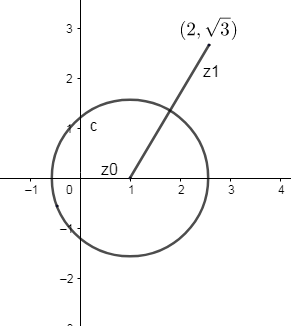
(Figure 1)
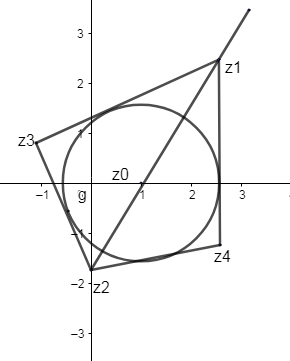
(Figure 2)
$\therefore \dfrac{{{z}_{1}}+{{z}_{2}}}{2}={{z}_{0}}$[From figure 2]
$\begin{align}
& \therefore {{z}_{1}}+{{z}_{2}}=2{{z}_{0}} \\
& {{z}_{2}}=2{{z}_{0}}-{{z}_{1}}=2\times 1-\left( 2+i\sqrt{3} \right)=-\sqrt{3}i \\
& \therefore {{z}_{2}}=0-\sqrt{3}i \\
\end{align}$
A complex number is perpendicular to another complex number, ${{r}^{ei\theta }}$which is represented by ${{r}^{ei\left( \theta +\dfrac{\pi }{2} \right)}}$, where the $\theta $is the angle made by the complex number with the x-axis
$ \because \cos \dfrac{\pi }{2}=1$
$\Rightarrow \sin \dfrac{\pi }{2}=0 $
$ \left[ {{e}^{\pm \dfrac{\pi }{2}}}=\cos \dfrac{\pi }{2}\pm i\sin \dfrac{\pi }{2} \right]$
Now let us consider the vertex ${{z}_{1}}$and ${{z}_{3}}$,
$\begin{align}
& \dfrac{{{z}_{4}}-1}{{{z}_{1}}-1}={{e}^{\pm i\dfrac{\pi }{2}}} \\
& {{z}_{4}}-1=\left( {{z}_{1}}-1 \right){{e}^{\pm i\dfrac{\pi }{2}}} \\
& {{z}_{4}}-1=\left( 2+i\sqrt{3}-1 \right)\left( \cos \dfrac{\pi }{2}\pm i\sin \dfrac{\pi }{2} \right) \\
& \Rightarrow {{z}_{4}}=\left( 1+i\sqrt{3} \right)\left( i\sin \dfrac{\pi }{2} \right)+1 \\
& {{z}_{4}}=i\left( 1+i\sqrt{3} \right)+1 \\
& {{z}_{4}}=i-\sqrt{3}+1 \\
\end{align}$
Hence, we got the required vertex of square as,
${{z}_{2}}=0-\sqrt{3}i,{{z}_{3}}=\left( 1-\sqrt{3}+i \right)$and ${{z}_{4}}=\left( 1+\sqrt{3}-i \right)$.
$\therefore $Vertices of square are $\left( 1-\sqrt{3},1 \right),\left( 0,-\sqrt{3} \right)$and $\left( 1+\sqrt{3},-1 \right)$.
Hence, option (c) is the correct answer.
Note:
Some complex numbers have absolute value 1. For a unit circle of radius 1 at centered at O. It includes all complex numbers of absolute value 1, which has the equation as $\left| z \right|=1$, where $z=x+iy$. In a question like this remember the properties of squares and circles which indulge in complex numbers.
Given the circle $\left| z-1 \right|=\sqrt{2}$, which is the equation of a circle with center (1, 0). Thus it becomes the midpoint of the diagonal of the square. The radius of the circle is $\sqrt{2}$, as per the equation of the circle given.
The graphical representation of $\left| z-1 \right|=\sqrt{2}$in the complex plane is a circle of radius $\sqrt{2}$centered at point (1, 0).
The graphical representation of $\left( 2+i\sqrt{3} \right)$is at the point $\left( 2,\sqrt{3} \right)$where x = 2 and $y=\sqrt{3}$, which is of the form $x+iy$.
Now let us consider each vertex as ${{z}_{1}},{{z}_{2}},{{z}_{3}}$and ${{z}_{4}}$of the square to be formed. We know one vertex, let it be ${{z}_{1}}=2+i\sqrt{3}$.
Let us consider O as the center of the circle. We know the coordinates of the center of the circle as (1, 0) which form $1+0i$. We can mark it as ${{z}_{0}}$.
$\therefore {{z}_{0}}=1+0i$.
In case of a square, all sides are equal. They have the same magnitude and are located at ${{90}^{\circ }}$from each other. The diagonals of a square are of the same length and congruent. Therefore, by using mid-point theorem, we can find the vertex ${{z}_{2}}$, where we know the value of other vertex ${{z}_{1}}$and midpoint, which is the same as the center.
(Figure 1)
(Figure 2)
$\therefore \dfrac{{{z}_{1}}+{{z}_{2}}}{2}={{z}_{0}}$[From figure 2]
$\begin{align}
& \therefore {{z}_{1}}+{{z}_{2}}=2{{z}_{0}} \\
& {{z}_{2}}=2{{z}_{0}}-{{z}_{1}}=2\times 1-\left( 2+i\sqrt{3} \right)=-\sqrt{3}i \\
& \therefore {{z}_{2}}=0-\sqrt{3}i \\
\end{align}$
A complex number is perpendicular to another complex number, ${{r}^{ei\theta }}$which is represented by ${{r}^{ei\left( \theta +\dfrac{\pi }{2} \right)}}$, where the $\theta $is the angle made by the complex number with the x-axis
$ \because \cos \dfrac{\pi }{2}=1$
$\Rightarrow \sin \dfrac{\pi }{2}=0 $
$ \left[ {{e}^{\pm \dfrac{\pi }{2}}}=\cos \dfrac{\pi }{2}\pm i\sin \dfrac{\pi }{2} \right]$
Now let us consider the vertex ${{z}_{1}}$and ${{z}_{3}}$,
$\begin{align}
& \dfrac{{{z}_{4}}-1}{{{z}_{1}}-1}={{e}^{\pm i\dfrac{\pi }{2}}} \\
& {{z}_{4}}-1=\left( {{z}_{1}}-1 \right){{e}^{\pm i\dfrac{\pi }{2}}} \\
& {{z}_{4}}-1=\left( 2+i\sqrt{3}-1 \right)\left( \cos \dfrac{\pi }{2}\pm i\sin \dfrac{\pi }{2} \right) \\
& \Rightarrow {{z}_{4}}=\left( 1+i\sqrt{3} \right)\left( i\sin \dfrac{\pi }{2} \right)+1 \\
& {{z}_{4}}=i\left( 1+i\sqrt{3} \right)+1 \\
& {{z}_{4}}=i-\sqrt{3}+1 \\
\end{align}$
Hence, we got the required vertex of square as,
${{z}_{2}}=0-\sqrt{3}i,{{z}_{3}}=\left( 1-\sqrt{3}+i \right)$and ${{z}_{4}}=\left( 1+\sqrt{3}-i \right)$.
$\therefore $Vertices of square are $\left( 1-\sqrt{3},1 \right),\left( 0,-\sqrt{3} \right)$and $\left( 1+\sqrt{3},-1 \right)$.
Hence, option (c) is the correct answer.
Note:
Some complex numbers have absolute value 1. For a unit circle of radius 1 at centered at O. It includes all complex numbers of absolute value 1, which has the equation as $\left| z \right|=1$, where $z=x+iy$. In a question like this remember the properties of squares and circles which indulge in complex numbers.
Recently Updated Pages
Basicity of sulphurous acid and sulphuric acid are

Master Class 11 Business Studies: Engaging Questions & Answers for Success
Master Class 11 Computer Science: Engaging Questions & Answers for Success
Master Class 11 Economics: Engaging Questions & Answers for Success
Master Class 11 Social Science: Engaging Questions & Answers for Success
Master Class 11 English: Engaging Questions & Answers for Success
Trending doubts
One Metric ton is equal to kg A 10000 B 1000 C 100 class 11 physics CBSE
The largest wind power cluster is located in the state class 11 social science CBSE
Explain zero factorial class 11 maths CBSE
State and prove Bernoullis theorem class 11 physics CBSE
Which among the following are examples of coming together class 11 social science CBSE
Draw a diagram of a plant cell and label at least eight class 11 biology CBSE