




If on a given base, a triangle be described such that the sum of the tangents of the base angles is constant, then the locus of the vertex is:
A. a circle
B. a parabola
C. an ellipse
D. a hyperbola
Answer
 Verified
585.9k+ views
Hint: First we need to draw a triangle on the coordinate plane. We draw a triangle by assuming $BC$ as the base of the triangle and the length of $BC=2a$. Then, we draw a perpendicular to base at point $D$. Then, we use the property of tangent in the form of trigonometric ratio, which is given by
$\tan \theta =\dfrac{\text{Perpendicular}}{\text{base}}$
Then, by adding the tangents of the base angles and solving these further we get the desired answer.
Complete step by step answer:
We have been given that a triangle be described such that the sum of the tangents of the base angles is constant.
Let us draw a diagram on the coordinate plane by assuming that the given base of the triangle is $BC$ and the length of $BC=2a$
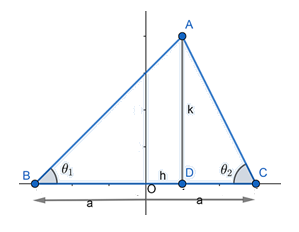
Let the coordinates of \[B\left( -a,0 \right)\] and $C\left( a,0 \right)$. Also, let the coordinates of $A\left( h,k \right)$.
We draw a perpendicular from $A$ to base $BC$, which meets $BC$ at point $D$.
So, we have $OB=OC=a,OD=h,AD=k$ .
Now, we have given that the sum of the tangents of the base angles is constant.
So, we have $\tan {{\theta }_{1}}+\tan {{\theta }_{2}}=c.....(i)$ where, $c=\text{constant}$
Now, let us consider $\Delta ABD$,
Now we know that $\tan \theta =\dfrac{\text{Perpendicular}}{\text{base}}$
So, we have $\tan {{\theta }_{1}}=\dfrac{AD}{BD}$
Now, substituting values, we get
$\begin{align}
& \Rightarrow \tan {{\theta }_{1}}=\dfrac{k}{OB+OD} \\
& \Rightarrow \tan {{\theta }_{1}}=\dfrac{k}{a+h} \\
\end{align}$
Now, let us consider $\Delta ADC$,
Now we know that $\tan \theta =\dfrac{\text{Perpendicular}}{\text{base}}$
So, we have $\tan {{\theta }_{2}}=\dfrac{AD}{DC}$
Now, substituting values, we get
$\begin{align}
& \Rightarrow \tan {{\theta }_{2}}=\dfrac{k}{OC-OD} \\
& \Rightarrow \tan {{\theta }_{2}}=\dfrac{k}{a-h} \\
\end{align}$
Now, substituting the values in equation (i), we get
$\begin{align}
& \tan {{\theta }_{1}}+\tan {{\theta }_{2}}=c \\
& \Rightarrow \dfrac{k}{a+h}+\dfrac{k}{a-h}=c \\
\end{align}$
Now, solving further we have
$\Rightarrow \dfrac{k\left( a-h \right)+k\left( a+h \right)}{\left( a+h \right)\left( a-h \right)}=c$
Now, we know that $\left( x+y \right)\left( x-y \right)={{x}^{2}}-{{y}^{2}}$
So, we have
$\begin{align}
& \dfrac{k\left( a-h \right)+k\left( a+h \right)}{{{a}^{2}}-{{h}^{2}}}=c \\
& \Rightarrow ak-kh+ak+kh=c\left( {{a}^{2}}-{{h}^{2}} \right) \\
& \Rightarrow 2ak=c\left( {{a}^{2}}-{{h}^{2}} \right) \\
\end{align}$
Therefore we can write
$\begin{align}
& \Rightarrow 2ak=c{{a}^{2}}-c{{h}^{2}} \\
& \Rightarrow c{{h}^{2}}=c{{a}^{2}}-2ak \\
& \Rightarrow {{h}^{2}}=\dfrac{c{{a}^{2}}}{c}-\dfrac{2ak}{c} \\
& \Rightarrow {{h}^{2}}=\dfrac{-2a}{c}\left( k-\dfrac{ca}{2} \right) \\
\end{align}$
Now, if we replace $h$ by $x$ and $k$ by $y$, we get
$\Rightarrow {{x}^{2}}=\dfrac{-2a}{c}\left( y-\dfrac{ca}{2} \right)$
Now, we know that the equation of parabola is given by
$\begin{align}
& \Rightarrow y-k=a{{\left( x-h \right)}^{2}} \\
& \Rightarrow x-h\text{=}a{{\left( y-k \right)}^{2}} \\
\end{align}$
So, the equation we get is comparable to parabola.
So, the locus of the vertex is parabola.
Option B is the correct answer.
Note:
When we draw a diagram we can take vertex $A,B,C$ anywhere. The equations of circle, hyperbola and ellipse are as follows:
$\begin{align}
& \text{Circle }{{\left( x-h \right)}^{2}}+{{\left( y-k \right)}^{2}}={{r}^{2}} \\
& \text{Ellipse }\dfrac{{{\left( x-h \right)}^{2}}}{{{a}^{2}}}+\dfrac{{{\left( y-k \right)}^{2}}}{{{b}^{2}}}=1 \\
& \text{Hyperbola }\dfrac{{{\left( x-h \right)}^{2}}}{{{a}^{2}}}-\dfrac{{{\left( y-k \right)}^{2}}}{{{b}^{2}}}=1 \\
\end{align}$
$\tan \theta =\dfrac{\text{Perpendicular}}{\text{base}}$
Then, by adding the tangents of the base angles and solving these further we get the desired answer.
Complete step by step answer:
We have been given that a triangle be described such that the sum of the tangents of the base angles is constant.
Let us draw a diagram on the coordinate plane by assuming that the given base of the triangle is $BC$ and the length of $BC=2a$
Let the coordinates of \[B\left( -a,0 \right)\] and $C\left( a,0 \right)$. Also, let the coordinates of $A\left( h,k \right)$.
We draw a perpendicular from $A$ to base $BC$, which meets $BC$ at point $D$.
So, we have $OB=OC=a,OD=h,AD=k$ .
Now, we have given that the sum of the tangents of the base angles is constant.
So, we have $\tan {{\theta }_{1}}+\tan {{\theta }_{2}}=c.....(i)$ where, $c=\text{constant}$
Now, let us consider $\Delta ABD$,
Now we know that $\tan \theta =\dfrac{\text{Perpendicular}}{\text{base}}$
So, we have $\tan {{\theta }_{1}}=\dfrac{AD}{BD}$
Now, substituting values, we get
$\begin{align}
& \Rightarrow \tan {{\theta }_{1}}=\dfrac{k}{OB+OD} \\
& \Rightarrow \tan {{\theta }_{1}}=\dfrac{k}{a+h} \\
\end{align}$
Now, let us consider $\Delta ADC$,
Now we know that $\tan \theta =\dfrac{\text{Perpendicular}}{\text{base}}$
So, we have $\tan {{\theta }_{2}}=\dfrac{AD}{DC}$
Now, substituting values, we get
$\begin{align}
& \Rightarrow \tan {{\theta }_{2}}=\dfrac{k}{OC-OD} \\
& \Rightarrow \tan {{\theta }_{2}}=\dfrac{k}{a-h} \\
\end{align}$
Now, substituting the values in equation (i), we get
$\begin{align}
& \tan {{\theta }_{1}}+\tan {{\theta }_{2}}=c \\
& \Rightarrow \dfrac{k}{a+h}+\dfrac{k}{a-h}=c \\
\end{align}$
Now, solving further we have
$\Rightarrow \dfrac{k\left( a-h \right)+k\left( a+h \right)}{\left( a+h \right)\left( a-h \right)}=c$
Now, we know that $\left( x+y \right)\left( x-y \right)={{x}^{2}}-{{y}^{2}}$
So, we have
$\begin{align}
& \dfrac{k\left( a-h \right)+k\left( a+h \right)}{{{a}^{2}}-{{h}^{2}}}=c \\
& \Rightarrow ak-kh+ak+kh=c\left( {{a}^{2}}-{{h}^{2}} \right) \\
& \Rightarrow 2ak=c\left( {{a}^{2}}-{{h}^{2}} \right) \\
\end{align}$
Therefore we can write
$\begin{align}
& \Rightarrow 2ak=c{{a}^{2}}-c{{h}^{2}} \\
& \Rightarrow c{{h}^{2}}=c{{a}^{2}}-2ak \\
& \Rightarrow {{h}^{2}}=\dfrac{c{{a}^{2}}}{c}-\dfrac{2ak}{c} \\
& \Rightarrow {{h}^{2}}=\dfrac{-2a}{c}\left( k-\dfrac{ca}{2} \right) \\
\end{align}$
Now, if we replace $h$ by $x$ and $k$ by $y$, we get
$\Rightarrow {{x}^{2}}=\dfrac{-2a}{c}\left( y-\dfrac{ca}{2} \right)$
Now, we know that the equation of parabola is given by
$\begin{align}
& \Rightarrow y-k=a{{\left( x-h \right)}^{2}} \\
& \Rightarrow x-h\text{=}a{{\left( y-k \right)}^{2}} \\
\end{align}$
So, the equation we get is comparable to parabola.
So, the locus of the vertex is parabola.
Option B is the correct answer.
Note:
When we draw a diagram we can take vertex $A,B,C$ anywhere. The equations of circle, hyperbola and ellipse are as follows:
$\begin{align}
& \text{Circle }{{\left( x-h \right)}^{2}}+{{\left( y-k \right)}^{2}}={{r}^{2}} \\
& \text{Ellipse }\dfrac{{{\left( x-h \right)}^{2}}}{{{a}^{2}}}+\dfrac{{{\left( y-k \right)}^{2}}}{{{b}^{2}}}=1 \\
& \text{Hyperbola }\dfrac{{{\left( x-h \right)}^{2}}}{{{a}^{2}}}-\dfrac{{{\left( y-k \right)}^{2}}}{{{b}^{2}}}=1 \\
\end{align}$
Recently Updated Pages
Master Class 11 Computer Science: Engaging Questions & Answers for Success

Master Class 11 Business Studies: Engaging Questions & Answers for Success
Master Class 11 Economics: Engaging Questions & Answers for Success
Master Class 11 English: Engaging Questions & Answers for Success
Master Class 11 Maths: Engaging Questions & Answers for Success
Master Class 11 Biology: Engaging Questions & Answers for Success
Trending doubts
There are 720 permutations of the digits 1 2 3 4 5 class 11 maths CBSE
Discuss the various forms of bacteria class 11 biology CBSE
Explain zero factorial class 11 maths CBSE
What organs are located on the left side of your body class 11 biology CBSE
Draw a diagram of nephron and explain its structur class 11 biology CBSE
How do I convert ms to kmh Give an example class 11 physics CBSE