




If O is the origin and \[P({x_1},{y_1})\],\[Q({x_2},{y_2})\] are two points then \[OP \times OQ\sin \angle POQ = \]
A. \[{x_1}{x_2} + {y_1}{y_2}\]
B. \[{x_1}{y_2} + {x_2}{y_1}\]
C. \[{x_1}{y_2} - {x_2}{y_1}\]
D. None of these
Answer
 Verified
627k+ views
Hint: We draw a rough diagram for the lines OP and OQ and use the formula of area of triangle formed by joining the three points O, P and Q. Calculate the area using matrix formula and area using the cross product formula. Equate the two equations obtained from the formula of area.
* Area of a triangle formed by points \[({x_1},{y_1}),({x_2},{y_2}),({x_3},{y_3})\]is given by \[\dfrac{1}{2}\left| {\begin{array}{*{20}{c}}
{{x_1}}&{{y_1}}&1 \\
{{x_2}}&{{y_2}}&1 \\
{{x_3}}&{{y_3}}&1
\end{array}} \right|\]
* Determinant of a matrix \[\left[ {\begin{array}{*{20}{c}}
a&b&c \\
d&e&f \\
g&h&i
\end{array}} \right] = a(ei - hf) - b(di - fg) + c(dh - eg)\]
* Area of a triangle formed by the two sides \[AB\]and \[CD\]is given by \[\dfrac{1}{2}\left( {AB} \right)\left( {CD} \right)\sin \theta \], where \[\theta \]is the angle between the sides.
Step-By-Step answer:
We first draw a diagram for the lines OP and OQ
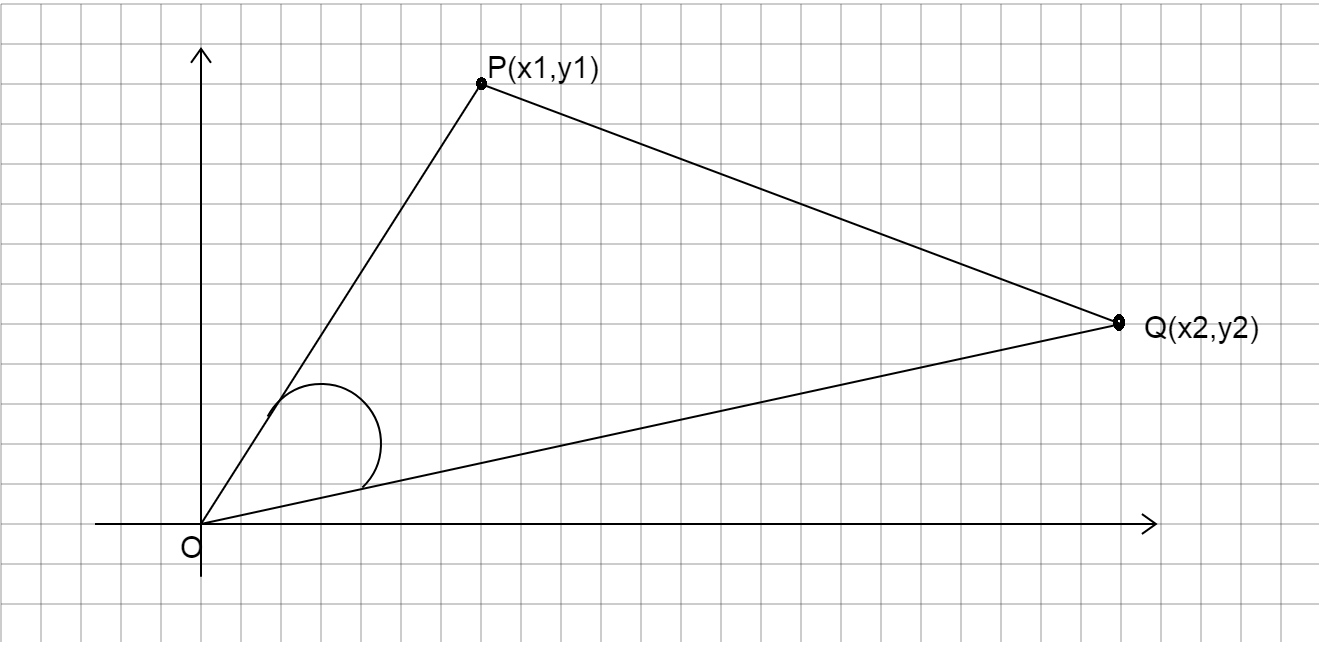
We are given three points \[O(0,0)\], \[P({x_1},{y_1})\]and \[Q({x_2},{y_2})\]
We can write the area of triangle formed by joining three points O, P and Q as
\[ \Rightarrow \]Area of triangle OPQ \[ = \dfrac{1}{2}\left| {\begin{array}{*{20}{c}}
{{x_1}}&{{y_1}}&1 \\
{{x_2}}&{{y_2}}&1 \\
0&0&1
\end{array}} \right|\]
Calculate the determinant in RHS of the equation
Since determinant of a matrix \[\left[ {\begin{array}{*{20}{c}}
a&b&c \\
d&e&f \\
g&h&i
\end{array}} \right] = a(ei - hf) - b(di - fg) + c(dh - eg)\]
\[ \Rightarrow \]Area of triangle OPQ \[ = \dfrac{1}{2}\left[ {{x_1}({y_2}) - {y_1}({x_2})} \right]\] … (1)
Now we calculate the area of triangle OPQ using length of sides formula
Since angle between the sides OP and OQ is \[\angle POQ,\]
We can write area of triangle OPQ \[ = \dfrac{1}{2}\left( {OP} \right)\left( {OQ} \right)\sin \angle POQ\] … (2)
Equate the area obtained from both equations (1) and (2)
\[ \Rightarrow \dfrac{1}{2}\left[ {{x_1}({y_2}) - {y_1}({x_2})} \right] = \dfrac{1}{2}\left( {OP} \right) \times \left( {OQ} \right)\sin \angle POQ\]
Cancel same factors from both sides of the equations
\[ \Rightarrow \left[ {{x_1}{y_2} - {y_1}{x_2}} \right] = OP \times OQ\sin \angle POQ\]
\[\therefore \]Option D is correct.
Note: Many students make mistake of assuming or writing the second formula of area of triangle as cross product or area of triangle made by vectors, keep in mind here we are not given any vectors, the formula states the area of triangle formed by two sides having one common vertex is given by the formula, do not mistake this formula with vector formula.
* Area of a triangle formed by points \[({x_1},{y_1}),({x_2},{y_2}),({x_3},{y_3})\]is given by \[\dfrac{1}{2}\left| {\begin{array}{*{20}{c}}
{{x_1}}&{{y_1}}&1 \\
{{x_2}}&{{y_2}}&1 \\
{{x_3}}&{{y_3}}&1
\end{array}} \right|\]
* Determinant of a matrix \[\left[ {\begin{array}{*{20}{c}}
a&b&c \\
d&e&f \\
g&h&i
\end{array}} \right] = a(ei - hf) - b(di - fg) + c(dh - eg)\]
* Area of a triangle formed by the two sides \[AB\]and \[CD\]is given by \[\dfrac{1}{2}\left( {AB} \right)\left( {CD} \right)\sin \theta \], where \[\theta \]is the angle between the sides.
Step-By-Step answer:
We first draw a diagram for the lines OP and OQ
We are given three points \[O(0,0)\], \[P({x_1},{y_1})\]and \[Q({x_2},{y_2})\]
We can write the area of triangle formed by joining three points O, P and Q as
\[ \Rightarrow \]Area of triangle OPQ \[ = \dfrac{1}{2}\left| {\begin{array}{*{20}{c}}
{{x_1}}&{{y_1}}&1 \\
{{x_2}}&{{y_2}}&1 \\
0&0&1
\end{array}} \right|\]
Calculate the determinant in RHS of the equation
Since determinant of a matrix \[\left[ {\begin{array}{*{20}{c}}
a&b&c \\
d&e&f \\
g&h&i
\end{array}} \right] = a(ei - hf) - b(di - fg) + c(dh - eg)\]
\[ \Rightarrow \]Area of triangle OPQ \[ = \dfrac{1}{2}\left[ {{x_1}({y_2}) - {y_1}({x_2})} \right]\] … (1)
Now we calculate the area of triangle OPQ using length of sides formula
Since angle between the sides OP and OQ is \[\angle POQ,\]
We can write area of triangle OPQ \[ = \dfrac{1}{2}\left( {OP} \right)\left( {OQ} \right)\sin \angle POQ\] … (2)
Equate the area obtained from both equations (1) and (2)
\[ \Rightarrow \dfrac{1}{2}\left[ {{x_1}({y_2}) - {y_1}({x_2})} \right] = \dfrac{1}{2}\left( {OP} \right) \times \left( {OQ} \right)\sin \angle POQ\]
Cancel same factors from both sides of the equations
\[ \Rightarrow \left[ {{x_1}{y_2} - {y_1}{x_2}} \right] = OP \times OQ\sin \angle POQ\]
\[\therefore \]Option D is correct.
Note: Many students make mistake of assuming or writing the second formula of area of triangle as cross product or area of triangle made by vectors, keep in mind here we are not given any vectors, the formula states the area of triangle formed by two sides having one common vertex is given by the formula, do not mistake this formula with vector formula.
Recently Updated Pages
Differentiate between voluntary action and reflex class 10 biology CBSE

The uses of bleaching powder are A It is used bleaching class 10 chemistry CBSE
Fill in the blanks with abstract nouns of the words class 10 english CBSE
How many threedigit numbers are there class 10 maths CBSE
What is a reflex arc class 10 biology CBSE
Construct a square whose diagonal is 6cm Measure the class 10 maths CBSE
Trending doubts
Explain the Treaty of Vienna of 1815 class 10 social science CBSE
The slogan Jai Hind was given by A Lal Bahadur Shastri class 10 social science CBSE
10 examples of evaporation in daily life with explanations
What is the full form of POSCO class 10 social science CBSE
Identify the feminine form of noun nephew a shenephew class 10 english CBSE
CSIR full form?