




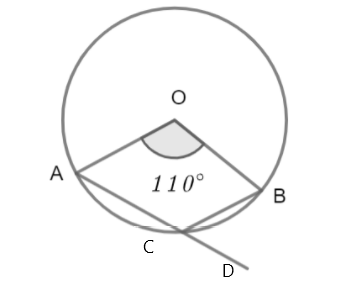
If O is the centre of a circle as shown in the figure and \[\angle AOB={{110}^{\circ }}\]. Find \[\angle BCD\].
Answer
 Verified
543.3k+ views
Hint: In order to find the measure of \[\angle BCD\], we will be finding the reflex of \[\angle AOB={{110}^{\circ }}\] first. Then we will be applying the property of supplementary angles to the angles \[\angle BCD\] and\[\angle ACB\]. We will be substituting the known angle values and solving it for the angle \[\angle BCD\]. This measure of \[\angle BCD\] is our required answer.
Complete step by step answer:
Now let us learn about supplementary angles. Supplementary angles are those angles whose measure is \[{{180}^{\circ }}\]. If two supplementary angles join together, it forms a straight line and a straight line. It is not necessary that the angles should be next to each other or joined together. In a pair of supplementary angles, one of the angles would be obtuse angle and the other would be acute angle. There are several other types of pairs of angles such as complementary angles, linear pair of angles, alternate angles, vertically opposite angles, etc.
Now let us find the measure of \[\angle BCD\].
We are given that \[\angle AOB={{110}^{\circ }}\]
Now let us find the reflex of \[\angle AOB\]
\[\Rightarrow 360-110=250\]
We can say that \[\angle ACB=\] \[\dfrac{1}{2}\times \]reflex of \[\angle AOB\], because the angle subtended by arc at the centre is double the angle subtended by it at any point on the remaining part of the circle.
\[\Rightarrow \dfrac{1}{2}\times 250=125\]
\[\angle ACB={{125}^{\circ }}\]
Now, we can apply the property of supplementary angles to \[\angle BCD\] and\[\angle ACB\].
\[\begin{align}
& \angle BCD+\angle ACB=180 \\
& \Rightarrow \angle BCD+125=180 \\
& \Rightarrow \angle BCD=180-125=55 \\
\end{align}\]
\[\therefore \angle BCD={{55}^{\circ }}\]
Note: While solving such problems regarding angles, we must check for the properties of angles that can be applied so that our solving would become easier. We can also observe that the quadrilateral in the circle forms a cyclic quadrilateral. We found the angle \[\angle ACB\] as it forms one of the supplements of the angles.
Complete step by step answer:
Now let us learn about supplementary angles. Supplementary angles are those angles whose measure is \[{{180}^{\circ }}\]. If two supplementary angles join together, it forms a straight line and a straight line. It is not necessary that the angles should be next to each other or joined together. In a pair of supplementary angles, one of the angles would be obtuse angle and the other would be acute angle. There are several other types of pairs of angles such as complementary angles, linear pair of angles, alternate angles, vertically opposite angles, etc.
Now let us find the measure of \[\angle BCD\].
We are given that \[\angle AOB={{110}^{\circ }}\]
Now let us find the reflex of \[\angle AOB\]
\[\Rightarrow 360-110=250\]
We can say that \[\angle ACB=\] \[\dfrac{1}{2}\times \]reflex of \[\angle AOB\], because the angle subtended by arc at the centre is double the angle subtended by it at any point on the remaining part of the circle.
\[\Rightarrow \dfrac{1}{2}\times 250=125\]
\[\angle ACB={{125}^{\circ }}\]
Now, we can apply the property of supplementary angles to \[\angle BCD\] and\[\angle ACB\].
\[\begin{align}
& \angle BCD+\angle ACB=180 \\
& \Rightarrow \angle BCD+125=180 \\
& \Rightarrow \angle BCD=180-125=55 \\
\end{align}\]
\[\therefore \angle BCD={{55}^{\circ }}\]
Note: While solving such problems regarding angles, we must check for the properties of angles that can be applied so that our solving would become easier. We can also observe that the quadrilateral in the circle forms a cyclic quadrilateral. We found the angle \[\angle ACB\] as it forms one of the supplements of the angles.
Recently Updated Pages
Master Class 12 Economics: Engaging Questions & Answers for Success

Master Class 12 English: Engaging Questions & Answers for Success
Master Class 12 Social Science: Engaging Questions & Answers for Success
Master Class 12 Maths: Engaging Questions & Answers for Success
Master Class 12 Physics: Engaging Questions & Answers for Success
Master Class 9 General Knowledge: Engaging Questions & Answers for Success
Trending doubts
Explain the Treaty of Vienna of 1815 class 10 social science CBSE
Who Won 36 Oscar Awards? Record Holder Revealed
Why is it 530 pm in india when it is 1200 afternoon class 10 social science CBSE
Make a sketch of the human nerve cell What function class 10 biology CBSE
What is the full form of POSCO class 10 social science CBSE
Define Potential, Developed, Stock and Reserved resources