



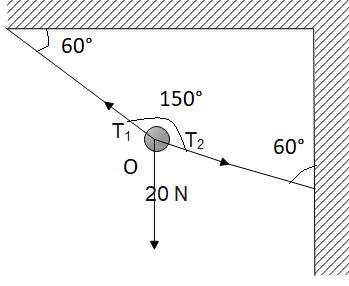
If 'O' is at equilibrium then the values of the tension T$_1$ and T$_2$ are (20 N is acting vertically downwards at O).
(A) 20 N, 30 N
(B) 20$\sqrt{3}$ N, 20 N
(C) 20$\sqrt{3}$ N, 20$\sqrt{3}$ N
(D) 10 N, 30 N
Answer
 Verified
605.1k+ views
Hint: In the figure, it can be clearly seen that an equilibrium of the forces have been established. The ball is at the balance point so the vertical and horizontal components of the forces can be equated to provide us two equations for two variables.
Formula Used:
The sum of all the forces on a body in equilibrium is zero:
${\vec F_1} + {\vec F_2} + {\vec F_3} + ... = 0$.
These forces are to be written in the component form and the same equation applies to both x and y (or horizontal or vertical) components.
Complete answer:
Consider the following diagram:
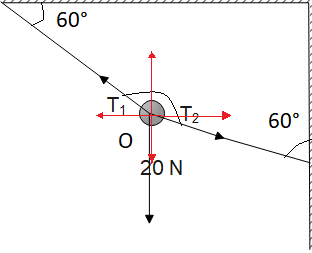
Looking at the arrows, we can get an idea about the direction of the forces. Two red lines have been drawn to mark the direction of the horizontal and the vertical axis.
First let us consider the vertical components, the downwards forces and upwards force components and upon balancing these components, we will get:
$\eqalign{
& {T_1}\cos 30^\circ = {T_2}\sin 30^\circ + 20{\rm{ N}} \cr
& \Rightarrow {T_1}\sqrt 3 = {T_2} + 40 \cr} $
Now, if we consider the horizontal components and we balance those, we get:
$\eqalign{
& {T_1}\sin 30^\circ = {T_2}\cos 30^\circ \cr
& \Rightarrow {T_1} = {T_2}\sqrt 3 \cr} $
Keeping this in the previous equation:
$\eqalign{
& \therefore 3{T_2} = {T_2} + 40 \cr
& \Rightarrow {T_2} = 20{\text{ N}}{\text{.}} \cr} $
Keeping this value in the equation for T$_1$, we get:
${T_1} = 20\sqrt 3 $N.
Therefore, from the given set of options, the correct answer is option (B).
Note:
To obtain the angles that the vectors make with the horizontal components, we just took the right angled triangles that were forming with the string and the directions. For example, to get what angle the vector T$_1$ makes with the vertical (upwards) direction, we just could extend our red line further up and form a right angled triangle. The required angle plus the given angle (question diagram) should make a right angle.
Formula Used:
The sum of all the forces on a body in equilibrium is zero:
${\vec F_1} + {\vec F_2} + {\vec F_3} + ... = 0$.
These forces are to be written in the component form and the same equation applies to both x and y (or horizontal or vertical) components.
Complete answer:
Consider the following diagram:
Looking at the arrows, we can get an idea about the direction of the forces. Two red lines have been drawn to mark the direction of the horizontal and the vertical axis.
First let us consider the vertical components, the downwards forces and upwards force components and upon balancing these components, we will get:
$\eqalign{
& {T_1}\cos 30^\circ = {T_2}\sin 30^\circ + 20{\rm{ N}} \cr
& \Rightarrow {T_1}\sqrt 3 = {T_2} + 40 \cr} $
Now, if we consider the horizontal components and we balance those, we get:
$\eqalign{
& {T_1}\sin 30^\circ = {T_2}\cos 30^\circ \cr
& \Rightarrow {T_1} = {T_2}\sqrt 3 \cr} $
Keeping this in the previous equation:
$\eqalign{
& \therefore 3{T_2} = {T_2} + 40 \cr
& \Rightarrow {T_2} = 20{\text{ N}}{\text{.}} \cr} $
Keeping this value in the equation for T$_1$, we get:
${T_1} = 20\sqrt 3 $N.
Therefore, from the given set of options, the correct answer is option (B).
Note:
To obtain the angles that the vectors make with the horizontal components, we just took the right angled triangles that were forming with the string and the directions. For example, to get what angle the vector T$_1$ makes with the vertical (upwards) direction, we just could extend our red line further up and form a right angled triangle. The required angle plus the given angle (question diagram) should make a right angle.
Recently Updated Pages
If x a + bt + ct2 where x is in meters and t is in class 11 physics CBSE

A car covers the first half distance between two places class 11 physics CBSE
The resultant of two vectors overrightarrow P and overrightarrow class 11 physics CBSE
Find the value of cos 135 class 11 maths CBSE
A mass M is held in place by an applied force F and class 11 physics CBSE
A solution of glucose in water is labelled as 10 dfracwv class 11 chemistry CBSE
Trending doubts
One Metric ton is equal to kg A 10000 B 1000 C 100 class 11 physics CBSE
Find the value of the expression given below sin 30circ class 11 maths CBSE
Draw a diagram of nephron and explain its structur class 11 biology CBSE
10 examples of friction in our daily life
Proton was discovered by A Thomson B Rutherford C Chadwick class 11 chemistry CBSE
Bond order ofO2 O2+ O2 and O22 is in order A O2 langle class 11 chemistry CBSE