




If $m{x^2} - 9mx + 5m + 1 > 0\forall X \in R$, then $m$ lies in which interval?
A) $\left( { - \dfrac{4}{{61}},0} \right)$
B) $\left( {0,\dfrac{4}{{61}}} \right)$
C) $\left( {\dfrac{4}{{61}},\dfrac{{61}}{4}} \right)$
D) $\left( {\dfrac{{ - 61}}{4},0} \right)$
Answer
 Verified
611.4k+ views
Hint: In this question, we are given an equation in terms of $x$ and $m$, and we have been asked in which interval $m$ lies. Observe that the given equation is quadratic of the form: $a{x^2} + bx + c = 0$.
For the given equation to be greater than 0, identify the conditions and fulfill them by putting the values and using formulae.
Complete step-by-step answer:
We have been given an equation: $m{x^2} - 9mx + 5m + 1 > 0\forall X \in R$ and we have been asked the interval within which $m$ lies.
If we observe properly, the given equation is a quadratic equation of the form: $a{x^2} + bx + c = 0$, where $a = m$, $b = - 9m$ and $c = 5m + 1$.
For our equation to be greater than 0, we need to follow certain conditions:
$a > 0$, and D (determinant) $ < 0$
We know that $D = {b^2} - 4ac$, and as per the condition, $d < 0$. Let us put the values in the formula:
$ \Rightarrow {\left( { - 9m} \right)^2} - 4m\left( {5m + 1} \right) < 0$
On simplifying we get,
$ \Rightarrow 81{m^2} - 20{m^2} - 4m < 0$
$ \Rightarrow 61{m^2} - 4m < 0$
Taking $m$ common,
$ \Rightarrow m(61m - 4) < 0$
$ \Rightarrow m = 0,\dfrac{4}{{61}}$
Now, we have two values of m. Let us plot them on the number line and use a wavy curve method. In this method, we start marking each interval as positive, negative, starting from making the right most interval as positive, next as negative and so on… It is done in the following way:
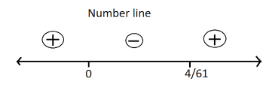
Now since we want our D to be negative, we will choose the interval $\left( {0,\dfrac{4}{{61}}} \right)$ as it is negative.
Hence, our correct option is option (B) $\left( {0,\dfrac{4}{{61}}} \right)$.
Note: We could also solve the question by elimination method. By looking at our condition that $a > 0$, and in this case, $a = m$, we know that m can only be positive. By this, we can eliminate our options (A) and (D).
Now, we only have options (B) and (C). We can check both of them by putting the values in the equation. This is called a hit and trial method. This will help us in eliminating one option.
For the given equation to be greater than 0, identify the conditions and fulfill them by putting the values and using formulae.
Complete step-by-step answer:
We have been given an equation: $m{x^2} - 9mx + 5m + 1 > 0\forall X \in R$ and we have been asked the interval within which $m$ lies.
If we observe properly, the given equation is a quadratic equation of the form: $a{x^2} + bx + c = 0$, where $a = m$, $b = - 9m$ and $c = 5m + 1$.
For our equation to be greater than 0, we need to follow certain conditions:
$a > 0$, and D (determinant) $ < 0$
We know that $D = {b^2} - 4ac$, and as per the condition, $d < 0$. Let us put the values in the formula:
$ \Rightarrow {\left( { - 9m} \right)^2} - 4m\left( {5m + 1} \right) < 0$
On simplifying we get,
$ \Rightarrow 81{m^2} - 20{m^2} - 4m < 0$
$ \Rightarrow 61{m^2} - 4m < 0$
Taking $m$ common,
$ \Rightarrow m(61m - 4) < 0$
$ \Rightarrow m = 0,\dfrac{4}{{61}}$
Now, we have two values of m. Let us plot them on the number line and use a wavy curve method. In this method, we start marking each interval as positive, negative, starting from making the right most interval as positive, next as negative and so on… It is done in the following way:
Now since we want our D to be negative, we will choose the interval $\left( {0,\dfrac{4}{{61}}} \right)$ as it is negative.
Hence, our correct option is option (B) $\left( {0,\dfrac{4}{{61}}} \right)$.
Note: We could also solve the question by elimination method. By looking at our condition that $a > 0$, and in this case, $a = m$, we know that m can only be positive. By this, we can eliminate our options (A) and (D).
Now, we only have options (B) and (C). We can check both of them by putting the values in the equation. This is called a hit and trial method. This will help us in eliminating one option.
Recently Updated Pages
Master Class 11 English: Engaging Questions & Answers for Success

Master Class 11 Social Science: Engaging Questions & Answers for Success
Master Class 11 Maths: Engaging Questions & Answers for Success
Master Class 11 Biology: Engaging Questions & Answers for Success
Master Class 11 Physics: Engaging Questions & Answers for Success
Master Class 11 Chemistry: Engaging Questions & Answers for Success
Trending doubts
Explain the Treaty of Vienna of 1815 class 10 social science CBSE
What is the full form of CNG A Complete Natural Gas class 10 social science CBSE
In cricket, what is a "Yorker" designed to do?
What is the full form of POSCO class 10 social science CBSE
Define Potential, Developed, Stock and Reserved resources
What were the majoritarian measures taken in Sri Lanka class 10 social science CBSE