




If ${\mathrm l}_1,\;{\mathrm m}_1,\;{\mathrm n}_1\;\mathrm{and}\;{\mathrm l}_2,\;{\mathrm m}_2,\;{\mathrm n}_2$ are DCs of two lines inclined to each other at an angle $\mathrm\theta$, then the DCs of the internal bisector of the angle between these lines are
$A.\;\dfrac{l_1+l_2}{2\sin{\displaystyle\dfrac\theta2}},\;\dfrac{m_1+m_2}{2\sin {\displaystyle\dfrac\theta2}},\;\dfrac{n_1+n_2}{2\sin{\displaystyle\dfrac\theta2}}\\B.\;\dfrac{l_1+l_2}{2\cos{\displaystyle\dfrac\theta2}},\;\dfrac{m_1+m_2}{2\cos{\displaystyle\dfrac\theta2}},\;\dfrac{n_1+n_2}{2\cos{\displaystyle\dfrac\theta2}}\\C.\;\dfrac{l_1-l_2}{2\sin{\displaystyle\dfrac\theta2}},\;\dfrac{m_1-m_2}{2\sin{\displaystyle\dfrac\theta2}},\;\dfrac{n_1-n_2}{2\sin{\displaystyle\dfrac\theta2}}\\D.\;\dfrac{l_1-l_2}{2\cos{\displaystyle\dfrac\theta2}},\;\dfrac{m_1-m_2}{2\cos{\displaystyle\dfrac\theta2}},\;\dfrac{n_1-n_2}{2\cos{\displaystyle\dfrac\theta2}}$
Answer
 Verified
615.9k+ views
Hint: This problem requires knowledge of direction cosines(DCs). A direction cosine is the cosine of the angle made by the vector/line with all the three axes. If p, q, r are the DCs of a line then $p^2 + q^2 + r^2 = 1$. Internal angle bisector is a line which divides the angle between two lines equally.
Complete step-by-step answer:
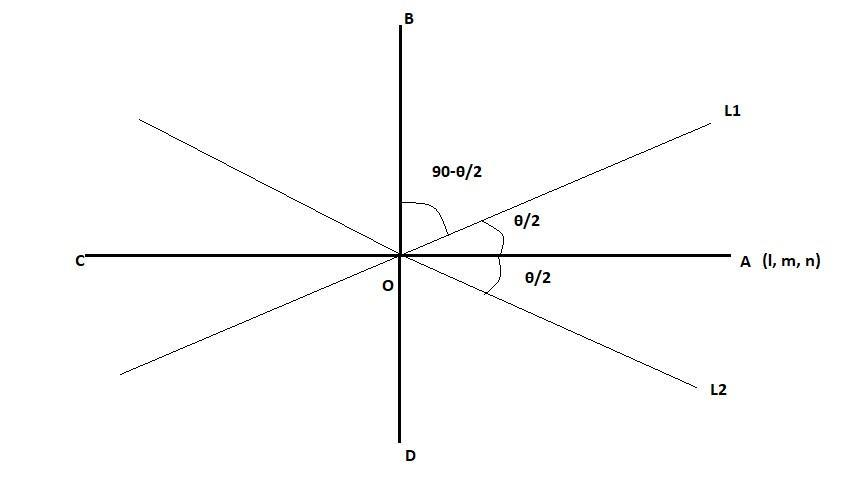
Let the two lines be $L_1$ and $L_2$. Let OA and OB be the two angle bisectors of the line. We have to find the DC of line OA(l, m, n). The formula for cosine of the angle between two lines in terms of the direction cosines is-
$\mathrm{lp}+\mathrm{mq}+\mathrm{nr}=\mathrm{cos\mathrm\alpha}$
Where l, m, n and p, q, r are DCs of the lines.
So, for lines L1 and OA,
$\cos\dfrac{\mathrm\theta}2={\mathrm{ll}}_1+{\mathrm{mm}}_1+ {\mathrm{nn}}_1\\\mathrm{Similarly}\;\mathrm{for}\;{\mathrm L}_2\;\mathrm{and}\;\mathrm{OA},\;\\\cos\dfrac{\mathrm\theta}2={\mathrm{ll}}_2+ {\mathrm{mm}}_2+{\mathrm{nn}}_2$
Adding these two equations, we get-
$2\cos\dfrac{\mathrm\theta}2=\mathrm l\left({\mathrm l}_1+{\mathrm l}_2\right)+\mathrm m\left({\mathrm m}_1+{\mathrm m}_2\right)+\mathrm n\left({\mathrm n}_1+{\mathrm n}_2\right)$
Cross-multiplying the equation we get-
$\dfrac{\mathrm l\left({\mathrm l}_1+{\mathrm l}_2\right)}{2\cos\dfrac{\mathrm\theta}2}+\dfrac{\mathrm m\left({\mathrm m}_1+{\mathrm m}_2\right)}{2\cos\dfrac{\mathrm\theta}2}+\dfrac{\mathrm n\left({\mathrm n}_1+{\mathrm n}_2\right)}{2\cos\dfrac{\mathrm\theta}2}=1=\cos0$
When looked closely, this equation represents the formula for finding the cosine between two lines with DCs l,m,n and $\dfrac{l_1+l_2}{2\cos{\displaystyle\dfrac\theta2}},\;\dfrac{m_1+m_2}{2\cos{\displaystyle\dfrac\theta2}},\;\dfrac{n_1+n_2}{2\cos{\displaystyle\dfrac\theta2}}$
But the angle between these lines is 0, this means that they coincide and their DCs are equal. This gives the required answer.
Hence,the correct option is B. $\dfrac{l_1+l_2}{2\cos{\displaystyle\dfrac\theta2}},\;\dfrac{m_1+m_2}{2\cos{\displaystyle\dfrac\theta2}},\;\dfrac{n_1+n_2}{2\cos{\displaystyle\dfrac\theta2}}$
Note: In this type of problem diagrams are necessary to understand the question. If diagrams are drawn correctly and students know the formula, this problem can be solved with ease.
Complete step-by-step answer:
Let the two lines be $L_1$ and $L_2$. Let OA and OB be the two angle bisectors of the line. We have to find the DC of line OA(l, m, n). The formula for cosine of the angle between two lines in terms of the direction cosines is-
$\mathrm{lp}+\mathrm{mq}+\mathrm{nr}=\mathrm{cos\mathrm\alpha}$
Where l, m, n and p, q, r are DCs of the lines.
So, for lines L1 and OA,
$\cos\dfrac{\mathrm\theta}2={\mathrm{ll}}_1+{\mathrm{mm}}_1+ {\mathrm{nn}}_1\\\mathrm{Similarly}\;\mathrm{for}\;{\mathrm L}_2\;\mathrm{and}\;\mathrm{OA},\;\\\cos\dfrac{\mathrm\theta}2={\mathrm{ll}}_2+ {\mathrm{mm}}_2+{\mathrm{nn}}_2$
Adding these two equations, we get-
$2\cos\dfrac{\mathrm\theta}2=\mathrm l\left({\mathrm l}_1+{\mathrm l}_2\right)+\mathrm m\left({\mathrm m}_1+{\mathrm m}_2\right)+\mathrm n\left({\mathrm n}_1+{\mathrm n}_2\right)$
Cross-multiplying the equation we get-
$\dfrac{\mathrm l\left({\mathrm l}_1+{\mathrm l}_2\right)}{2\cos\dfrac{\mathrm\theta}2}+\dfrac{\mathrm m\left({\mathrm m}_1+{\mathrm m}_2\right)}{2\cos\dfrac{\mathrm\theta}2}+\dfrac{\mathrm n\left({\mathrm n}_1+{\mathrm n}_2\right)}{2\cos\dfrac{\mathrm\theta}2}=1=\cos0$
When looked closely, this equation represents the formula for finding the cosine between two lines with DCs l,m,n and $\dfrac{l_1+l_2}{2\cos{\displaystyle\dfrac\theta2}},\;\dfrac{m_1+m_2}{2\cos{\displaystyle\dfrac\theta2}},\;\dfrac{n_1+n_2}{2\cos{\displaystyle\dfrac\theta2}}$
But the angle between these lines is 0, this means that they coincide and their DCs are equal. This gives the required answer.
Hence,the correct option is B. $\dfrac{l_1+l_2}{2\cos{\displaystyle\dfrac\theta2}},\;\dfrac{m_1+m_2}{2\cos{\displaystyle\dfrac\theta2}},\;\dfrac{n_1+n_2}{2\cos{\displaystyle\dfrac\theta2}}$
Note: In this type of problem diagrams are necessary to understand the question. If diagrams are drawn correctly and students know the formula, this problem can be solved with ease.
Recently Updated Pages
Basicity of sulphurous acid and sulphuric acid are

Master Class 12 English: Engaging Questions & Answers for Success
Master Class 12 Social Science: Engaging Questions & Answers for Success
Master Class 12 Maths: Engaging Questions & Answers for Success
Master Class 12 Economics: Engaging Questions & Answers for Success
Master Class 12 Physics: Engaging Questions & Answers for Success
Trending doubts
Which are the Top 10 Largest Countries of the World?
Draw a labelled sketch of the human eye class 12 physics CBSE
Draw ray diagrams each showing i myopic eye and ii class 12 physics CBSE
Give 10 examples of unisexual and bisexual flowers
Coming together federation is practiced in A India class 12 social science CBSE
Write the formula to find the shortest distance between class 12 maths CBSE