




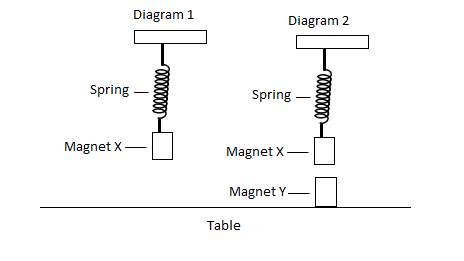
If Magnet X is stationary, What are the forces acting on Magnet X in Diagram 2?
A: Magnetic force
B: Spring force
C: Friction
D: Gravitational force
$ (A) $ A and B only
$ (B) $ A and D only
$ (C) $ A, B and D only
$ (D) $ A, B, C and D
Answer
 Verified
525.6k+ views
Hint : In order to solve this question we will focus on when does Magnetic force, Spring force, Frictional force and Gravitational force act on an object.
Complete Step By Step Answer:
Let us see when the above-mentioned forces act on an object.
Magnetic force: Magnetic force is a contactless force which is experienced by a magnet when it is near another magnet and resulting in attraction or repulsion.
Spring force: Spring force is exerted by a compressed or stretched spring upon any object that is attached to it.
Frictional force: Frictional force is a contact force which requires contact of two surfaces of objects. Frictional force is defined as force resisting the relative motion of surfaces in contact.
Gravitational force: Gravitational force is a force acting on two bodies having mass. This force acts on every object (except when the object is in vacuum) because every object attracts every other object according to Newton’s universal law of gravitation.
As we can see here in diagram 2 there will be Magnetic force acting on Magnet X as it will be influenced by Magnet Y (either attraction or repulsion). There will also be Spring force acting on it because the spring is stretched as it is attached with Magnet X. there will be Gravitational force acting on it as well because magnet X will be having some mass and will be pulled towards earth due to gravity. But there will be no Frictional force acting on Magnet X as there is no contact between two surfaces of bodies.
So Magnetic force, spring force, Gravitational force is acting on Magnet X.
Hence, option is the correct answer.
Note :
Spring force is also known as restoring force. Here one should note that if the magnet X was in contact with the surface of another object and was in motion then frictional force would be acting on it. But since there is no contact there will be all forces except frictional force acting on the magnet X.
Complete Step By Step Answer:
Let us see when the above-mentioned forces act on an object.
Magnetic force: Magnetic force is a contactless force which is experienced by a magnet when it is near another magnet and resulting in attraction or repulsion.
Spring force: Spring force is exerted by a compressed or stretched spring upon any object that is attached to it.
Frictional force: Frictional force is a contact force which requires contact of two surfaces of objects. Frictional force is defined as force resisting the relative motion of surfaces in contact.
Gravitational force: Gravitational force is a force acting on two bodies having mass. This force acts on every object (except when the object is in vacuum) because every object attracts every other object according to Newton’s universal law of gravitation.
As we can see here in diagram 2 there will be Magnetic force acting on Magnet X as it will be influenced by Magnet Y (either attraction or repulsion). There will also be Spring force acting on it because the spring is stretched as it is attached with Magnet X. there will be Gravitational force acting on it as well because magnet X will be having some mass and will be pulled towards earth due to gravity. But there will be no Frictional force acting on Magnet X as there is no contact between two surfaces of bodies.
So Magnetic force, spring force, Gravitational force is acting on Magnet X.
Hence, option is the correct answer.
Note :
Spring force is also known as restoring force. Here one should note that if the magnet X was in contact with the surface of another object and was in motion then frictional force would be acting on it. But since there is no contact there will be all forces except frictional force acting on the magnet X.
Recently Updated Pages
Master Class 11 Computer Science: Engaging Questions & Answers for Success

Master Class 11 Business Studies: Engaging Questions & Answers for Success
Master Class 11 Economics: Engaging Questions & Answers for Success
Master Class 11 English: Engaging Questions & Answers for Success
Master Class 11 Maths: Engaging Questions & Answers for Success
Master Class 11 Biology: Engaging Questions & Answers for Success
Trending doubts
One Metric ton is equal to kg A 10000 B 1000 C 100 class 11 physics CBSE
There are 720 permutations of the digits 1 2 3 4 5 class 11 maths CBSE
Discuss the various forms of bacteria class 11 biology CBSE
Draw a diagram of a plant cell and label at least eight class 11 biology CBSE
State the laws of reflection of light
Explain zero factorial class 11 maths CBSE