




If M and N are any two events, the probability that exactly one of them occurs is for an event set A, the complement is \[A^\circ \].
A. P( M ) + P( N ) – 2P( M\[ \cap \]N )
B. P( M ) + P( N ) – P( M\[ \cap \]N )
C. P( \[M^\circ \]) + P( \[N^\circ \]) – 2P(\[M^\circ \]\[ \cup \]\[N^\circ \])
D. P( M \[ \cap \]\[N^\circ \]) + P(\[M^\circ \]\[ \cup \] N )
Answer
 Verified
596.4k+ views
Hint: M and N are the events of set A. In such a type of question the Venn diagram is the best way to understand the question properly so let us first of all draw a Venn diagram and then we will move on to solving the question.
Complete step-by-step answer:
M and N are two sets.
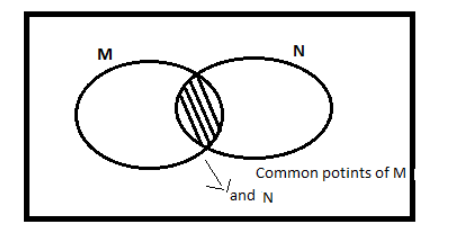
So, probability of getting M as a result is = P ( M )
And probability of getting N = P ( N )
And the probability of getting both i.e. ( P ( M ) and P ( N ) = \[P(M \cap N)\]
As we know that only 1 event can occur at time.
So, probability of getting exactly one occur
\[ \Rightarrow \] P ( Getting only a event ) = P ( M ) + P( N ) – P ( M \[ \cap \] N ) (whether it is event M or N)
This is because we want only a event and P ( M ) and P ( N ) are the events which are exactly one but P ( M \[ \cap \] N ) consists both the events together so we had subtract it from the exactly one events ( i.e. event M and N here ).ss
Now\[\]P ( Getting only a event ) = P ( M ) + P( N ) – P ( M \[ \cap \] N ) - P ( N \[ \cap \] M )
\[ \Rightarrow \] P ( M ) + P ( N ) – 2P ( M \[ \cap \]N ) ( as P ( M \[ \cap \] N ) = P ( N \[ \cap \] M ) )
Hence the correct option is A.
Note:Whenever we find difficulty in solving such types of problems it is very easy to draw the Venn’s diagram with the help of data given in question. The Venn diagram will solve this problem quickly. Here the two sets are equal so the common points or we can say the intersection points of such questions are always the same and equal to each other. And with all this knowledge we will find the result quickly and accurately.
Complete step-by-step answer:
M and N are two sets.
So, probability of getting M as a result is = P ( M )
And probability of getting N = P ( N )
And the probability of getting both i.e. ( P ( M ) and P ( N ) = \[P(M \cap N)\]
As we know that only 1 event can occur at time.
So, probability of getting exactly one occur
\[ \Rightarrow \] P ( Getting only a event ) = P ( M ) + P( N ) – P ( M \[ \cap \] N ) (whether it is event M or N)
This is because we want only a event and P ( M ) and P ( N ) are the events which are exactly one but P ( M \[ \cap \] N ) consists both the events together so we had subtract it from the exactly one events ( i.e. event M and N here ).ss
Now\[\]P ( Getting only a event ) = P ( M ) + P( N ) – P ( M \[ \cap \] N ) - P ( N \[ \cap \] M )
\[ \Rightarrow \] P ( M ) + P ( N ) – 2P ( M \[ \cap \]N ) ( as P ( M \[ \cap \] N ) = P ( N \[ \cap \] M ) )
Hence the correct option is A.
Note:Whenever we find difficulty in solving such types of problems it is very easy to draw the Venn’s diagram with the help of data given in question. The Venn diagram will solve this problem quickly. Here the two sets are equal so the common points or we can say the intersection points of such questions are always the same and equal to each other. And with all this knowledge we will find the result quickly and accurately.
Recently Updated Pages
Master Class 11 Computer Science: Engaging Questions & Answers for Success

Master Class 11 Business Studies: Engaging Questions & Answers for Success
Master Class 11 Economics: Engaging Questions & Answers for Success
Master Class 11 English: Engaging Questions & Answers for Success
Master Class 11 Maths: Engaging Questions & Answers for Success
Master Class 11 Biology: Engaging Questions & Answers for Success
Trending doubts
One Metric ton is equal to kg A 10000 B 1000 C 100 class 11 physics CBSE
There are 720 permutations of the digits 1 2 3 4 5 class 11 maths CBSE
Discuss the various forms of bacteria class 11 biology CBSE
Draw a diagram of a plant cell and label at least eight class 11 biology CBSE
State the laws of reflection of light
Explain zero factorial class 11 maths CBSE