




If ${\log _{0.3}}({\text{x - 1) < lo}}{{\text{g}}_{0.09}}{\text{(x - 1) }}$, then x lies in the interval
A. (2, $\infty $)
B. (1,2)
C. (-2, -1)
D. None of these
Answer
 Verified
612k+ views
Hint: to solve this problem, we have to check whether the logarithmic function is an increasing or decreasing function. So, we will make the graph of log x and then with the help of graph we will solve the given inequality. We will also use some properties of logarithmic function. We will use the property $log_{b^c}a = \dfrac{1}{c} log_{b}a$ and $log{m^n} = nlogm$.
Complete step-by-step answer:
Now, we will first draw the graph of log x.
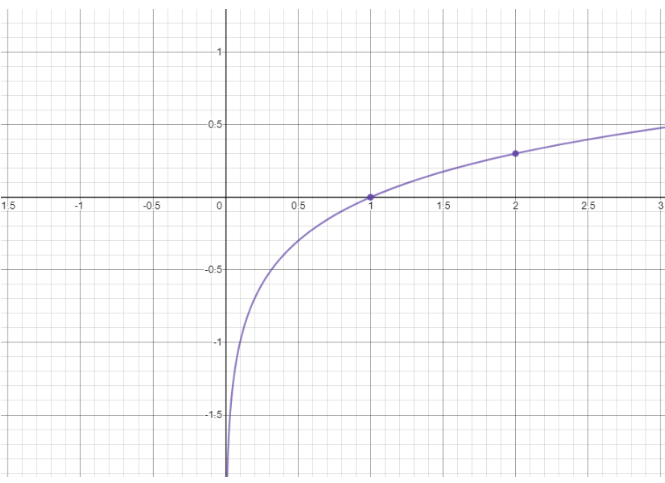
From the graph, we can see that log x is an increasing function, which means the value of log x increases as the value of x increases.
Now, for an increasing function the inequality remains the same, but for a decreasing function, the given inequality reverses.
Given inequality is
${\log _{0.3}}({\text{x - 1) < lo}}{{\text{g}}_{0.09}}{\text{(x - 1) }}$
Now, above equation can be written as
${\log _{0.3}}({\text{x - 1) < }}\dfrac{1}{2}{\log _{0.3}}({\text{x - 1)}}$ as ${\log _{{{\text{b}}^{\text{c}}}}}{\text{a = }}\dfrac{1}{{\text{c}}}{\log _{\text{b}}}{\text{a}}$
$ \Rightarrow $ ${\log _{0.3}}({\text{x - 1) < l}}o{g_{0.3}}{({\text{x - 1)}}^{\dfrac{1}{2}}}$ as $\log {{\text{m}}^{\text{n}}}{\text{ = nlogm}}$
Taking anti – log both sides, we get
$({\text{x - 1) < }}{({\text{x - 1)}}^{\dfrac{1}{2}}}$
Squaring both sides,
${({\text{x - 1)}}^2}{\text{ < }}({\text{x - 1)}}$
Solving the above equation by opening the square and taking (x – 1) to the left – hand side, we get
$({\text{x - 1)(x - 2) < 0}}$
So, the interval is (1,2)
So, x lies in the interval (1,2). So, option (B) is correct.
Note: When we come up with such types of questions, which includes inequality, we have to first draw the graph to find the nature of function, whether it is increasing or decreasing function. Then we will apply properties of the given function to solve the inequality and to find the interval which satisfies the given inequality.
Complete step-by-step answer:
Now, we will first draw the graph of log x.
From the graph, we can see that log x is an increasing function, which means the value of log x increases as the value of x increases.
Now, for an increasing function the inequality remains the same, but for a decreasing function, the given inequality reverses.
Given inequality is
${\log _{0.3}}({\text{x - 1) < lo}}{{\text{g}}_{0.09}}{\text{(x - 1) }}$
Now, above equation can be written as
${\log _{0.3}}({\text{x - 1) < }}\dfrac{1}{2}{\log _{0.3}}({\text{x - 1)}}$ as ${\log _{{{\text{b}}^{\text{c}}}}}{\text{a = }}\dfrac{1}{{\text{c}}}{\log _{\text{b}}}{\text{a}}$
$ \Rightarrow $ ${\log _{0.3}}({\text{x - 1) < l}}o{g_{0.3}}{({\text{x - 1)}}^{\dfrac{1}{2}}}$ as $\log {{\text{m}}^{\text{n}}}{\text{ = nlogm}}$
Taking anti – log both sides, we get
$({\text{x - 1) < }}{({\text{x - 1)}}^{\dfrac{1}{2}}}$
Squaring both sides,
${({\text{x - 1)}}^2}{\text{ < }}({\text{x - 1)}}$
Solving the above equation by opening the square and taking (x – 1) to the left – hand side, we get
$({\text{x - 1)(x - 2) < 0}}$
So, the interval is (1,2)
So, x lies in the interval (1,2). So, option (B) is correct.
Note: When we come up with such types of questions, which includes inequality, we have to first draw the graph to find the nature of function, whether it is increasing or decreasing function. Then we will apply properties of the given function to solve the inequality and to find the interval which satisfies the given inequality.
Recently Updated Pages
Master Class 11 Computer Science: Engaging Questions & Answers for Success

Master Class 11 Business Studies: Engaging Questions & Answers for Success
Master Class 11 Economics: Engaging Questions & Answers for Success
Master Class 11 English: Engaging Questions & Answers for Success
Master Class 11 Maths: Engaging Questions & Answers for Success
Master Class 11 Biology: Engaging Questions & Answers for Success
Trending doubts
One Metric ton is equal to kg A 10000 B 1000 C 100 class 11 physics CBSE
There are 720 permutations of the digits 1 2 3 4 5 class 11 maths CBSE
Discuss the various forms of bacteria class 11 biology CBSE
Draw a diagram of a plant cell and label at least eight class 11 biology CBSE
State the laws of reflection of light
Explain zero factorial class 11 maths CBSE