




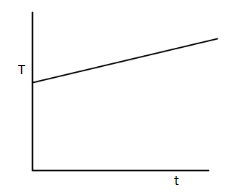
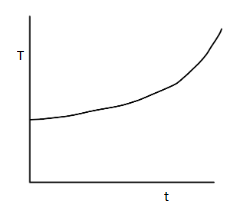
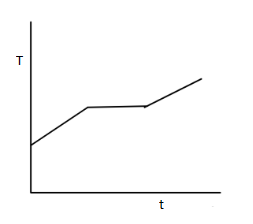
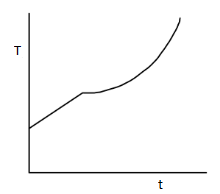
If liquefied oxygen at 1 atmospheric pressure is heated from 50K to 300k by supplying heat at a constant rate. The graph of temperature vs time will be
(A)
(B)
(C)
(D)
Answer
 Verified
602.1k+ views
Hint : The temperature of the oxygen will rise up to its boiling point at which point the oxygen will convert to gaseous form while the temperature remains constant in the conversion. The temperature of the oxygen gas will then again begin to rise. We will use this behaviour of the oxygen gas to determine the graph of temperature vs time.
Complete step by step answer
The boiling point of oxygen is known to be 91 K. As given in the question when we start heating liquefied oxygen up from 50 K temperature the liquid oxygen will start gaining temperature up to 91 K temperature. Once it reaches 91 K temperature, the liquids oxygen will start converting into gaseous form. To convert liquid oxygen into gaseous oxygen, we must provide energy to the liquid oxygen which is also known as the latent heat of vaporization.
So, at 91 K, the temperature of the oxygen will remain stable for some time as all the liquid oxygen is converted into gaseous oxygen. Once all the oxygen is converted into gaseous form, the temperature will start rising again with time.
All of these features that were just described above correspond to the graph in option (C) which is the correct choice.
Note
In an ideal situation, the graph in option (C) is correct but in a real-world scenario, the temperature of the gas will still increase slightly when the liquid oxygen is being converted to gaseous oxygen as the energy deposition is not uniform throughout the liquid and the oxygen that has already converted to gaseous will start heating simultaneously along with the remaining liquid getting converted.
Complete step by step answer
The boiling point of oxygen is known to be 91 K. As given in the question when we start heating liquefied oxygen up from 50 K temperature the liquid oxygen will start gaining temperature up to 91 K temperature. Once it reaches 91 K temperature, the liquids oxygen will start converting into gaseous form. To convert liquid oxygen into gaseous oxygen, we must provide energy to the liquid oxygen which is also known as the latent heat of vaporization.
So, at 91 K, the temperature of the oxygen will remain stable for some time as all the liquid oxygen is converted into gaseous oxygen. Once all the oxygen is converted into gaseous form, the temperature will start rising again with time.
All of these features that were just described above correspond to the graph in option (C) which is the correct choice.
Note
In an ideal situation, the graph in option (C) is correct but in a real-world scenario, the temperature of the gas will still increase slightly when the liquid oxygen is being converted to gaseous oxygen as the energy deposition is not uniform throughout the liquid and the oxygen that has already converted to gaseous will start heating simultaneously along with the remaining liquid getting converted.
Recently Updated Pages
Master Class 12 Economics: Engaging Questions & Answers for Success

Master Class 12 English: Engaging Questions & Answers for Success
Master Class 12 Social Science: Engaging Questions & Answers for Success
Master Class 12 Maths: Engaging Questions & Answers for Success
Master Class 12 Physics: Engaging Questions & Answers for Success
Master Class 11 Social Science: Engaging Questions & Answers for Success
Trending doubts
One Metric ton is equal to kg A 10000 B 1000 C 100 class 11 physics CBSE
Difference Between Prokaryotic Cells and Eukaryotic Cells
Find the value of the expression given below sin 30circ class 11 maths CBSE
Two of the body parts which do not appear in MRI are class 11 biology CBSE
Draw a diagram of nephron and explain its structur class 11 biology CBSE
10 examples of friction in our daily life