




If \[\left( {{\alpha }^{2}},\alpha -2 \right)\] be a point interior to the region of the parabola \[{{y}^{2}}=2x\] bounded by the chord joining the points (2, 2) and (8, -4) then P belongs to the interval
(a)\[-2+2\sqrt{2}<\alpha <2\]
(b)\[\alpha >-2+2\sqrt{2}\]
(c)\[\alpha >-2-2\sqrt{2}\]
(d)None of these
Answer
 Verified
609.9k+ views
Hint: Any point \[\left( {{x}_{1}},{{y}_{1}} \right)\] lying inside of any conic S = 0 will satisfy the equation, \[S\left( {{x}_{1}},{{y}_{1}} \right)<0\], where S is the standard form of conic. Put (0, 0) to the chord and determine the sign of it and hence, according to it the sign will change, while putting \[\left( {{\alpha }^{2}},\alpha -2 \right)\] to the equation of chord. If they point to chords and use ‘< 0’ and vice – versa for positive sign (> 0). Solve the two inequalities calculated with the help of two conditions mentioned above. Take their intersection to get the answer.
Complete step-by-step answer:
Here, we have to find the interval for \[\alpha \], if it is given that \[\left( {{\alpha }^{2}},\alpha -2 \right)\] is a point lying in the region of the parabola \[{{y}^{2}}=4x\] bounded by the chord joining the points (2, 2) and (8, -4).
So, diagram with the help of the given informations can be given as,
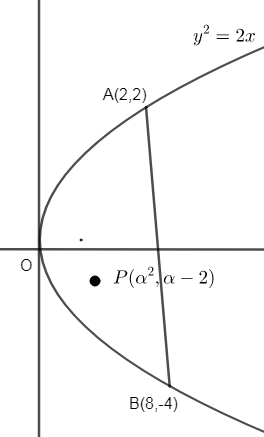
Let us find out the equation of the line passing through the points A and B.
We know equation of a line with given two points \[\left( {{x}_{1}},{{y}_{1}} \right)\] and \[\left( {{x}_{2}},{{y}_{2}} \right)\] as,
\[y-{{y}_{1}}=\dfrac{{{y}_{2}}-{{y}_{1}}}{{{x}_{2}}-{{x}_{1}}}\left( x-{{x}_{1}} \right)-(i)\]
Now, we have two points A and B, so, we can get the equation of line passing through A and B as,
\[\begin{align}
& y-2=\dfrac{-4-2}{8-2}\left( x-2 \right) \\
& y-2=\dfrac{-6}{6}\left( x-2 \right) \\
& y-2=-1\left( x-2 \right) \\
& y-2=-x+2 \\
& x+y=4 \\
\end{align}\]
Or
\[x+y-4=0-(ii)\]
Now, as \[\left( {{\alpha }^{2}},\alpha -2 \right)\] is lying inside the region of parabola. And we know if any point lies inside the curve, S = 0, then
\[S\left( {{x}_{1}},{{y}_{1}} \right)<0-(iii)\]
Where \[\left( {{x}_{1}},{{y}_{1}} \right)\] is a point lying inside the curve S.
So, as equation of parabola given is,
\[{{y}^{2}}-2x=0-(iv)\]
Now, as \[\left( {{\alpha }^{2}},\alpha -2 \right)\] is lying inside the curve (iv). So, using equation (iii), we get,
\[\begin{align}
& {{\left( \alpha -2 \right)}^{2}}-2{{\alpha }^{2}}<0 \\
& {{\alpha }^{2}}+4-4\alpha -2{{\alpha }^{2}}<0 \\
& -{{\alpha }^{2}}-4\alpha +4<0 \\
\end{align}\]
Multiplying with -1 will change the above inequality. So, we get,
\[{{\alpha }^{2}}+4\alpha -4>0-(v)\]
Now, we can find roots of equation \[{{\alpha }^{2}}+4\alpha -4=0\] by using the quadratic formula given for any quadratic \[a{{x}^{2}}+bx+c=0\] as,
\[x=\dfrac{-b\pm \sqrt{{{b}^{2}}-4ac}}{2a}-(vi)\]
Hence, roots of equation (v), we get,
\[\begin{align}
& =\dfrac{-4\pm \sqrt{16-4\times \left( -4 \right)}}{2\times 1} \\
& =\dfrac{-4\pm \sqrt{16+16}}{2} \\
& =\dfrac{-4\pm \sqrt{32}}{2}=\dfrac{-4\pm 4 \sqrt{2}}{2} \\
& =-2\pm 2\sqrt{2} \\
\end{align}\]
Now, we can write the equation (v) as,
\[\left( \alpha -\left( -2+2\sqrt{2} \right) \right)\left( \alpha +\left( -2-2\sqrt{2} \right) \right)>0\]
We know,
If \[\left( x-a \right)\left( x-b \right)>0\]
Then, \[x\in \left( -\infty ,a \right)\cup \left( b,\infty \right)\], where (a < b).
So, we get,
\[\begin{align}
& \left( \alpha -\left( -2+2\sqrt{2} \right) \right)\left( \alpha -\left( -2-2\sqrt{2} \right) \right)>0 \\
& \alpha \in \left( -\infty ,-2-2\sqrt{2} \right)\cup \left( -2+2\sqrt{2},\infty \right)-(vii) \\
\end{align}\]
Now, as the point \[\left( {{\alpha }^{2}},\alpha -2 \right)\] is lying left to the equation represented by line segment AB. i.e. \[x+y-4=0\].
Now, as we can observe (0, 0) is also lying on the left hand side of the line, so the sign given by putting (0, 0) to (x + y -4) is same as sign by putting \[\left( {{\alpha }^{2}},\alpha -2 \right)\] to \[x+y-4=0\].
So, putting (0, 0) to the line \[x+y-4=0\], we get,
\[0+0-4=-4<0\]
Hence, \[\left( {{\alpha }^{2}},\alpha -2 \right)\] will also give less than 0 by putting it to \[x+y-4=0\].
So, we get,
\[\begin{align}
& {{\alpha }^{2}}+\alpha -2-4<0 \\
& {{\alpha }^{2}}+\alpha -6<0 \\
\end{align}\]
We can factorize the equation as,
\[\begin{align}
& {{\alpha }^{2}}+3\alpha -2\alpha -6<0 \\
& \alpha \left( \alpha +3 \right)-2\left( \alpha +3 \right)<0 \\
& \left( \alpha -2 \right)\left( \alpha +3 \right)<0 \\
\end{align}\]
We know,
If \[\left( x-a \right)\left( x-b \right)<0\]
\[x\in \left( a,b \right)\], where a < b
Hence, we get,
\[\begin{align}
& \left( \alpha -2 \right)\left( \alpha +3 \right)<0 \\
& \left( \alpha -2 \right)\left( \alpha -\left( -3 \right) \right)<0 \\
& \alpha \in \left( -3,2 \right)-(viii) \\
\end{align}\]
Now, we know the range of \[\alpha \] with respect to parabola as well as with respect to line AB as well. But we need to find ‘\[\alpha \]’, where both conditions are satisfied. So, we need to take the intersection of the ranges of \[\alpha \] from equations (vii) and (viii).
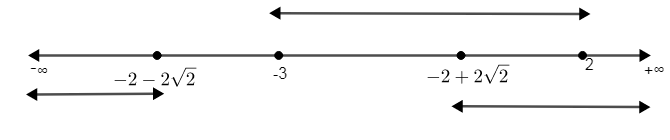
Now, we can observe from the above representation of intervals, we get the intersection of \[\alpha \] as,
\[\alpha \in \left( -2+2\sqrt{2},2 \right)\]
Or
\[-2+2\sqrt{2}<\alpha <2\]
Hence, option (a) is the correct answer.
Note: One may go wrong if he / she put \[\left( {{\alpha }^{2}},\alpha -2 \right)\] to the equation \[2x-{{y}^{2}}=0\] and put the same inequality i.e. ‘<’. Here, we need to use only standard form of curves i.e. \[{{y}^{2}}-4ax=0\] or \[ax+by+c=0\], not any other form, otherwise, we need to change the inequality as well according to the equation.
One may use a number line for the inequalities \[\left( x-a \right)\left( x-b \right)<0\] or \[\left( x-a \right)\left( x-b \right)>0\] as well. We used the direct results of these inequalities in the solution. So, try to remember the results for future reference with these kinds of questions.
Complete step-by-step answer:
Here, we have to find the interval for \[\alpha \], if it is given that \[\left( {{\alpha }^{2}},\alpha -2 \right)\] is a point lying in the region of the parabola \[{{y}^{2}}=4x\] bounded by the chord joining the points (2, 2) and (8, -4).
So, diagram with the help of the given informations can be given as,
Let us find out the equation of the line passing through the points A and B.
We know equation of a line with given two points \[\left( {{x}_{1}},{{y}_{1}} \right)\] and \[\left( {{x}_{2}},{{y}_{2}} \right)\] as,
\[y-{{y}_{1}}=\dfrac{{{y}_{2}}-{{y}_{1}}}{{{x}_{2}}-{{x}_{1}}}\left( x-{{x}_{1}} \right)-(i)\]
Now, we have two points A and B, so, we can get the equation of line passing through A and B as,
\[\begin{align}
& y-2=\dfrac{-4-2}{8-2}\left( x-2 \right) \\
& y-2=\dfrac{-6}{6}\left( x-2 \right) \\
& y-2=-1\left( x-2 \right) \\
& y-2=-x+2 \\
& x+y=4 \\
\end{align}\]
Or
\[x+y-4=0-(ii)\]
Now, as \[\left( {{\alpha }^{2}},\alpha -2 \right)\] is lying inside the region of parabola. And we know if any point lies inside the curve, S = 0, then
\[S\left( {{x}_{1}},{{y}_{1}} \right)<0-(iii)\]
Where \[\left( {{x}_{1}},{{y}_{1}} \right)\] is a point lying inside the curve S.
So, as equation of parabola given is,
\[{{y}^{2}}-2x=0-(iv)\]
Now, as \[\left( {{\alpha }^{2}},\alpha -2 \right)\] is lying inside the curve (iv). So, using equation (iii), we get,
\[\begin{align}
& {{\left( \alpha -2 \right)}^{2}}-2{{\alpha }^{2}}<0 \\
& {{\alpha }^{2}}+4-4\alpha -2{{\alpha }^{2}}<0 \\
& -{{\alpha }^{2}}-4\alpha +4<0 \\
\end{align}\]
Multiplying with -1 will change the above inequality. So, we get,
\[{{\alpha }^{2}}+4\alpha -4>0-(v)\]
Now, we can find roots of equation \[{{\alpha }^{2}}+4\alpha -4=0\] by using the quadratic formula given for any quadratic \[a{{x}^{2}}+bx+c=0\] as,
\[x=\dfrac{-b\pm \sqrt{{{b}^{2}}-4ac}}{2a}-(vi)\]
Hence, roots of equation (v), we get,
\[\begin{align}
& =\dfrac{-4\pm \sqrt{16-4\times \left( -4 \right)}}{2\times 1} \\
& =\dfrac{-4\pm \sqrt{16+16}}{2} \\
& =\dfrac{-4\pm \sqrt{32}}{2}=\dfrac{-4\pm 4 \sqrt{2}}{2} \\
& =-2\pm 2\sqrt{2} \\
\end{align}\]
Now, we can write the equation (v) as,
\[\left( \alpha -\left( -2+2\sqrt{2} \right) \right)\left( \alpha +\left( -2-2\sqrt{2} \right) \right)>0\]
We know,
If \[\left( x-a \right)\left( x-b \right)>0\]
Then, \[x\in \left( -\infty ,a \right)\cup \left( b,\infty \right)\], where (a < b).
So, we get,
\[\begin{align}
& \left( \alpha -\left( -2+2\sqrt{2} \right) \right)\left( \alpha -\left( -2-2\sqrt{2} \right) \right)>0 \\
& \alpha \in \left( -\infty ,-2-2\sqrt{2} \right)\cup \left( -2+2\sqrt{2},\infty \right)-(vii) \\
\end{align}\]
Now, as the point \[\left( {{\alpha }^{2}},\alpha -2 \right)\] is lying left to the equation represented by line segment AB. i.e. \[x+y-4=0\].
Now, as we can observe (0, 0) is also lying on the left hand side of the line, so the sign given by putting (0, 0) to (x + y -4) is same as sign by putting \[\left( {{\alpha }^{2}},\alpha -2 \right)\] to \[x+y-4=0\].
So, putting (0, 0) to the line \[x+y-4=0\], we get,
\[0+0-4=-4<0\]
Hence, \[\left( {{\alpha }^{2}},\alpha -2 \right)\] will also give less than 0 by putting it to \[x+y-4=0\].
So, we get,
\[\begin{align}
& {{\alpha }^{2}}+\alpha -2-4<0 \\
& {{\alpha }^{2}}+\alpha -6<0 \\
\end{align}\]
We can factorize the equation as,
\[\begin{align}
& {{\alpha }^{2}}+3\alpha -2\alpha -6<0 \\
& \alpha \left( \alpha +3 \right)-2\left( \alpha +3 \right)<0 \\
& \left( \alpha -2 \right)\left( \alpha +3 \right)<0 \\
\end{align}\]
We know,
If \[\left( x-a \right)\left( x-b \right)<0\]
\[x\in \left( a,b \right)\], where a < b
Hence, we get,
\[\begin{align}
& \left( \alpha -2 \right)\left( \alpha +3 \right)<0 \\
& \left( \alpha -2 \right)\left( \alpha -\left( -3 \right) \right)<0 \\
& \alpha \in \left( -3,2 \right)-(viii) \\
\end{align}\]
Now, we know the range of \[\alpha \] with respect to parabola as well as with respect to line AB as well. But we need to find ‘\[\alpha \]’, where both conditions are satisfied. So, we need to take the intersection of the ranges of \[\alpha \] from equations (vii) and (viii).
Now, we can observe from the above representation of intervals, we get the intersection of \[\alpha \] as,
\[\alpha \in \left( -2+2\sqrt{2},2 \right)\]
Or
\[-2+2\sqrt{2}<\alpha <2\]
Hence, option (a) is the correct answer.
Note: One may go wrong if he / she put \[\left( {{\alpha }^{2}},\alpha -2 \right)\] to the equation \[2x-{{y}^{2}}=0\] and put the same inequality i.e. ‘<’. Here, we need to use only standard form of curves i.e. \[{{y}^{2}}-4ax=0\] or \[ax+by+c=0\], not any other form, otherwise, we need to change the inequality as well according to the equation.
One may use a number line for the inequalities \[\left( x-a \right)\left( x-b \right)<0\] or \[\left( x-a \right)\left( x-b \right)>0\] as well. We used the direct results of these inequalities in the solution. So, try to remember the results for future reference with these kinds of questions.
Recently Updated Pages
Master Class 11 Computer Science: Engaging Questions & Answers for Success

Master Class 11 Business Studies: Engaging Questions & Answers for Success
Master Class 11 Economics: Engaging Questions & Answers for Success
Master Class 11 English: Engaging Questions & Answers for Success
Master Class 11 Maths: Engaging Questions & Answers for Success
Master Class 11 Biology: Engaging Questions & Answers for Success
Trending doubts
One Metric ton is equal to kg A 10000 B 1000 C 100 class 11 physics CBSE
There are 720 permutations of the digits 1 2 3 4 5 class 11 maths CBSE
Discuss the various forms of bacteria class 11 biology CBSE
Draw a diagram of a plant cell and label at least eight class 11 biology CBSE
State the laws of reflection of light
Explain zero factorial class 11 maths CBSE