




If \[\left( { - 4,3} \right)\] and \[\left( {4,3} \right)\] are two vertices of an equilateral triangle, find the co-ordinates of the third vertex, given that the origin lies in the (i) interior, (ii) exterior of the triangle.
Answer
 Verified
601.2k+ views
Hint:
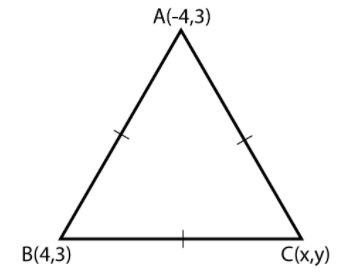
Let the equilateral triangle be $\Delta ABC$ with vertices \[A\left( { - 4,3} \right), {\text{ }}B\left( {4,3} \right)\] and \[C\left( {x,y} \right)\].
First, find the distance AB, BC and Ac using the distance formula $d = \sqrt {{{\left( {{x_1} - {x_2}} \right)}^2} + {{\left( {{y_1} - {y_2}} \right)}^2}} $ .
Now, as it is given, the triangle is an equilateral triangle, \[AB = BC = AC\] .
Find AB and then by \[BC = AC\] and \[AC = AB\] find the linear relations in terms of x and y.
Thus, find x and y which will give the coordinates of the third vertex.
Complete step by step solution:
Let the equilateral triangle be $\Delta ABC$ with vertices \[A\left( { - 4,3} \right), {\text{ }}B\left( {4,3} \right)\] and \[C\left( {x,y} \right)\] .
Now, let us first find the distance between the points A and B using the distance formula $AB = \sqrt {{{\left( {{x_1} - {x_2}} \right)}^2} + {{\left( {{y_1} - {y_2}} \right)}^2}} $ .
\[ \Rightarrow AB = \sqrt {{{\left( { - 4 - 4} \right)}^2} + {{\left( {3 - 3} \right)}^2}} \]
$
= \sqrt {{{\left( { - 8} \right)}^2} + 0} \\
= \sqrt {64}
=8
$
So, let us now find the distance between B and C.
$ \Rightarrow BC = \sqrt {{{\left( {4 - x} \right)}^2} + {{\left( {3 - y} \right)}^2}} $
Also, the distance between A and C will be
$AC = \sqrt {{{\left( { - 4 - x} \right)}^2} + {{\left( {3 - y} \right)}^2}} $
Now, as it is an equilateral triangle, the distances AB, BC and AC must be equal.
So, \[BC = AC\]
\[ \Rightarrow \sqrt {{{\left( {4 - x} \right)}^2} + {{\left( {3 - y} \right)}^2}} = \sqrt {{{\left( { - 4 - x} \right)}^2} + {{\left( {3 - y} \right)}^2}} \]
Squaring both sides
\[
\Rightarrow {\left( {4 - x} \right)^2} + {\left( {3 - y} \right)^2} = {\left( { - 4 - x} \right)^2} + {\left( {3 - y} \right)^2} \\
\Rightarrow 16 - 8x + {x^2} = 16 + 8x + {x^2} \\
\Rightarrow 16x = 0 \\
\Rightarrow x = 0
\]
Also, \[AB = BC\]
\[ \Rightarrow 8 = \sqrt {{{\left( {4 - x} \right)}^2} + {{\left( {3 - y} \right)}^2}} \]
Now, squaring both sides
\[
\Rightarrow 64 = {\left( {4 - x} \right)^2} + {\left( {3 - y} \right)^2} \\
\Rightarrow 64 = 16 - 8x + {x^2} + 9 - 6y + {y^2} \\
\Rightarrow {x^2} + {y^2} - 8x - 6y + 25 - 64 = 0 \\
\Rightarrow {x^2} + {y^2} = 8x + 6y + 39
\]
Now, substituting \[x = 0\] in the above equation will give
\[
{y^2} - 6y - 39 = 0 \\
\Rightarrow {y^2} - 6y + 9 - 9 - 39 = 0 \\
\Rightarrow {\left( {y - 3} \right)^2} - 48 = 0 \\
\Rightarrow {\left( {y - 3} \right)^2} - {\left( {4\sqrt 3 } \right)^2} = 0 \\
\Rightarrow \left( {y - 3 + 4\sqrt 3 } \right)\left( {y - 3 - 4\sqrt 3 } \right) = 0
\]
Thus, $y - 3 + 4\sqrt 3 = 0$ or $y - 3 - 4\sqrt 3 = 0$
$y = 3 - 4\sqrt 3 $ or $y = 3 + 4\sqrt 3 $
So, when the origin lies in the interior, the third vertex will be $C\left( {0,3 - 4\sqrt 3 } \right)$.
When the origin lies in the exterior, the third vertex will be $C\left( {0,3 + 4\sqrt 3 } \right)$.
Note:
Equilateral triangle:
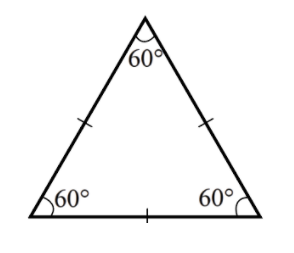
The triangle which has the length of all three sides the same is called an equilateral triangle. Also, equilateral triangle is equiangular which means all the angles have the same values.
Let the equilateral triangle be $\Delta ABC$ with vertices \[A\left( { - 4,3} \right), {\text{ }}B\left( {4,3} \right)\] and \[C\left( {x,y} \right)\].
First, find the distance AB, BC and Ac using the distance formula $d = \sqrt {{{\left( {{x_1} - {x_2}} \right)}^2} + {{\left( {{y_1} - {y_2}} \right)}^2}} $ .
Now, as it is given, the triangle is an equilateral triangle, \[AB = BC = AC\] .
Find AB and then by \[BC = AC\] and \[AC = AB\] find the linear relations in terms of x and y.
Thus, find x and y which will give the coordinates of the third vertex.
Complete step by step solution:
Let the equilateral triangle be $\Delta ABC$ with vertices \[A\left( { - 4,3} \right), {\text{ }}B\left( {4,3} \right)\] and \[C\left( {x,y} \right)\] .
Now, let us first find the distance between the points A and B using the distance formula $AB = \sqrt {{{\left( {{x_1} - {x_2}} \right)}^2} + {{\left( {{y_1} - {y_2}} \right)}^2}} $ .
\[ \Rightarrow AB = \sqrt {{{\left( { - 4 - 4} \right)}^2} + {{\left( {3 - 3} \right)}^2}} \]
$
= \sqrt {{{\left( { - 8} \right)}^2} + 0} \\
= \sqrt {64}
=8
$
So, let us now find the distance between B and C.
$ \Rightarrow BC = \sqrt {{{\left( {4 - x} \right)}^2} + {{\left( {3 - y} \right)}^2}} $
Also, the distance between A and C will be
$AC = \sqrt {{{\left( { - 4 - x} \right)}^2} + {{\left( {3 - y} \right)}^2}} $
Now, as it is an equilateral triangle, the distances AB, BC and AC must be equal.
So, \[BC = AC\]
\[ \Rightarrow \sqrt {{{\left( {4 - x} \right)}^2} + {{\left( {3 - y} \right)}^2}} = \sqrt {{{\left( { - 4 - x} \right)}^2} + {{\left( {3 - y} \right)}^2}} \]
Squaring both sides
\[
\Rightarrow {\left( {4 - x} \right)^2} + {\left( {3 - y} \right)^2} = {\left( { - 4 - x} \right)^2} + {\left( {3 - y} \right)^2} \\
\Rightarrow 16 - 8x + {x^2} = 16 + 8x + {x^2} \\
\Rightarrow 16x = 0 \\
\Rightarrow x = 0
\]
Also, \[AB = BC\]
\[ \Rightarrow 8 = \sqrt {{{\left( {4 - x} \right)}^2} + {{\left( {3 - y} \right)}^2}} \]
Now, squaring both sides
\[
\Rightarrow 64 = {\left( {4 - x} \right)^2} + {\left( {3 - y} \right)^2} \\
\Rightarrow 64 = 16 - 8x + {x^2} + 9 - 6y + {y^2} \\
\Rightarrow {x^2} + {y^2} - 8x - 6y + 25 - 64 = 0 \\
\Rightarrow {x^2} + {y^2} = 8x + 6y + 39
\]
Now, substituting \[x = 0\] in the above equation will give
\[
{y^2} - 6y - 39 = 0 \\
\Rightarrow {y^2} - 6y + 9 - 9 - 39 = 0 \\
\Rightarrow {\left( {y - 3} \right)^2} - 48 = 0 \\
\Rightarrow {\left( {y - 3} \right)^2} - {\left( {4\sqrt 3 } \right)^2} = 0 \\
\Rightarrow \left( {y - 3 + 4\sqrt 3 } \right)\left( {y - 3 - 4\sqrt 3 } \right) = 0
\]
Thus, $y - 3 + 4\sqrt 3 = 0$ or $y - 3 - 4\sqrt 3 = 0$
$y = 3 - 4\sqrt 3 $ or $y = 3 + 4\sqrt 3 $
So, when the origin lies in the interior, the third vertex will be $C\left( {0,3 - 4\sqrt 3 } \right)$.
When the origin lies in the exterior, the third vertex will be $C\left( {0,3 + 4\sqrt 3 } \right)$.
Note:
Equilateral triangle:
The triangle which has the length of all three sides the same is called an equilateral triangle. Also, equilateral triangle is equiangular which means all the angles have the same values.
Recently Updated Pages
Master Class 11 Business Studies: Engaging Questions & Answers for Success

Master Class 11 Biology: Engaging Questions & Answers for Success
Master Class 11 Physics: Engaging Questions & Answers for Success
Master Class 11 Accountancy: Engaging Questions & Answers for Success
Master Class 11 Computer Science: Engaging Questions & Answers for Success
Master Class 11 Chemistry: Engaging Questions & Answers for Success
Trending doubts
One Metric ton is equal to kg A 10000 B 1000 C 100 class 11 physics CBSE
There are 720 permutations of the digits 1 2 3 4 5 class 11 maths CBSE
State and prove Bernoullis theorem class 11 physics CBSE
Draw a diagram of a plant cell and label at least eight class 11 biology CBSE
Difference Between Prokaryotic Cells and Eukaryotic Cells
Discuss the various forms of bacteria class 11 biology CBSE