



If $\left( -1,2 \right),\left( 4,1 \right),\left( 7,16 \right)$ are three vertices of a parallelogram taken in order, then the fourth vertex and also the areas of the parallelogram are
A. $\left( -4,3 \right),16sq.unit$
B. $\left( 2,17 \right),78sq.unit$
C. $\left( -8,3 \right),24sq.unit$
D. $\left( 10,-5 \right),36sq.unit$
Answer
 Verified
605.1k+ views
Hint: We will start by using the fact that the diagonals of a parallelogram bisect each other. Then we will let the fourth vertex be $\left( {{x}_{1}},{{y}_{1}} \right)$ and apply the midpoint formula to find the midpoint of both the opposite pair of vertices and equate them to find the fourth vertex. Then we will find the area of two sub triangle by using coordinate formula determinant $A=\dfrac{1}{2}\left| \begin{matrix}
{{x}_{1}} & {{x}_{2}} & {{x}_{3}} \\
{{y}_{1}} & {{y}_{2}} & {{y}_{3}} \\
1 & 1 & 1 \\
\end{matrix} \right|$.
Complete step-by-step answer:
Now, we have been given that the three vertices of a parallelogram are $\left( -1,2 \right),\left( 4,1 \right),\left( 7,16 \right)$.
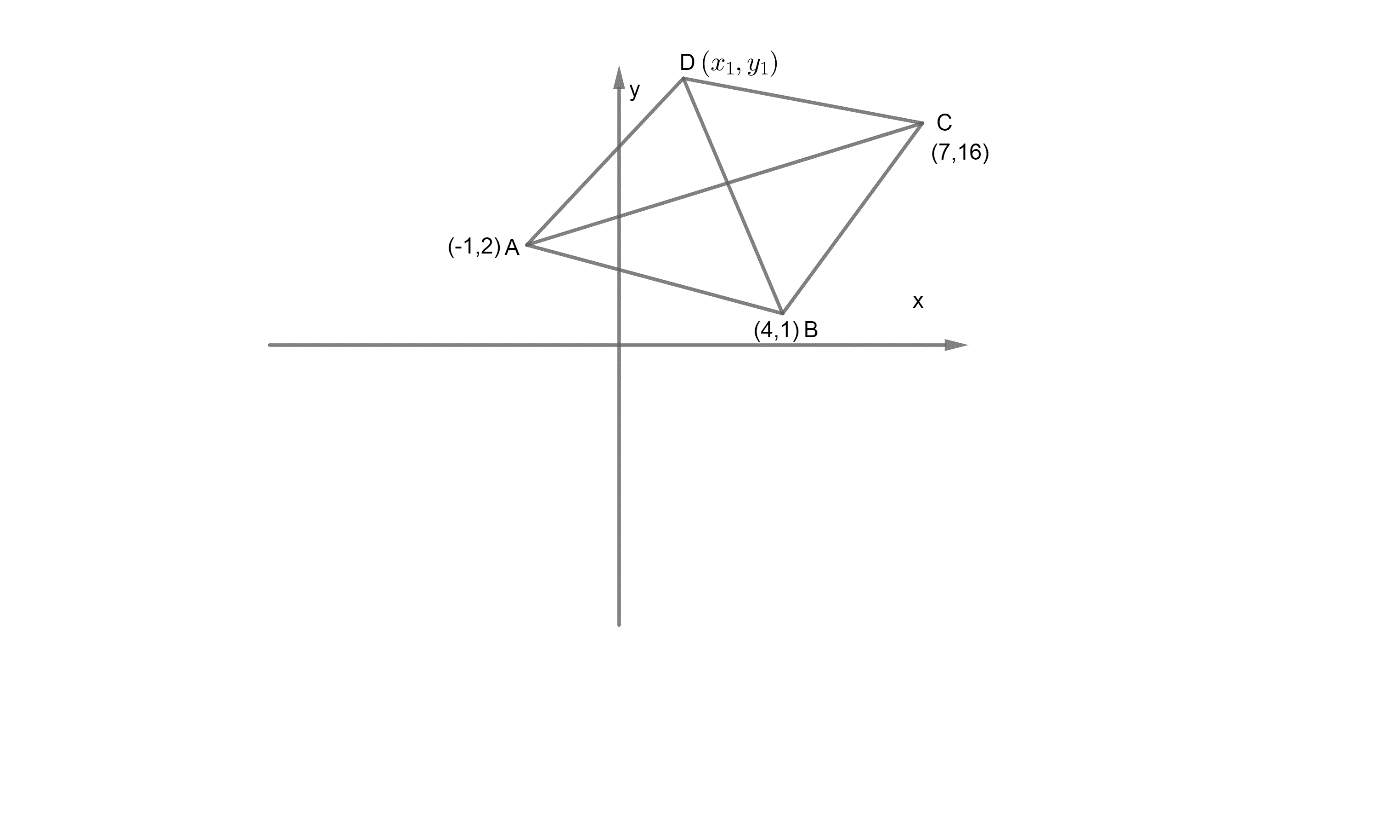
Now, we let the fourth vertex be $\left( {{x}_{1}},{{y}_{1}} \right)$.
Now, we know that the midpoint of vertex $\left( {{x}_{1}},{{y}_{1}} \right)\ and\ \left( {{x}_{2}},{{y}_{2}} \right)$ is $\left( \dfrac{{{x}_{1}}+{{x}_{2}}}{2},\dfrac{{{y}_{1}}+{{y}_{2}}}{2} \right)$.
Since, we know that the diagonals of a parallelogram bisect each other. Therefore, we have,
$\left( \dfrac{-1+7}{2},\dfrac{16+2}{2} \right)=\left( \dfrac{{{x}_{1}}+4}{2},\dfrac{{{y}_{1}}+1}{2} \right)$
On comparing both coordinates we have,
$\begin{align}
& \dfrac{6}{2}=\dfrac{{{x}_{1}}+4}{2} \\
& 6-4={{x}_{1}} \\
& 2={{x}_{1}} \\
& \dfrac{16+2}{2}=\dfrac{{{y}_{1}}+1}{2} \\
& 18-1={{y}_{1}} \\
& 17={{y}_{1}} \\
\end{align}$
Hence, the fourth vertex is $\left( 2,17 \right)$.
Now, we know that the diagonal of a parallelogram divides it into two equal parts. So, we have area of triangle in coordinate system as,
$A=\dfrac{1}{2}\left| \begin{matrix}
{{x}_{1}} & {{x}_{2}} & {{x}_{3}} \\
{{y}_{1}} & {{y}_{2}} & {{y}_{3}} \\
1 & 1 & 1 \\
\end{matrix} \right|$
So, we have area of \[\Delta ACB=\]$\dfrac{1}{2}\left| \begin{matrix}
-1 & 4 & 7 \\
2 & 1 & 16 \\
1 & 1 & 1 \\
\end{matrix} \right|$
Now, expanding along ${{R}_{3}}$ we have,
$\begin{align}
&= \dfrac{1}{2}\left\{ 1\left( 64-7 \right)-1\left( -16-14 \right)+1\left( -1-8 \right) \right\} \\
& =\dfrac{1}{2}\left\{ 57-1\left( -30 \right)+1\left( -9 \right) \right\} \\
&= \dfrac{1}{2}\left\{ 57+30-9 \right\} \\
&= \dfrac{1}{2}\left\{ 87-9 \right\} \\
&= \dfrac{1}{2}\times 78 \\
\end{align}$
Now, we have the $ar\Delta ACB=ar\Delta DCA=\dfrac{78}{2}$.
Therefore, we have an area of parallelogram as 78 sq. units.
Hence, the correct option is (B).
Note: It is important to note that for finding the fourth vertex we have used the fact that at midpoint both pairs of opposite vertex will be the same. Also, it is important to note that for finding the area of triangle we have used the formula that $ar=\dfrac{1}{2}\left| \begin{matrix}
{{x}_{1}} & {{x}_{2}} & {{x}_{3}} \\
{{y}_{1}} & {{y}_{2}} & {{y}_{3}} \\
1 & 1 & 1 \\
\end{matrix} \right|$. We must make sure not to make a mistake in sign of the terms while finding the area by expanding the determinant.
{{x}_{1}} & {{x}_{2}} & {{x}_{3}} \\
{{y}_{1}} & {{y}_{2}} & {{y}_{3}} \\
1 & 1 & 1 \\
\end{matrix} \right|$.
Complete step-by-step answer:
Now, we have been given that the three vertices of a parallelogram are $\left( -1,2 \right),\left( 4,1 \right),\left( 7,16 \right)$.
Now, we let the fourth vertex be $\left( {{x}_{1}},{{y}_{1}} \right)$.
Now, we know that the midpoint of vertex $\left( {{x}_{1}},{{y}_{1}} \right)\ and\ \left( {{x}_{2}},{{y}_{2}} \right)$ is $\left( \dfrac{{{x}_{1}}+{{x}_{2}}}{2},\dfrac{{{y}_{1}}+{{y}_{2}}}{2} \right)$.
Since, we know that the diagonals of a parallelogram bisect each other. Therefore, we have,
$\left( \dfrac{-1+7}{2},\dfrac{16+2}{2} \right)=\left( \dfrac{{{x}_{1}}+4}{2},\dfrac{{{y}_{1}}+1}{2} \right)$
On comparing both coordinates we have,
$\begin{align}
& \dfrac{6}{2}=\dfrac{{{x}_{1}}+4}{2} \\
& 6-4={{x}_{1}} \\
& 2={{x}_{1}} \\
& \dfrac{16+2}{2}=\dfrac{{{y}_{1}}+1}{2} \\
& 18-1={{y}_{1}} \\
& 17={{y}_{1}} \\
\end{align}$
Hence, the fourth vertex is $\left( 2,17 \right)$.
Now, we know that the diagonal of a parallelogram divides it into two equal parts. So, we have area of triangle in coordinate system as,
$A=\dfrac{1}{2}\left| \begin{matrix}
{{x}_{1}} & {{x}_{2}} & {{x}_{3}} \\
{{y}_{1}} & {{y}_{2}} & {{y}_{3}} \\
1 & 1 & 1 \\
\end{matrix} \right|$
So, we have area of \[\Delta ACB=\]$\dfrac{1}{2}\left| \begin{matrix}
-1 & 4 & 7 \\
2 & 1 & 16 \\
1 & 1 & 1 \\
\end{matrix} \right|$
Now, expanding along ${{R}_{3}}$ we have,
$\begin{align}
&= \dfrac{1}{2}\left\{ 1\left( 64-7 \right)-1\left( -16-14 \right)+1\left( -1-8 \right) \right\} \\
& =\dfrac{1}{2}\left\{ 57-1\left( -30 \right)+1\left( -9 \right) \right\} \\
&= \dfrac{1}{2}\left\{ 57+30-9 \right\} \\
&= \dfrac{1}{2}\left\{ 87-9 \right\} \\
&= \dfrac{1}{2}\times 78 \\
\end{align}$
Now, we have the $ar\Delta ACB=ar\Delta DCA=\dfrac{78}{2}$.
Therefore, we have an area of parallelogram as 78 sq. units.
Hence, the correct option is (B).
Note: It is important to note that for finding the fourth vertex we have used the fact that at midpoint both pairs of opposite vertex will be the same. Also, it is important to note that for finding the area of triangle we have used the formula that $ar=\dfrac{1}{2}\left| \begin{matrix}
{{x}_{1}} & {{x}_{2}} & {{x}_{3}} \\
{{y}_{1}} & {{y}_{2}} & {{y}_{3}} \\
1 & 1 & 1 \\
\end{matrix} \right|$. We must make sure not to make a mistake in sign of the terms while finding the area by expanding the determinant.

Recently Updated Pages
Master Class 8 Social Science: Engaging Questions & Answers for Success

Master Class 8 English: Engaging Questions & Answers for Success
Class 8 Question and Answer - Your Ultimate Solutions Guide
Master Class 8 Maths: Engaging Questions & Answers for Success
Master Class 8 Science: Engaging Questions & Answers for Success
Master Class 9 General Knowledge: Engaging Questions & Answers for Success
Trending doubts
What is BLO What is the full form of BLO class 8 social science CBSE
Citizens of India can vote at the age of A 18 years class 8 social science CBSE
Full form of STD, ISD and PCO
Advantages and disadvantages of science
Right to vote is a AFundamental Right BFundamental class 8 social science CBSE
What are the 12 elements of nature class 8 chemistry CBSE