




If l, m, n are the directions cosines of a line, then prove that ${l^2} + {m^2} + {n^2} = 1$. Hence find the directions angles of the line with the x-axis which makes direction angles of ${135^\circ }$ and ${45^\circ }$ with y and z axis respectively.
Answer
 Verified
596.4k+ views
Hint: In this particular type of question assume any variable be the angle of any line with the x, y and z axis respectively, so the cosine of the angle is the direction cosines of the line so use these concepts to reach the solution of the question.
Complete step-by-step answer:
Proof –
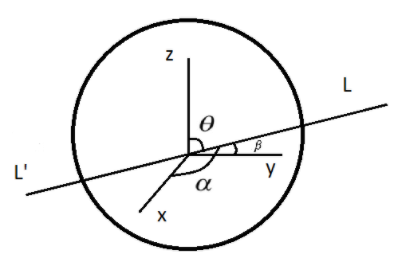
Consider a line LL’ which makes an angle $\alpha ,\beta ,\theta $ with the x, y and z axis respectively as shown in the above figure.
It is given that l, m and n are the direction cosines of a line.
Therefore, $l = \cos \alpha $, $m = \cos \beta $ and $n = \cos \theta $
Therefore, ${l^2} + {m^2} + {n^2} = {\cos ^2}\alpha + {\cos ^2}\beta + {\cos ^2}\theta $.................. (1)
Now consider a vector, $\vec p$ be any non-zero vector along the line LL’
Let, $\vec p = {p_1}\hat i + {p_2}\hat j + {p_3}\hat k$.................. (2)
Now since $\hat i$ is a unit vector along the x-axis.
Therefore,
$\vec p.\hat i = \left| {\vec p} \right|.\left| {\hat i} \right|\cos \alpha $....................... (3)
Now from equation (2)
$ \Rightarrow \left| {\vec p} \right| = \sqrt {p_1^2 + p_2^2 + p_3^2} $
And
$\left| {\hat i} \right| = 1$
Now from equation (3) we have,
Now from equation (3) we have,
$ \Rightarrow \left( {{p_1}\hat i + {p_2}\hat j + {p_3}\hat k} \right).\hat i = \sqrt {p_1^2 + p_2^2 + p_3^2} .\left( 1 \right)\cos \alpha $
$ \Rightarrow \left( {{p_1} + 0 + 0} \right) = \sqrt {p_1^2 + p_2^2 + p_3^2} .\left( 1 \right)\cos \alpha $, $\left[ {\because \hat i.\hat i = 1,\hat i.\hat j = 0,\hat i.\hat k = 0} \right]$
\[ \Rightarrow \cos \alpha = \dfrac{{{p_1}}}{{\sqrt {p_1^2 + p_2^2 + p_3^2} }}\]
Similarly,
\[ \Rightarrow \cos \beta = \dfrac{{{p_2}}}{{\sqrt {p_1^2 + p_2^2 + p_3^2} }}\]
\[ \Rightarrow \cos \theta = \dfrac{{{p_3}}}{{\sqrt {p_1^2 + p_2^2 + p_3^2} }}\]
Now substitute these values in equation (1) we have,
$ \Rightarrow {l^2} + {m^2} + {n^2} = {\left( {\dfrac{{{p_1}}}{{\sqrt {p_1^2 + p_2^2 + p_3^2} }}} \right)^2} + {\left( {\dfrac{{{p_2}}}{{\sqrt {p_1^2 + p_2^2 + p_3^2} }}} \right)^2} + {\left( {\dfrac{{{p_3}}}{{\sqrt {p_1^2 + p_2^2 + p_3^2} }}} \right)^2}$
$ \Rightarrow {l^2} + {m^2} + {n^2} = \left( {\dfrac{{p_1^2}}{{p_1^2 + p_2^2 + p_3^2}}} \right) + \left( {\dfrac{{p_2^2}}{{p_1^2 + p_2^2 + p_3^2}}} \right) + \left( {\dfrac{{p_3^2}}{{p_1^2 + p_2^2 + p_3^2}}} \right)$
$ \Rightarrow {l^2} + {m^2} + {n^2} = \left( {\dfrac{{p_1^2 + p_2^2 + p_3^2}}{{p_1^2 + p_2^2 + p_3^2}}} \right) = 1$
Hence proved.
So from equation (1) we have,
$ \Rightarrow {\cos ^2}\alpha + {\cos ^2}\beta + {\cos ^2}\theta = 1$
Now it is given that the line makes an angle of ${135^\circ }$ and ${45^\circ }$ with y and z axis respectively.
Therefore, $\beta = {135^\circ },\theta = {45^\circ }$
Now substitute these values in the above equation we have,
$ \Rightarrow {\cos ^2}\alpha + {\cos ^2}{135^\circ } + {\cos ^2}{45^\circ } = 1$
$ \Rightarrow {\cos ^2}\alpha + {\left( {\dfrac{{ - 1}}{{\sqrt 2 }}} \right)^2} + {\left( {\dfrac{1}{{\sqrt 2 }}} \right)^2} = 1$, $\left[ {\because \cos {{135}^\circ } = \dfrac{{ - 1}}{{\sqrt 2 }},\cos {{45}^\circ } = \dfrac{1}{{\sqrt 2 }}} \right]$
Now simplify this we have,
$ \Rightarrow {\cos ^2}\alpha + \dfrac{1}{2} + \dfrac{1}{2} = 1$
$ \Rightarrow {\cos ^2}\alpha + 1 = 1$
$ \Rightarrow {\cos ^2}\alpha = 0$
$ \Rightarrow \cos \alpha = 0$
$ \Rightarrow \cos \alpha = \cos {90^\circ }$
$ \Rightarrow \alpha = {90^\circ }$
So the line makes an angle 90 degrees with the x-axis.
So this is the required answer.
Note: Whenever we face such types of questions the key concept we have to remember is that always recall the values of the standard trigonometric angles which is stated above, then simply substitute the values in the equation and simplify as above we will get the required direction angle of line with the x-axis.
Complete step-by-step answer:
Proof –
Consider a line LL’ which makes an angle $\alpha ,\beta ,\theta $ with the x, y and z axis respectively as shown in the above figure.
It is given that l, m and n are the direction cosines of a line.
Therefore, $l = \cos \alpha $, $m = \cos \beta $ and $n = \cos \theta $
Therefore, ${l^2} + {m^2} + {n^2} = {\cos ^2}\alpha + {\cos ^2}\beta + {\cos ^2}\theta $.................. (1)
Now consider a vector, $\vec p$ be any non-zero vector along the line LL’
Let, $\vec p = {p_1}\hat i + {p_2}\hat j + {p_3}\hat k$.................. (2)
Now since $\hat i$ is a unit vector along the x-axis.
Therefore,
$\vec p.\hat i = \left| {\vec p} \right|.\left| {\hat i} \right|\cos \alpha $....................... (3)
Now from equation (2)
$ \Rightarrow \left| {\vec p} \right| = \sqrt {p_1^2 + p_2^2 + p_3^2} $
And
$\left| {\hat i} \right| = 1$
Now from equation (3) we have,
Now from equation (3) we have,
$ \Rightarrow \left( {{p_1}\hat i + {p_2}\hat j + {p_3}\hat k} \right).\hat i = \sqrt {p_1^2 + p_2^2 + p_3^2} .\left( 1 \right)\cos \alpha $
$ \Rightarrow \left( {{p_1} + 0 + 0} \right) = \sqrt {p_1^2 + p_2^2 + p_3^2} .\left( 1 \right)\cos \alpha $, $\left[ {\because \hat i.\hat i = 1,\hat i.\hat j = 0,\hat i.\hat k = 0} \right]$
\[ \Rightarrow \cos \alpha = \dfrac{{{p_1}}}{{\sqrt {p_1^2 + p_2^2 + p_3^2} }}\]
Similarly,
\[ \Rightarrow \cos \beta = \dfrac{{{p_2}}}{{\sqrt {p_1^2 + p_2^2 + p_3^2} }}\]
\[ \Rightarrow \cos \theta = \dfrac{{{p_3}}}{{\sqrt {p_1^2 + p_2^2 + p_3^2} }}\]
Now substitute these values in equation (1) we have,
$ \Rightarrow {l^2} + {m^2} + {n^2} = {\left( {\dfrac{{{p_1}}}{{\sqrt {p_1^2 + p_2^2 + p_3^2} }}} \right)^2} + {\left( {\dfrac{{{p_2}}}{{\sqrt {p_1^2 + p_2^2 + p_3^2} }}} \right)^2} + {\left( {\dfrac{{{p_3}}}{{\sqrt {p_1^2 + p_2^2 + p_3^2} }}} \right)^2}$
$ \Rightarrow {l^2} + {m^2} + {n^2} = \left( {\dfrac{{p_1^2}}{{p_1^2 + p_2^2 + p_3^2}}} \right) + \left( {\dfrac{{p_2^2}}{{p_1^2 + p_2^2 + p_3^2}}} \right) + \left( {\dfrac{{p_3^2}}{{p_1^2 + p_2^2 + p_3^2}}} \right)$
$ \Rightarrow {l^2} + {m^2} + {n^2} = \left( {\dfrac{{p_1^2 + p_2^2 + p_3^2}}{{p_1^2 + p_2^2 + p_3^2}}} \right) = 1$
Hence proved.
So from equation (1) we have,
$ \Rightarrow {\cos ^2}\alpha + {\cos ^2}\beta + {\cos ^2}\theta = 1$
Now it is given that the line makes an angle of ${135^\circ }$ and ${45^\circ }$ with y and z axis respectively.
Therefore, $\beta = {135^\circ },\theta = {45^\circ }$
Now substitute these values in the above equation we have,
$ \Rightarrow {\cos ^2}\alpha + {\cos ^2}{135^\circ } + {\cos ^2}{45^\circ } = 1$
$ \Rightarrow {\cos ^2}\alpha + {\left( {\dfrac{{ - 1}}{{\sqrt 2 }}} \right)^2} + {\left( {\dfrac{1}{{\sqrt 2 }}} \right)^2} = 1$, $\left[ {\because \cos {{135}^\circ } = \dfrac{{ - 1}}{{\sqrt 2 }},\cos {{45}^\circ } = \dfrac{1}{{\sqrt 2 }}} \right]$
Now simplify this we have,
$ \Rightarrow {\cos ^2}\alpha + \dfrac{1}{2} + \dfrac{1}{2} = 1$
$ \Rightarrow {\cos ^2}\alpha + 1 = 1$
$ \Rightarrow {\cos ^2}\alpha = 0$
$ \Rightarrow \cos \alpha = 0$
$ \Rightarrow \cos \alpha = \cos {90^\circ }$
$ \Rightarrow \alpha = {90^\circ }$
So the line makes an angle 90 degrees with the x-axis.
So this is the required answer.
Note: Whenever we face such types of questions the key concept we have to remember is that always recall the values of the standard trigonometric angles which is stated above, then simply substitute the values in the equation and simplify as above we will get the required direction angle of line with the x-axis.
Recently Updated Pages
Master Class 11 Computer Science: Engaging Questions & Answers for Success

Master Class 11 Business Studies: Engaging Questions & Answers for Success
Master Class 11 Economics: Engaging Questions & Answers for Success
Master Class 11 English: Engaging Questions & Answers for Success
Master Class 11 Maths: Engaging Questions & Answers for Success
Master Class 11 Biology: Engaging Questions & Answers for Success
Trending doubts
One Metric ton is equal to kg A 10000 B 1000 C 100 class 11 physics CBSE
There are 720 permutations of the digits 1 2 3 4 5 class 11 maths CBSE
Discuss the various forms of bacteria class 11 biology CBSE
Draw a diagram of a plant cell and label at least eight class 11 biology CBSE
State the laws of reflection of light
10 examples of friction in our daily life