




If in an A.C circuit, L-C series circuit \[{{X}_{C}}>{{X}_{L}}\]. Hence, potential _____.
A) Leads the current by \[\pi \] in phase.
B) Leads the current by \[\dfrac{\pi }{2}\] in phase.
C) Lags behind the current by \[\dfrac{\pi }{2}\] in phase.
D) Lags behind the current by \[\pi \] in phase.
Answer
 Verified
588.6k+ views
Hint: We need to understand the relation between the reactance of the capacitive circuit and the inductive circuit with the potential drop and the current flows through the reactive element. The current either leads or lags depending on the dominating element.
Complete step by step solution:
We know that the voltage and current in a circuit can possess phase differences with one another in the case of reactive circuits such as the capacitive or inductive circuits. The phase difference is dependent on whether the capacitive reactance or the inductive reactance is dominating the circuit.
For a capacitive circuit, the relations for the voltage and the current are given as –
\[\begin{align}
& I={{I}_{o}}\sin (\omega t+\dfrac{\pi }{2}) \\
& \text{and,} \\
& V={{V}_{0}}\sin (\omega t) \\
\end{align}\]
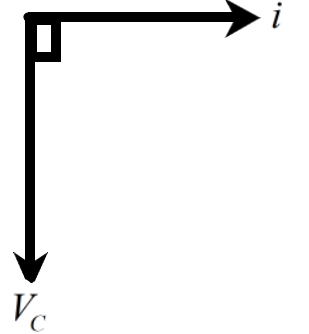
The current is leading the voltage by a phase of \[\dfrac{\pi }{2}\].
The phase diagram is given below.
For an inductive circuit, the relations for the voltage and current is given as –
\[\begin{align}
& I={{I}_{o}}\sin (\omega t) \\
& \text{and,} \\
& V={{V}_{0}}\sin (\omega t+\dfrac{\pi }{2}) \\
\end{align}\]
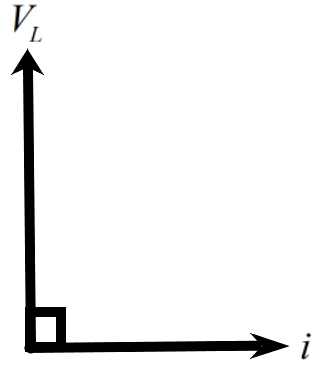
The current lags behind the voltage by a phase of \[\dfrac{\pi }{2}\].
The phase diagram is shown below.
Now, for the circuit in which the capacitive reactance is dominating the inductive reactance, the phasor diagram is given below.
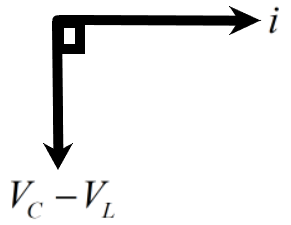
From this, we understand that the voltage is lagging the current by a phase of \[\dfrac{\pi }{2}\]. This is the peculiar feature of a capacitive circuit.
The correct answer is option C.
Note: The higher the capacitive reactance in an A.C circuit, the current will be leading the A.C circuit. The inductive reactance dominating over the capacitive reactance can result in the voltage to be leading current by a phase of \[\dfrac{\pi }{2}\] in the A.C circuit.
Complete step by step solution:
We know that the voltage and current in a circuit can possess phase differences with one another in the case of reactive circuits such as the capacitive or inductive circuits. The phase difference is dependent on whether the capacitive reactance or the inductive reactance is dominating the circuit.
For a capacitive circuit, the relations for the voltage and the current are given as –
\[\begin{align}
& I={{I}_{o}}\sin (\omega t+\dfrac{\pi }{2}) \\
& \text{and,} \\
& V={{V}_{0}}\sin (\omega t) \\
\end{align}\]
The current is leading the voltage by a phase of \[\dfrac{\pi }{2}\].
The phase diagram is given below.
For an inductive circuit, the relations for the voltage and current is given as –
\[\begin{align}
& I={{I}_{o}}\sin (\omega t) \\
& \text{and,} \\
& V={{V}_{0}}\sin (\omega t+\dfrac{\pi }{2}) \\
\end{align}\]
The current lags behind the voltage by a phase of \[\dfrac{\pi }{2}\].
The phase diagram is shown below.
Now, for the circuit in which the capacitive reactance is dominating the inductive reactance, the phasor diagram is given below.
From this, we understand that the voltage is lagging the current by a phase of \[\dfrac{\pi }{2}\]. This is the peculiar feature of a capacitive circuit.
The correct answer is option C.
Note: The higher the capacitive reactance in an A.C circuit, the current will be leading the A.C circuit. The inductive reactance dominating over the capacitive reactance can result in the voltage to be leading current by a phase of \[\dfrac{\pi }{2}\] in the A.C circuit.
Recently Updated Pages
Master Class 12 Social Science: Engaging Questions & Answers for Success

Master Class 12 Physics: Engaging Questions & Answers for Success
Master Class 12 Maths: Engaging Questions & Answers for Success
Master Class 12 Economics: Engaging Questions & Answers for Success
Master Class 12 Chemistry: Engaging Questions & Answers for Success
Master Class 12 Business Studies: Engaging Questions & Answers for Success
Trending doubts
Which are the Top 10 Largest Countries of the World?
Draw a labelled sketch of the human eye class 12 physics CBSE
Explain the structure of megasporangium class 12 biology CBSE
What are the major means of transport Explain each class 12 social science CBSE
How many chromosomes are found in human ovum a 46 b class 12 biology CBSE
The diagram of the section of a maize grain is given class 12 biology CBSE