




If in a triangle ABC, (a + b + c) (b + c – a) = k. bc, then
A. k < 0
B. k > 0
C. 0 < k < 4
D. k < 4
Answer
 Verified
623.7k+ views
Hint: To solve this question, we will use the law of cosines which is used to find the angles of a triangle if we are given the sides of a triangle The law of cosine is $\cos {\text{A = }}\dfrac{{{{\text{b}}^2}{\text{ + }}{{\text{c}}^2}{\text{ - }}{{\text{a}}^2}}}{{{\text{2bc}}}}$.
Complete step-by-step answer:
Now, we are given (a + b + c) (b + c -a) = k. bc. We can also write it as,
(b + c + a) (b + c – a) = k. bc
Now, we can see that in the above equation the left – hand term is of the type (x + y) (x – y).
So, we will use the property (x + y) (x – y) = ${{\text{x}}^2}{\text{ - }}{{\text{y}}^2}$.so, we have
${{\text{(b + c)}}^2}{\text{ - }}{{\text{a}}^2}$ = k. bc
Now, we will use the identity ${({\text{a + b)}}^2}{\text{ = }}{{\text{a}}^2}{\text{ + }}{{\text{b}}^2}{\text{ + 2ab}}$ to open the square in the above term. So, applying property, we get
${{\text{b}}^2}{\text{ + }}{{\text{c}}^2}{\text{ + 2bc - }}{{\text{a}}^2}$ = k. bc
${{\text{b}}^2}{\text{ + }}{{\text{c}}^2}{\text{ - }}{{\text{a}}^2}$ = k. bc – 2bc
Taking bc common in R. H. S, we get
${{\text{b}}^2}{\text{ + }}{{\text{c}}^2}{\text{ - }}{{\text{a}}^2}$ = (k – 2) bc
It can also be written as, $\dfrac{{{{\text{b}}^2}{\text{ + }}{{\text{c}}^2}{\text{ - }}{{\text{a}}^2}}}{{{\text{bc}}}}$ = k – 2
Now, dividing both sides by 2, we get
$\dfrac{{{{\text{b}}^2}{\text{ + }}{{\text{c}}^2}{\text{ - }}{{\text{a}}^2}}}{{{\text{2bc}}}}$ = $\dfrac{{{\text{k - 2}}}}{2}$
Now, by law of cosine, $\cos {\text{A = }}\dfrac{{{{\text{b}}^2}{\text{ + }}{{\text{c}}^2}{\text{ - }}{{\text{a}}^2}}}{{{\text{2bc}}}}$. We can find any angle with the help of the law of cosine from the figure drawn below.
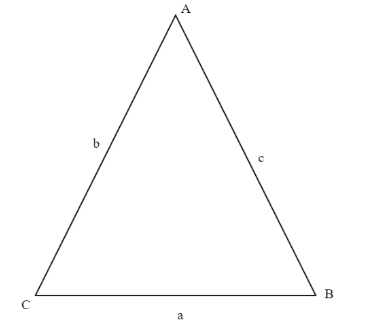
Therefore, cos A = $\dfrac{{{\text{k - 2}}}}{2}$ … (1)
Now, cos A has a maximum value of 1 and minimum value of -1. So, we have
${\text{ - 1}} \leqslant {\text{ cosA }} \leqslant {\text{1}}$
Putting value of cos A from equation (1), we have
${\text{ - 1}} \leqslant {\text{ }}\dfrac{{{\text{k - 2}}}}{2} \leqslant {\text{1}}$
Multiplying the above term by 2, we get
${\text{ - 2}} \leqslant {\text{ k - 2}} \leqslant 2$
Adding 2 in the above term, we get
${\text{ - 2 + }}{\text{ 2}} \leqslant {\text{ k - 2 + }}{\text{ 2}} \leqslant 2{\text{ + 2}}$
$0 \leqslant {\text{ k }} \leqslant 4$
So, 0 < k < 4
So, option (3) is the correct answer.
Note: When we come up with such types of question, we will first simplify the given expression by using the properties of (x + y)(x – y) = ${{\text{x}}^2}{\text{ - }}{{\text{y}}^2}$ and ${({\text{a + b)}}^2}{\text{ = }}{{\text{a}}^2}{\text{ + }}{{\text{b}}^2}{\text{ + 2ab}}$. After it, we will use the law of cosine to find the value of the variable asked in the question.
Complete step-by-step answer:
Now, we are given (a + b + c) (b + c -a) = k. bc. We can also write it as,
(b + c + a) (b + c – a) = k. bc
Now, we can see that in the above equation the left – hand term is of the type (x + y) (x – y).
So, we will use the property (x + y) (x – y) = ${{\text{x}}^2}{\text{ - }}{{\text{y}}^2}$.so, we have
${{\text{(b + c)}}^2}{\text{ - }}{{\text{a}}^2}$ = k. bc
Now, we will use the identity ${({\text{a + b)}}^2}{\text{ = }}{{\text{a}}^2}{\text{ + }}{{\text{b}}^2}{\text{ + 2ab}}$ to open the square in the above term. So, applying property, we get
${{\text{b}}^2}{\text{ + }}{{\text{c}}^2}{\text{ + 2bc - }}{{\text{a}}^2}$ = k. bc
${{\text{b}}^2}{\text{ + }}{{\text{c}}^2}{\text{ - }}{{\text{a}}^2}$ = k. bc – 2bc
Taking bc common in R. H. S, we get
${{\text{b}}^2}{\text{ + }}{{\text{c}}^2}{\text{ - }}{{\text{a}}^2}$ = (k – 2) bc
It can also be written as, $\dfrac{{{{\text{b}}^2}{\text{ + }}{{\text{c}}^2}{\text{ - }}{{\text{a}}^2}}}{{{\text{bc}}}}$ = k – 2
Now, dividing both sides by 2, we get
$\dfrac{{{{\text{b}}^2}{\text{ + }}{{\text{c}}^2}{\text{ - }}{{\text{a}}^2}}}{{{\text{2bc}}}}$ = $\dfrac{{{\text{k - 2}}}}{2}$
Now, by law of cosine, $\cos {\text{A = }}\dfrac{{{{\text{b}}^2}{\text{ + }}{{\text{c}}^2}{\text{ - }}{{\text{a}}^2}}}{{{\text{2bc}}}}$. We can find any angle with the help of the law of cosine from the figure drawn below.
Therefore, cos A = $\dfrac{{{\text{k - 2}}}}{2}$ … (1)
Now, cos A has a maximum value of 1 and minimum value of -1. So, we have
${\text{ - 1}} \leqslant {\text{ cosA }} \leqslant {\text{1}}$
Putting value of cos A from equation (1), we have
${\text{ - 1}} \leqslant {\text{ }}\dfrac{{{\text{k - 2}}}}{2} \leqslant {\text{1}}$
Multiplying the above term by 2, we get
${\text{ - 2}} \leqslant {\text{ k - 2}} \leqslant 2$
Adding 2 in the above term, we get
${\text{ - 2 + }}{\text{ 2}} \leqslant {\text{ k - 2 + }}{\text{ 2}} \leqslant 2{\text{ + 2}}$
$0 \leqslant {\text{ k }} \leqslant 4$
So, 0 < k < 4
So, option (3) is the correct answer.
Note: When we come up with such types of question, we will first simplify the given expression by using the properties of (x + y)(x – y) = ${{\text{x}}^2}{\text{ - }}{{\text{y}}^2}$ and ${({\text{a + b)}}^2}{\text{ = }}{{\text{a}}^2}{\text{ + }}{{\text{b}}^2}{\text{ + 2ab}}$. After it, we will use the law of cosine to find the value of the variable asked in the question.
Recently Updated Pages
Basicity of sulphurous acid and sulphuric acid are

Master Class 12 English: Engaging Questions & Answers for Success
Master Class 12 Social Science: Engaging Questions & Answers for Success
Master Class 12 Maths: Engaging Questions & Answers for Success
Master Class 12 Economics: Engaging Questions & Answers for Success
Master Class 12 Physics: Engaging Questions & Answers for Success
Trending doubts
Which are the Top 10 Largest Countries of the World?
Draw a labelled sketch of the human eye class 12 physics CBSE
Draw ray diagrams each showing i myopic eye and ii class 12 physics CBSE
Give 10 examples of unisexual and bisexual flowers
Coming together federation is practiced in A India class 12 social science CBSE
Write the formula to find the shortest distance between class 12 maths CBSE