




If in a triangle ABC, 2 cos A = sin B cosec C, then
(a) a = h
(b) b = c
(c) c = a
(d) 2a = bc
Answer
 Verified
660.3k+ views
Hint: To solve this question given above, we will first find out the value of sin B from the relation given in the question. Then we will make use of the fact that the sum of all the angles in a triangle is \[{{180}^{o}}.\] From there, we will find the value of B in terms of A and C and then we will put this value in sin B. Now, we will write these trigonometric ratios in terms of the side length.
Complete step-by-step answer:
To start with, we are given in the question that,
\[2\cos A=\sin B\operatorname{cosec}C.....\left( i \right)\]
Now, we know that, \[\operatorname{cosec}\theta =\dfrac{1}{\sin \theta }.\] Thus, applying this formula in (i), we will get,
\[\Rightarrow 2\cos A=\dfrac{\sin B}{\sin C}\]
\[\Rightarrow 2\cos A\sin C=\sin B\]
\[\Rightarrow \sin B=2\cos A\sin C.....\left( ii \right)\]
Now, we will draw a triangle ABC.
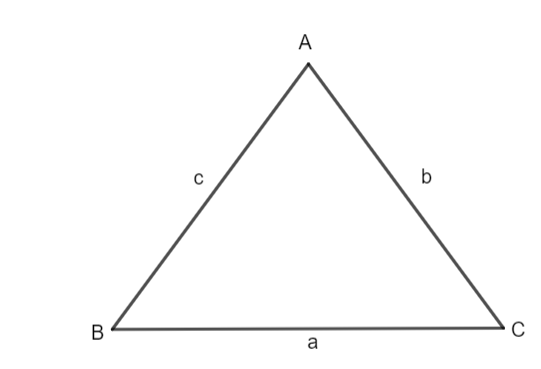
Now, we know that the sum of all the angles in the triangle is \[{{180}^{o}}.\] Thus, we will get,
\[A+B+C={{180}^{o}}\]
\[\Rightarrow A+C={{180}^{o}}-B\]
\[\Rightarrow B={{180}^{o}}-\left( A+C \right).....\left( iii \right)\]
Now, we will apply sine on both sides. Thus, we will get,
\[\Rightarrow \sin B=\sin \left[ {{180}^{o}}-\left( A+C \right) \right]\]
We know that, \[\sin \left( {{180}^{o}}-\theta \right)=\sin \theta ,\] so we will get,
\[\Rightarrow \sin B=\sin \left( A+C \right)....\left( iv \right)\]
From (ii) and (iv), we will get,
\[\Rightarrow \sin \left( A+C \right)=2\cos A\sin C\]
Now, we will apply the following identity in the above equation,
\[\sin \left( x+y \right)=\sin x\cos y+\cos x\sin y\]
Thus, we will get,
\[\Rightarrow \sin A\cos C+\cos A\sin C=2\cos A\sin C\]
\[\Rightarrow \sin A\cos C=\cos A\sin C.....\left( v \right)\]
Now, we know that,
\[\dfrac{\sin A}{a}=\dfrac{\sin C}{c}=k\]
Also,
\[\cos A=\dfrac{{{b}^{2}}+{{c}^{2}}-{{a}^{2}}}{2bc}\]
\[\cos C=\dfrac{{{a}^{2}}+{{b}^{2}}-{{c}^{2}}}{2ab}\]
Thus, we will put these values in equation (v). After doing this, we will get,
\[\Rightarrow ka\left( \dfrac{{{a}^{2}}+{{b}^{2}}-{{c}^{2}}}{2ab} \right)=\left( \dfrac{{{b}^{2}}+{{c}^{2}}-{{a}^{2}}}{2bc} \right)kc\]
\[\Rightarrow a\left( \dfrac{{{a}^{2}}+{{b}^{2}}-{{c}^{2}}}{2ab} \right)=c\left( \dfrac{{{b}^{2}}+{{c}^{2}}-{{a}^{2}}}{2bc} \right)\]
\[\Rightarrow \dfrac{{{a}^{2}}+{{b}^{2}}-{{c}^{2}}}{2b}=\dfrac{{{b}^{2}}+{{c}^{2}}-{{a}^{2}}}{2b}\]
\[\Rightarrow {{a}^{2}}+{{b}^{2}}-{{c}^{2}}={{b}^{2}}+{{c}^{2}}-{{a}^{2}}\]
\[\Rightarrow 2{{a}^{2}}=2{{c}^{2}}\]
\[\Rightarrow {{a}^{2}}={{c}^{2}}\]
\[\Rightarrow a=c\]
Hence, the option (c) is the right answer.
Note: The above question can also be solved by an alternate method as shown below:
\[2\cos A=\sin B\operatorname{cosec}C\]
Now, we will write cosec C in terms of sin C with the help of the following relation:
\[\operatorname{cosec}C=\dfrac{1}{\sin C}\]
Thus, we will get the following equation:
\[2\cos A=\dfrac{\sin B}{\sin C}\]
Now, we know that,
\[\dfrac{\sin B}{b}=\dfrac{\sin C}{c}\]
\[\Rightarrow \dfrac{\sin B}{\sin C}=\dfrac{b}{c}\]
Thus, we will get the following equation,
\[\Rightarrow 2\cos A=\dfrac{b}{c}\]
Now, we will use the formula of cos A in the above equation which is shown below:
\[\cos A=\dfrac{{{b}^{2}}+{{c}^{2}}-{{a}^{2}}}{2bc}\]
Thus, we will get,
\[\Rightarrow 2\left( \dfrac{{{b}^{2}}+{{c}^{2}}-{{a}^{2}}}{2bc} \right)=\dfrac{b}{c}\]
\[\Rightarrow \dfrac{{{b}^{2}}+{{c}^{2}}-{{a}^{2}}}{bc}=\dfrac{b}{c}\]
\[\Rightarrow {{b}^{2}}+{{c}^{2}}-{{a}^{2}}={{b}^{2}}\]
\[\Rightarrow {{c}^{2}}-{{a}^{2}}=0\]
\[\Rightarrow {{c}^{2}}={{a}^{2}}\]
\[\Rightarrow c=a\]
Complete step-by-step answer:
To start with, we are given in the question that,
\[2\cos A=\sin B\operatorname{cosec}C.....\left( i \right)\]
Now, we know that, \[\operatorname{cosec}\theta =\dfrac{1}{\sin \theta }.\] Thus, applying this formula in (i), we will get,
\[\Rightarrow 2\cos A=\dfrac{\sin B}{\sin C}\]
\[\Rightarrow 2\cos A\sin C=\sin B\]
\[\Rightarrow \sin B=2\cos A\sin C.....\left( ii \right)\]
Now, we will draw a triangle ABC.
Now, we know that the sum of all the angles in the triangle is \[{{180}^{o}}.\] Thus, we will get,
\[A+B+C={{180}^{o}}\]
\[\Rightarrow A+C={{180}^{o}}-B\]
\[\Rightarrow B={{180}^{o}}-\left( A+C \right).....\left( iii \right)\]
Now, we will apply sine on both sides. Thus, we will get,
\[\Rightarrow \sin B=\sin \left[ {{180}^{o}}-\left( A+C \right) \right]\]
We know that, \[\sin \left( {{180}^{o}}-\theta \right)=\sin \theta ,\] so we will get,
\[\Rightarrow \sin B=\sin \left( A+C \right)....\left( iv \right)\]
From (ii) and (iv), we will get,
\[\Rightarrow \sin \left( A+C \right)=2\cos A\sin C\]
Now, we will apply the following identity in the above equation,
\[\sin \left( x+y \right)=\sin x\cos y+\cos x\sin y\]
Thus, we will get,
\[\Rightarrow \sin A\cos C+\cos A\sin C=2\cos A\sin C\]
\[\Rightarrow \sin A\cos C=\cos A\sin C.....\left( v \right)\]
Now, we know that,
\[\dfrac{\sin A}{a}=\dfrac{\sin C}{c}=k\]
Also,
\[\cos A=\dfrac{{{b}^{2}}+{{c}^{2}}-{{a}^{2}}}{2bc}\]
\[\cos C=\dfrac{{{a}^{2}}+{{b}^{2}}-{{c}^{2}}}{2ab}\]
Thus, we will put these values in equation (v). After doing this, we will get,
\[\Rightarrow ka\left( \dfrac{{{a}^{2}}+{{b}^{2}}-{{c}^{2}}}{2ab} \right)=\left( \dfrac{{{b}^{2}}+{{c}^{2}}-{{a}^{2}}}{2bc} \right)kc\]
\[\Rightarrow a\left( \dfrac{{{a}^{2}}+{{b}^{2}}-{{c}^{2}}}{2ab} \right)=c\left( \dfrac{{{b}^{2}}+{{c}^{2}}-{{a}^{2}}}{2bc} \right)\]
\[\Rightarrow \dfrac{{{a}^{2}}+{{b}^{2}}-{{c}^{2}}}{2b}=\dfrac{{{b}^{2}}+{{c}^{2}}-{{a}^{2}}}{2b}\]
\[\Rightarrow {{a}^{2}}+{{b}^{2}}-{{c}^{2}}={{b}^{2}}+{{c}^{2}}-{{a}^{2}}\]
\[\Rightarrow 2{{a}^{2}}=2{{c}^{2}}\]
\[\Rightarrow {{a}^{2}}={{c}^{2}}\]
\[\Rightarrow a=c\]
Hence, the option (c) is the right answer.
Note: The above question can also be solved by an alternate method as shown below:
\[2\cos A=\sin B\operatorname{cosec}C\]
Now, we will write cosec C in terms of sin C with the help of the following relation:
\[\operatorname{cosec}C=\dfrac{1}{\sin C}\]
Thus, we will get the following equation:
\[2\cos A=\dfrac{\sin B}{\sin C}\]
Now, we know that,
\[\dfrac{\sin B}{b}=\dfrac{\sin C}{c}\]
\[\Rightarrow \dfrac{\sin B}{\sin C}=\dfrac{b}{c}\]
Thus, we will get the following equation,
\[\Rightarrow 2\cos A=\dfrac{b}{c}\]
Now, we will use the formula of cos A in the above equation which is shown below:
\[\cos A=\dfrac{{{b}^{2}}+{{c}^{2}}-{{a}^{2}}}{2bc}\]
Thus, we will get,
\[\Rightarrow 2\left( \dfrac{{{b}^{2}}+{{c}^{2}}-{{a}^{2}}}{2bc} \right)=\dfrac{b}{c}\]
\[\Rightarrow \dfrac{{{b}^{2}}+{{c}^{2}}-{{a}^{2}}}{bc}=\dfrac{b}{c}\]
\[\Rightarrow {{b}^{2}}+{{c}^{2}}-{{a}^{2}}={{b}^{2}}\]
\[\Rightarrow {{c}^{2}}-{{a}^{2}}=0\]
\[\Rightarrow {{c}^{2}}={{a}^{2}}\]
\[\Rightarrow c=a\]
Recently Updated Pages
Master Class 11 Social Science: Engaging Questions & Answers for Success

Master Class 11 English: Engaging Questions & Answers for Success
Master Class 11 Accountancy: Engaging Questions & Answers for Success
Master Class 11 Physics: Engaging Questions & Answers for Success
Master Class 11 Computer Science: Engaging Questions & Answers for Success
Master Class 11 Business Studies: Engaging Questions & Answers for Success
Trending doubts
One Metric ton is equal to kg A 10000 B 1000 C 100 class 11 physics CBSE
Find the value of the expression given below sin 30circ class 11 maths CBSE
Draw a diagram of nephron and explain its structur class 11 biology CBSE
10 examples of friction in our daily life
Proton was discovered by A Thomson B Rutherford C Chadwick class 11 chemistry CBSE
The teeth used for biting and cutting food are called class 11 biology CBSE