




If in a quadrilateral, each pair of opposite angles is equal, then it is parallelogram.
Answer
 Verified
634.2k+ views
Hint: In this theorem we have proof that in a quadrilateral, each pair of opposite angles is parallelogram. For that we are going to prove that it is a parallelogram and has given a step by step solution. A Quadrilateral has four-sides, it is $2$ - dimensional (a flat shape), closed (the lines join up), and has straight sides.
Complete step-by-step answer:
Given that ${\text{ABCD}}$ is a quadrilateral whose opposite angles are equal.
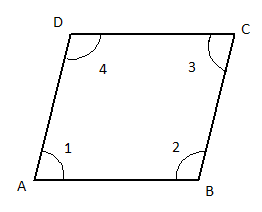
That is, $\angle {\text{A = }}\angle {\text{C}}$ and \[\angle {\text{B = }}\angle {\text{D}}\]
To prove that ${\text{ABCD}}$ is a parallelogram
A parallelogram is a simple (non-self-intersecting) quadrilateral with two pairs of parallel sides. The opposite or facing sides of a parallelogram are of equal length and the opposite angles of a parallelogram are of measure.
Proof:
As we know the sum of angle of Quadrilateral is ${360^\circ}$
$ \Rightarrow \angle {\text{A + }}\angle {\text{B + }}\angle {\text{C + }}\angle {\text{D = 36}}{{\text{0}}^\circ}$
Since $\angle {\text{A = }}\angle {\text{C}}$ and \[\angle {\text{B = }}\angle {\text{D}}\],
Substitute the terms, we get
$ \Rightarrow \angle {\text{A + }}\angle {\text{D + }}\angle {\text{A + }}\angle {\text{D = 36}}{{\text{0}}^\circ}$
Here adding the terms, we have that
$ \Rightarrow 2\angle {\text{A + 2}}\angle {\text{D = 36}}{{\text{0}}^\circ}$
By taking the value common,
\[ \Rightarrow 2(\angle {\text{A + }}\angle {\text{D) = 36}}{{\text{0}}^\circ}\]
By dividing the term, we get
$ \Rightarrow \angle {\text{A + }}\angle {\text{D = 18}}{{\text{0}}^\circ}$(Co-interior angle)
$ \Rightarrow {\text{AB}}$ is parallelogram to ${\text{DC}}$
Similarly, $\angle {\text{A + }}\angle {\text{B + }}\angle {\text{C + }}\angle {\text{D = 36}}{{\text{0}}^\circ}$
Since $\angle {\text{A = }}\angle {\text{C}}$ and \[\angle {\text{B = }}\angle {\text{D}}\],
Substitute the terms, we get
$ \Rightarrow \angle {\text{A + }}\angle {\text{B + }}\angle {\text{A + }}\angle {\text{B = 36}}{{\text{0}}^\circ}$
Adding the terms, we have that
$ \Rightarrow 2\angle {\text{A + 2}}\angle {\text{B = 36}}{{\text{0}}^\circ}$
By taking the value common,
\[ \Rightarrow 2(\angle {\text{A + }}\angle {\text{B) = 36}}{{\text{0}}^\circ}\]
By dividing the term, we get
$ \Rightarrow \angle {\text{A + }}\angle {\text{B = 18}}{{\text{0}}^\circ}$ (Co-interior angle)
$ \Rightarrow {\text{AB}}$ is parallelogram to ${\text{BC}}$
Hence ${\text{AB}}$ parallelogram to ${\text{DC}}$. And ${\text{AB}}$is parallelogram to ${\text{BC}}$
$\therefore $ ${\text{ABCD}}$ is a parallelogram.
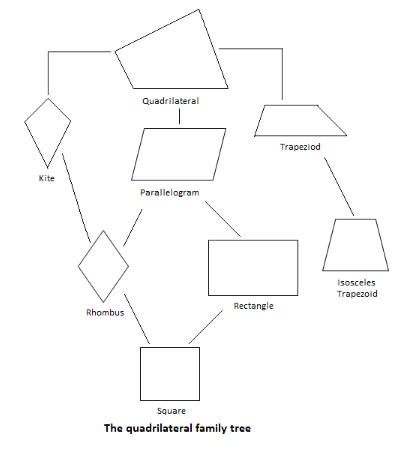
Note: A quadrilateral is a polygon with four sides. There are seven quadrilaterals, some that are surely familiar to you, and some that may not be so familiar. The quadrilateral family tree in the following figure.
Complete step-by-step answer:
Given that ${\text{ABCD}}$ is a quadrilateral whose opposite angles are equal.
That is, $\angle {\text{A = }}\angle {\text{C}}$ and \[\angle {\text{B = }}\angle {\text{D}}\]
To prove that ${\text{ABCD}}$ is a parallelogram
A parallelogram is a simple (non-self-intersecting) quadrilateral with two pairs of parallel sides. The opposite or facing sides of a parallelogram are of equal length and the opposite angles of a parallelogram are of measure.
Proof:
As we know the sum of angle of Quadrilateral is ${360^\circ}$
$ \Rightarrow \angle {\text{A + }}\angle {\text{B + }}\angle {\text{C + }}\angle {\text{D = 36}}{{\text{0}}^\circ}$
Since $\angle {\text{A = }}\angle {\text{C}}$ and \[\angle {\text{B = }}\angle {\text{D}}\],
Substitute the terms, we get
$ \Rightarrow \angle {\text{A + }}\angle {\text{D + }}\angle {\text{A + }}\angle {\text{D = 36}}{{\text{0}}^\circ}$
Here adding the terms, we have that
$ \Rightarrow 2\angle {\text{A + 2}}\angle {\text{D = 36}}{{\text{0}}^\circ}$
By taking the value common,
\[ \Rightarrow 2(\angle {\text{A + }}\angle {\text{D) = 36}}{{\text{0}}^\circ}\]
By dividing the term, we get
$ \Rightarrow \angle {\text{A + }}\angle {\text{D = 18}}{{\text{0}}^\circ}$(Co-interior angle)
$ \Rightarrow {\text{AB}}$ is parallelogram to ${\text{DC}}$
Similarly, $\angle {\text{A + }}\angle {\text{B + }}\angle {\text{C + }}\angle {\text{D = 36}}{{\text{0}}^\circ}$
Since $\angle {\text{A = }}\angle {\text{C}}$ and \[\angle {\text{B = }}\angle {\text{D}}\],
Substitute the terms, we get
$ \Rightarrow \angle {\text{A + }}\angle {\text{B + }}\angle {\text{A + }}\angle {\text{B = 36}}{{\text{0}}^\circ}$
Adding the terms, we have that
$ \Rightarrow 2\angle {\text{A + 2}}\angle {\text{B = 36}}{{\text{0}}^\circ}$
By taking the value common,
\[ \Rightarrow 2(\angle {\text{A + }}\angle {\text{B) = 36}}{{\text{0}}^\circ}\]
By dividing the term, we get
$ \Rightarrow \angle {\text{A + }}\angle {\text{B = 18}}{{\text{0}}^\circ}$ (Co-interior angle)
$ \Rightarrow {\text{AB}}$ is parallelogram to ${\text{BC}}$
Hence ${\text{AB}}$ parallelogram to ${\text{DC}}$. And ${\text{AB}}$is parallelogram to ${\text{BC}}$
$\therefore $ ${\text{ABCD}}$ is a parallelogram.
Note: A quadrilateral is a polygon with four sides. There are seven quadrilaterals, some that are surely familiar to you, and some that may not be so familiar. The quadrilateral family tree in the following figure.
Recently Updated Pages
Which will be the least stable resonating structure class 11 chemistry CBSE

Explain the structure of megasporangium class 12 biology CBSE
Differentiate between voluntary action and reflex class 10 biology CBSE
How many 5 digit telephone numbers can be construc-class-11-maths-CBSE
How do you find the angle of the resultant vector class 11 physics CBSE
Why is chloroform kept in dark coloured bottles class 12 chemistry CBSE
Trending doubts
How many sides does a circle have a 10 sides b 20 sides class 8 maths CBSE
What is BLO What is the full form of BLO class 8 social science CBSE
Citizens of India can vote at the age of A 18 years class 8 social science CBSE
Full form of STD, ISD and PCO
One cusec is equal to how many liters class 8 maths CBSE
10 slogans on organ donation class 8 english CBSE