




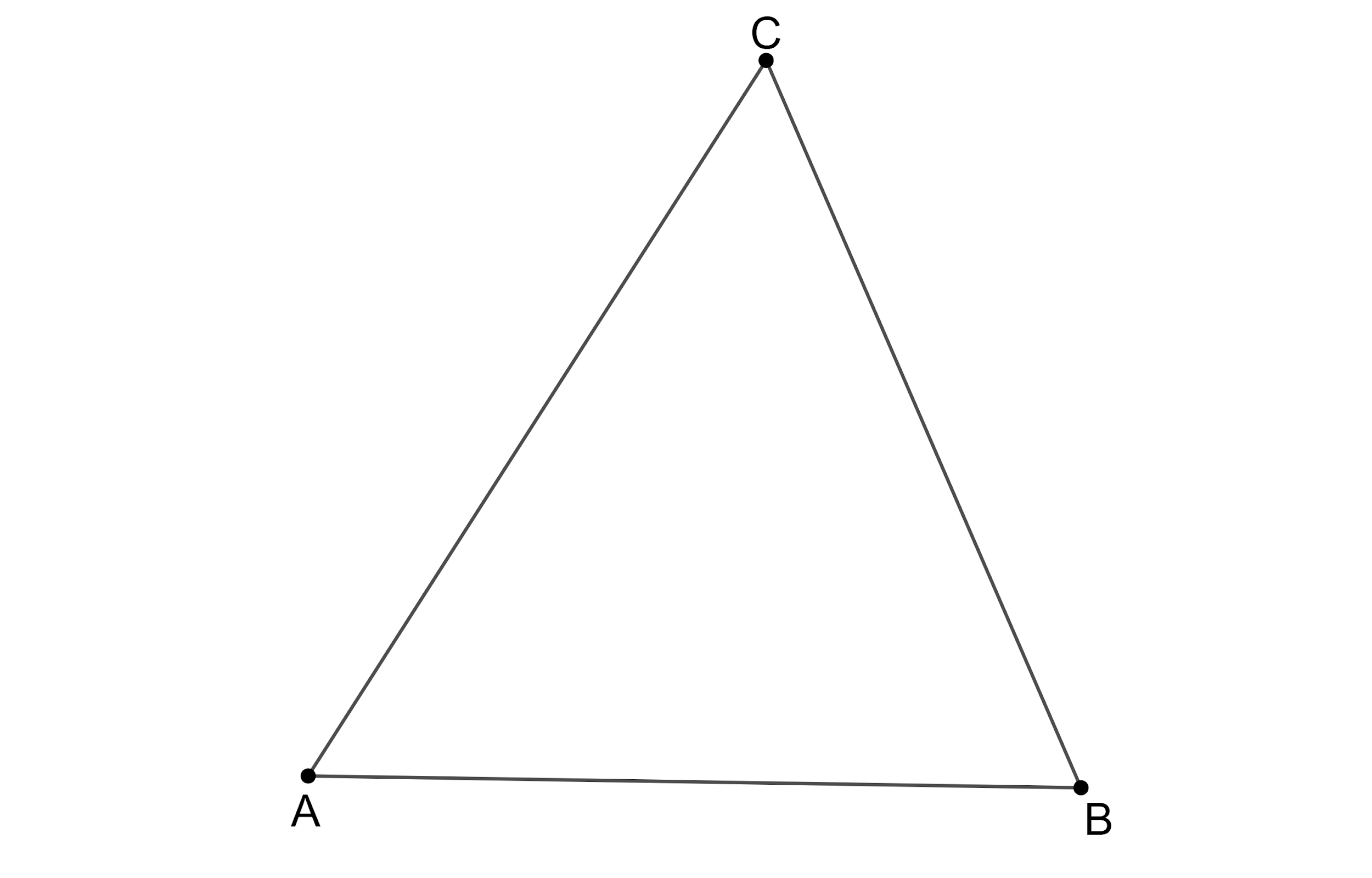
If in a \[\Delta ABC\], $\cos A.\cos B+\sin A.\sin B.\sin C=1$, then the triangle ABC is
(a) Isosceles
(b) Right angled
(c) Equilateral
(d) Right angle isosceles
Answer
 Verified
579k+ views
Hint: We start solving the problem by using the fact that the sine of the angle in any triangle is less than or equal to 1 for the angle C. We use this in the given equation $\cos A.\cos B+\sin A.\sin B.\sin C=1$ and use the fact $\cos \left( A-B \right)=\cos A.\cos B-\sin A.\sin B$ to get the relations between angles A and B. We then substitute this relation in the condition given in the problem to find the angle C, which gives us the required answer.
Complete step by step answer:
According to the question, we have given a triangle ABC satisfying $\cos A.\cos B+\sin A.\sin B.\sin C=1$. We need to check what the given triangle ABC is.
We know that the value of sine of the angle in any triangle is less than or equal to 1.
So, we have $\sin C\le 1$.
Let us multiply both sides with \[\sin A.\sin B\].
So, we get \[\sin A.\sin B.\sin C\le \sin A.\sin B\] ---(1).
Now, let us add both sides of equation (1) with $\cos A.\cos B$.
$\Rightarrow \cos A.\cos B+\sin A.\sin B.\sin C\le \cos A.\cos B+\sin A.\sin B$.
We know that $\cos \left( A-B \right)=\cos A.\cos B+\sin A.\sin B$.
$\Rightarrow \cos A.\cos B+\sin A.\sin B.\sin C\le \cos \left( A-B \right)$ ---(2).
According to the problem, we have $\cos A.\cos B+\sin A.\sin B.\sin C=1$. We substitute this in equation (2).
$\Rightarrow 1\le \cos \left( A-B \right)$.
We know that the range of the cosine function is $\left[ -1,1 \right]$. This tells us that the cosine function cannot be greater than 1.
So, we get $\cos \left( A-B \right)=1$.
$\Rightarrow \cos \left( A-B \right)=\cos {{0}^{\circ }}$.
So, we have got $A-B={{0}^{\circ }}\Leftrightarrow A=B$ ---(3). Let us use this result in $\cos A.\cos B+\sin A.\sin B.\sin C=1$.
So, we get $\cos A.\cos A+\sin A.\sin A.\sin C=1$.
$\Rightarrow {{\cos }^{2}}A+{{\sin }^{2}}A.\sin C=1$.
$\Rightarrow {{\cos }^{2}}A+{{\sin }^{2}}A.\left( 1-1+\sin C \right)=1$.
$\Rightarrow {{\cos }^{2}}A+{{\sin }^{2}}A-{{\sin }^{2}}A+{{\sin }^{2}}A.\sin C=1$.
$\Rightarrow 1-{{\sin }^{2}}A+{{\sin }^{2}}A.\sin C=1$.
$\Rightarrow -{{\sin }^{2}}A+{{\sin }^{2}}A.\sin C=0$.
$\Rightarrow {{\sin }^{2}}A.\sin C={{\sin }^{2}}A$.
$\Rightarrow \sin C=1$.
$\Rightarrow C=\dfrac{\pi }{2}$ ---(4).
We know that the sum of the angles in a triangle is ${{180}^{\circ }}$. So, we get $A+B+C={{180}^{\circ }}$.
From equations (3) and (4), we get $A+A+{{90}^{\circ }}={{180}^{\circ }}$.
$\Rightarrow 2A={{90}^{\circ }}$.
$\Rightarrow A={{45}^{\circ }}=B$ ---(5).
So, we have found the angles in triangle ABC as $A=B={{45}^{\circ }}$ and $C={{90}^{\circ }}$, which tells us that the triangle is right angle isosceles.
∴ The given triangle ABC is the right angle isosceles.
So, the correct answer is “Option d”.
Note: We can also solve this problem by substituting the angles $A=B=C={{60}^{\circ }}$ in order to check whether the given triangle is equilateral. We can substitute $C={{90}^{\circ }}$ by assuming the triangle is right angled at vertex C and check the properties of other properties. We can use the facts that $\cos A\cos B=\cos \left( A+B \right)+\cos \left( A-B \right)$, $-\sin A\sin B=\cos \left( A+B \right)-\cos \left( A-B \right)$ and $A+B={{180}^{\circ }}-C$ to solve the problem alternatively.
Complete step by step answer:
According to the question, we have given a triangle ABC satisfying $\cos A.\cos B+\sin A.\sin B.\sin C=1$. We need to check what the given triangle ABC is.
We know that the value of sine of the angle in any triangle is less than or equal to 1.
So, we have $\sin C\le 1$.
Let us multiply both sides with \[\sin A.\sin B\].
So, we get \[\sin A.\sin B.\sin C\le \sin A.\sin B\] ---(1).
Now, let us add both sides of equation (1) with $\cos A.\cos B$.
$\Rightarrow \cos A.\cos B+\sin A.\sin B.\sin C\le \cos A.\cos B+\sin A.\sin B$.
We know that $\cos \left( A-B \right)=\cos A.\cos B+\sin A.\sin B$.
$\Rightarrow \cos A.\cos B+\sin A.\sin B.\sin C\le \cos \left( A-B \right)$ ---(2).
According to the problem, we have $\cos A.\cos B+\sin A.\sin B.\sin C=1$. We substitute this in equation (2).
$\Rightarrow 1\le \cos \left( A-B \right)$.
We know that the range of the cosine function is $\left[ -1,1 \right]$. This tells us that the cosine function cannot be greater than 1.
So, we get $\cos \left( A-B \right)=1$.
$\Rightarrow \cos \left( A-B \right)=\cos {{0}^{\circ }}$.
So, we have got $A-B={{0}^{\circ }}\Leftrightarrow A=B$ ---(3). Let us use this result in $\cos A.\cos B+\sin A.\sin B.\sin C=1$.
So, we get $\cos A.\cos A+\sin A.\sin A.\sin C=1$.
$\Rightarrow {{\cos }^{2}}A+{{\sin }^{2}}A.\sin C=1$.
$\Rightarrow {{\cos }^{2}}A+{{\sin }^{2}}A.\left( 1-1+\sin C \right)=1$.
$\Rightarrow {{\cos }^{2}}A+{{\sin }^{2}}A-{{\sin }^{2}}A+{{\sin }^{2}}A.\sin C=1$.
$\Rightarrow 1-{{\sin }^{2}}A+{{\sin }^{2}}A.\sin C=1$.
$\Rightarrow -{{\sin }^{2}}A+{{\sin }^{2}}A.\sin C=0$.
$\Rightarrow {{\sin }^{2}}A.\sin C={{\sin }^{2}}A$.
$\Rightarrow \sin C=1$.
$\Rightarrow C=\dfrac{\pi }{2}$ ---(4).
We know that the sum of the angles in a triangle is ${{180}^{\circ }}$. So, we get $A+B+C={{180}^{\circ }}$.
From equations (3) and (4), we get $A+A+{{90}^{\circ }}={{180}^{\circ }}$.
$\Rightarrow 2A={{90}^{\circ }}$.
$\Rightarrow A={{45}^{\circ }}=B$ ---(5).
So, we have found the angles in triangle ABC as $A=B={{45}^{\circ }}$ and $C={{90}^{\circ }}$, which tells us that the triangle is right angle isosceles.
∴ The given triangle ABC is the right angle isosceles.
So, the correct answer is “Option d”.
Note: We can also solve this problem by substituting the angles $A=B=C={{60}^{\circ }}$ in order to check whether the given triangle is equilateral. We can substitute $C={{90}^{\circ }}$ by assuming the triangle is right angled at vertex C and check the properties of other properties. We can use the facts that $\cos A\cos B=\cos \left( A+B \right)+\cos \left( A-B \right)$, $-\sin A\sin B=\cos \left( A+B \right)-\cos \left( A-B \right)$ and $A+B={{180}^{\circ }}-C$ to solve the problem alternatively.
Recently Updated Pages
Master Class 11 Computer Science: Engaging Questions & Answers for Success

Master Class 11 Business Studies: Engaging Questions & Answers for Success
Master Class 11 Economics: Engaging Questions & Answers for Success
Master Class 11 English: Engaging Questions & Answers for Success
Master Class 11 Maths: Engaging Questions & Answers for Success
Master Class 11 Biology: Engaging Questions & Answers for Success
Trending doubts
One Metric ton is equal to kg A 10000 B 1000 C 100 class 11 physics CBSE
There are 720 permutations of the digits 1 2 3 4 5 class 11 maths CBSE
Discuss the various forms of bacteria class 11 biology CBSE
Draw a diagram of a plant cell and label at least eight class 11 biology CBSE
State the laws of reflection of light
Explain zero factorial class 11 maths CBSE