




If $f(x) = x + \dfrac{1}{x}$ , $x > 0$ then its greatest value is
A) -2
B) 0
C) 2
D) None of these
Answer
 Verified
577.2k+ views
Hint: To find the answer of the question, You have to differentiate a given function with equal to zero. Then find the value of $x$ from the first differentiation. Then do a second differentiation and put a value of $x$ In it and check whether the coming answer is negative or positive. If it’s negative then put that value of $x$ in our main function and you will find the answer.
Complete step by step answer:
Let’s write given function once again,
$ \Rightarrow f(x) = x + \dfrac{1}{x}$
Now, differentiate our function with equal to zero to find the value for $x$ and we will get,
$ \Rightarrow f'(x) = 0$
$ \Rightarrow f'(x) = 1 - \dfrac{1}{{{x^2}}} = 0$
From further simplification we will get,
$ \Rightarrow {x^2} = 1$
Find the value for $x$ and we will get,
$ \Rightarrow x = \pm 1$
But, it’s given that $x > 0$ so just consider positive value of $x$ ,
So, value for $x$ is
$ \Rightarrow x = 1$
Now, do second differentiation,
$ \Rightarrow f''(x) = \dfrac{2}{{{x^3}}}$
Now, put value for $x$ that we find from first differentiation,
$ \Rightarrow f''(1) = \dfrac{2}{{{1^3}}}$
From further simplification we will get,
$ \Rightarrow f''(1) = 2$
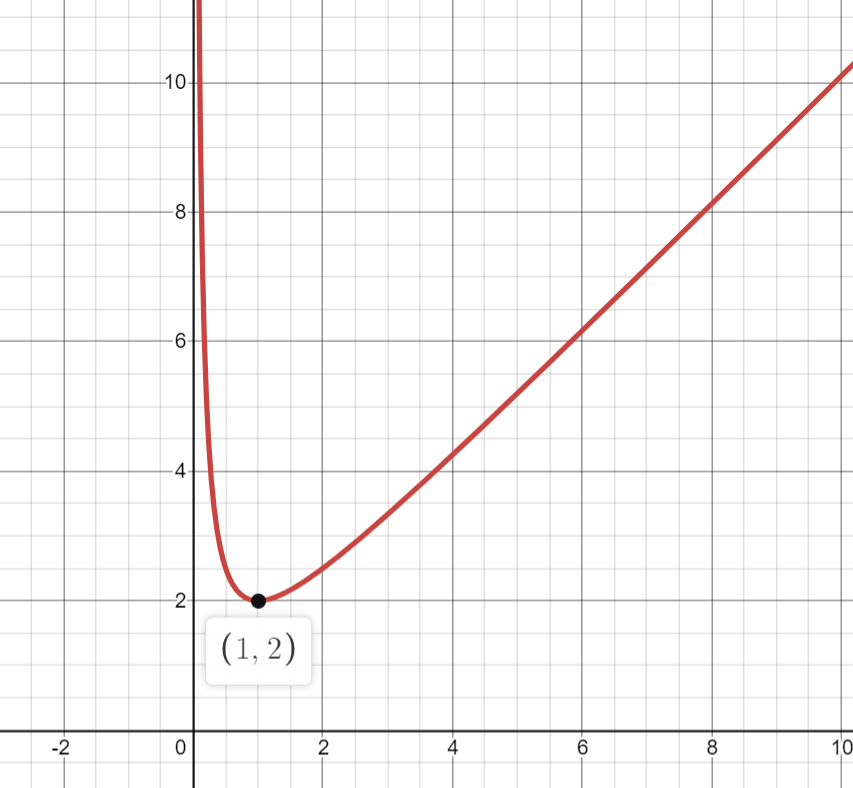
See our second differentiation is positive in value so $x$ is minimum at $x=1$
So, it’s clear that we could not find the maximum value for a given equation with condition $x > 0$.
We can see the graph of the given function here for better understanding of the scenario:
So, the correct answer for this problem is option (D) None of these.
Note:
In this problem we have to find our maximum value, but what if they ask for the minimum value? so there is nothing new for that. You just have to do a second differentiation and check whether the coming value is positive or negative. If value is positive then at that value for $x$ function have minimum value else if value is negative then at That value for $x$ function have greatest value.
Complete step by step answer:
Let’s write given function once again,
$ \Rightarrow f(x) = x + \dfrac{1}{x}$
Now, differentiate our function with equal to zero to find the value for $x$ and we will get,
$ \Rightarrow f'(x) = 0$
$ \Rightarrow f'(x) = 1 - \dfrac{1}{{{x^2}}} = 0$
From further simplification we will get,
$ \Rightarrow {x^2} = 1$
Find the value for $x$ and we will get,
$ \Rightarrow x = \pm 1$
But, it’s given that $x > 0$ so just consider positive value of $x$ ,
So, value for $x$ is
$ \Rightarrow x = 1$
Now, do second differentiation,
$ \Rightarrow f''(x) = \dfrac{2}{{{x^3}}}$
Now, put value for $x$ that we find from first differentiation,
$ \Rightarrow f''(1) = \dfrac{2}{{{1^3}}}$
From further simplification we will get,
$ \Rightarrow f''(1) = 2$
See our second differentiation is positive in value so $x$ is minimum at $x=1$
So, it’s clear that we could not find the maximum value for a given equation with condition $x > 0$.
We can see the graph of the given function here for better understanding of the scenario:
So, the correct answer for this problem is option (D) None of these.
Note:
In this problem we have to find our maximum value, but what if they ask for the minimum value? so there is nothing new for that. You just have to do a second differentiation and check whether the coming value is positive or negative. If value is positive then at that value for $x$ function have minimum value else if value is negative then at That value for $x$ function have greatest value.
Recently Updated Pages
If x a + bt + ct2 where x is in meters and t is in class 11 physics CBSE

A car covers the first half distance between two places class 11 physics CBSE
The resultant of two vectors overrightarrow P and overrightarrow class 11 physics CBSE
Find the value of cos 135 class 11 maths CBSE
A mass M is held in place by an applied force F and class 11 physics CBSE
A solution of glucose in water is labelled as 10 dfracwv class 11 chemistry CBSE
Trending doubts
Find the value of the expression given below sin 30circ class 11 maths CBSE
One Metric ton is equal to kg A 10000 B 1000 C 100 class 11 physics CBSE
Draw a diagram of nephron and explain its structur class 11 biology CBSE
10 examples of friction in our daily life
Proton was discovered by A Thomson B Rutherford C Chadwick class 11 chemistry CBSE
Bond order ofO2 O2+ O2 and O22 is in order A O2 langle class 11 chemistry CBSE