




If $f(x) = {2^{{{\sin }^3}\pi x + x - \left[ x \right]}}$ where $\left[ x \right]$ denotes the integral part of $x$ is a periodic function with the period.
Answer
 Verified
581.1k+ views
Hint:
Hint: For $f(x)$ to be periodic function so we know that a function f is periodic with period T if $f(x + T) = f(x)$ where $T$ is the period. We’ll also use the property of the greatest integer function that is $x - [x] = \{ x\} $ and its period is 1.
Complete step by step solution:
Here we are given the function which is defined as $f(x) = {2^{{{\sin }^3}\pi x + x - \left[ x \right]}}$ where $\left[ x \right]$ denotes the integral part. We need to find the period of this function. Given that the function is periodic now we need to know what the periodic function means. So periodic function is the function which repeats its value after the regular interval. For example any trigonometric function repeats its value after the interval $2\pi $. Periodic function can be easily determined by using the graph. So for the periodic function it must follow that $f(x + T) = f(x)$ where $T$ represents the period. Now if we are given the function
$f(x) = {2^{{{\sin }^3}\pi x + x - \left[ x \right]}}$
We need to find the period of the function ${\sin ^3}\pi x$ and $x - [x]$
So let us suppose that $g(x) = x - [x]$
Now if we take $g(x + T) = x + T - [x + T]$
Now we know that $x - [x] = \{ x\} $
Here $\{ x\} $ is the fractional part of $x$ whose graph is given by
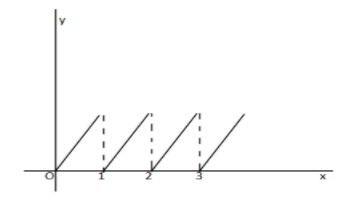
So as we see the graph is similar in $[0,1),[1,2),...{\text{and so on}}$
Hence we can say that $g(x + 1) = g(x)$
Therefore the period of $x - [x] = \{ x\} $ is $1$
For ${\sin ^3}\pi x$ if we replace $x \to x + 2$
Then we can write as ${\sin ^3}\pi (x + 2)$
Which is ${(\sin (2\pi + \pi x))^3}$
And we know that $\sin (2\pi + \theta ) = \sin \theta $
If we take $h(x) = {\sin ^3}\pi x$
$h(x + 2) = {\sin ^3}(2\pi + \pi x)$
$ = {\sin ^3}\pi x$
$\Rightarrow h(x + 2) = h(x)$
Therefore its period is $2$
Now for finding the period of ${\sin ^3}\pi x + x - [x]$
We need to take the LCM of $1,2$ which is $2$
And as we have the function $f(x) = {2^{{{\sin }^3}\pi x + x - \left[ x \right]}}$
${\sin ^3}\pi x + x - [x]$ has the period $2$
So $f(x)$ has the period $2$
As we can find $f(x + 2)$
$
f(x + 2) = {2^{{{\sin }^3}\pi (x + 2) + x + 2 - \left[ {x + 2} \right]}} \\
\Rightarrow f(x + 2) = {2^{{{\sin }^3}(2\pi + \pi x) + x + 2 - [x] - 2}} \\
$
$\Rightarrow f(x + 2) = {2^{{{\sin }^3}\pi x + x - \left[ x \right]}}$$ = f(x)$
So, the period of $f(x)$ is $2$.
Note:
If $f(x)$ is periodic with the period $T$ then we can write that $f(x + nT) = f(x)$
We can also write that $f(x + 2T) = f(x + T) = f(x)$ and so on
All the trigonometric function have the period $2\pi $
For example for $\sin x$
$f(x + 2\pi ) = \sin (x + 2\pi ) = \sin x = f(x)$
So $2\pi $ is the period.
Hint: For $f(x)$ to be periodic function so we know that a function f is periodic with period T if $f(x + T) = f(x)$ where $T$ is the period. We’ll also use the property of the greatest integer function that is $x - [x] = \{ x\} $ and its period is 1.
Complete step by step solution:
Here we are given the function which is defined as $f(x) = {2^{{{\sin }^3}\pi x + x - \left[ x \right]}}$ where $\left[ x \right]$ denotes the integral part. We need to find the period of this function. Given that the function is periodic now we need to know what the periodic function means. So periodic function is the function which repeats its value after the regular interval. For example any trigonometric function repeats its value after the interval $2\pi $. Periodic function can be easily determined by using the graph. So for the periodic function it must follow that $f(x + T) = f(x)$ where $T$ represents the period. Now if we are given the function
$f(x) = {2^{{{\sin }^3}\pi x + x - \left[ x \right]}}$
We need to find the period of the function ${\sin ^3}\pi x$ and $x - [x]$
So let us suppose that $g(x) = x - [x]$
Now if we take $g(x + T) = x + T - [x + T]$
Now we know that $x - [x] = \{ x\} $
Here $\{ x\} $ is the fractional part of $x$ whose graph is given by
So as we see the graph is similar in $[0,1),[1,2),...{\text{and so on}}$
Hence we can say that $g(x + 1) = g(x)$
Therefore the period of $x - [x] = \{ x\} $ is $1$
For ${\sin ^3}\pi x$ if we replace $x \to x + 2$
Then we can write as ${\sin ^3}\pi (x + 2)$
Which is ${(\sin (2\pi + \pi x))^3}$
And we know that $\sin (2\pi + \theta ) = \sin \theta $
If we take $h(x) = {\sin ^3}\pi x$
$h(x + 2) = {\sin ^3}(2\pi + \pi x)$
$ = {\sin ^3}\pi x$
$\Rightarrow h(x + 2) = h(x)$
Therefore its period is $2$
Now for finding the period of ${\sin ^3}\pi x + x - [x]$
We need to take the LCM of $1,2$ which is $2$
And as we have the function $f(x) = {2^{{{\sin }^3}\pi x + x - \left[ x \right]}}$
${\sin ^3}\pi x + x - [x]$ has the period $2$
So $f(x)$ has the period $2$
As we can find $f(x + 2)$
$
f(x + 2) = {2^{{{\sin }^3}\pi (x + 2) + x + 2 - \left[ {x + 2} \right]}} \\
\Rightarrow f(x + 2) = {2^{{{\sin }^3}(2\pi + \pi x) + x + 2 - [x] - 2}} \\
$
$\Rightarrow f(x + 2) = {2^{{{\sin }^3}\pi x + x - \left[ x \right]}}$$ = f(x)$
So, the period of $f(x)$ is $2$.
Note:
If $f(x)$ is periodic with the period $T$ then we can write that $f(x + nT) = f(x)$
We can also write that $f(x + 2T) = f(x + T) = f(x)$ and so on
All the trigonometric function have the period $2\pi $
For example for $\sin x$
$f(x + 2\pi ) = \sin (x + 2\pi ) = \sin x = f(x)$
So $2\pi $ is the period.
Recently Updated Pages
Master Class 11 English: Engaging Questions & Answers for Success

Master Class 11 Maths: Engaging Questions & Answers for Success
Master Class 11 Biology: Engaging Questions & Answers for Success
Master Class 11 Social Science: Engaging Questions & Answers for Success
Master Class 11 Physics: Engaging Questions & Answers for Success
Master Class 11 Accountancy: Engaging Questions & Answers for Success
Trending doubts
One Metric ton is equal to kg A 10000 B 1000 C 100 class 11 physics CBSE
Discuss the various forms of bacteria class 11 biology CBSE
Draw a diagram of a plant cell and label at least eight class 11 biology CBSE
State the laws of reflection of light
Explain zero factorial class 11 maths CBSE
10 examples of friction in our daily life