




If from any point $P,$ tangents $PT,P{T}'$ are drawn to two given circles with centers $A$ and $B$ respectively; and if $PN$ is the perpendicular from $P$ on their radical axis, then $P{{T}^{2}}-P{{{T}'}^{2}}=$
$\left( a \right) 2.PN.AB$
$\left( b \right) 4.PN.AB$
$\left( c \right) PN.AB$
$\left( d \right)$ None of these
Answer
 Verified
528.9k+ views
Hint: We will write the equations of the given two circles. Then we will find the line joining the centers of the two circles. Then, we will find the equation of the tangents. Then, we will find the equation of the radical axis. With this information, we can find the difference of the squares of the tangents.
Complete step-by-step answer:
Let us draw the diagram as follows:
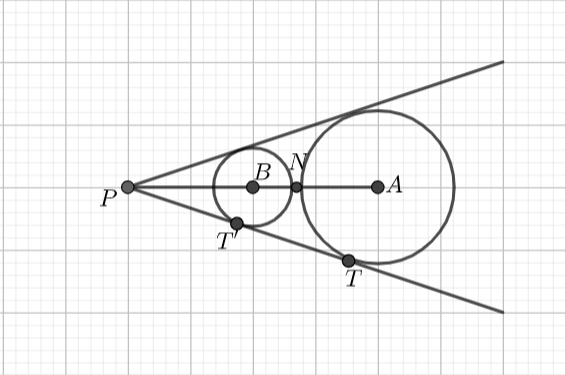
We need to write the equations of the two circles.
Let the equation of the first circle be ${{x}^{2}}+{{y}^{2}}+2{{g}_{1}}x+c=0.......\left( 1 \right)$
And let the equation of the second circle be ${{x}^{2}}+{{y}^{2}}+2{{g}_{2}}x+c=0.......\left( 2 \right)$
Then, we can say that the centers of the first and second circles are given by $A\left( -{{g}_{1}},0 \right)$ and $B\left( -{{g}_{2}},0 \right)$ respectively.
So, we will get $AB={{g}_{1}}-{{g}_{2}}.$
Now, let us suppose that the point $P$ is given by the coordinates $\left( {{x}_{1}},{{y}_{1}} \right).$
Then, we know that the tangent $PT$ is given by $PT=\sqrt{{{x}_{1}}^{2}+{{y}_{1}}^{2}+2{{g}_{1}}{{x}_{1}}+c}.$
Similarly, we can write the tangent $P{T}'$ as $P{T}'=\sqrt{{{x}_{1}}^{2}+{{y}_{1}}^{2}+2{{g}_{2}}{{x}_{1}}+c}.$
Now, we can find the radical axis of the given two circles by finding the difference of the equation $\left( 1 \right)$ and equation $\left( 2 \right).$
Therefore, the radical axis of the circles is given by $2\left( {{g}_{1}}-{{g}_{2}} \right)x=0$ or $x=0.$
We know that $PN$ is the length of the perpendicular from $P$ on the radical axis ${{x}_{1}}.$
Now, we will get $P{{T}^{2}}-P{{{T}'}^{2}}={{x}_{1}}^{2}+{{y}_{1}}^{2}+2{{g}_{1}}{{x}_{1}}+c-\left( {{x}_{1}}^{2}+{{y}_{1}}^{2}+2{{g}_{2}}{{x}_{1}}+c \right).$
We can write it as $P{{T}^{2}}-P{{{T}'}^{2}}={{x}_{1}}^{2}+{{y}_{1}}^{2}+2{{g}_{1}}{{x}_{1}}+c-{{x}_{1}}^{2}-{{y}_{1}}^{2}-2{{g}_{2}}{{x}_{1}}-c.$
After cancelling the similar terms with opposite signs, we will get $P{{T}^{2}}-P{{{T}'}^{2}}=2{{g}_{1}}{{x}_{1}}-2{{g}_{2}}{{x}_{1}}.$
From this, we will get $P{{T}^{2}}-P{{{T}'}^{2}}=2{{x}_{1}}\left( {{g}_{1}}-{{g}_{2}} \right).$
So, we get \[P{{T}^{2}}-P{{{T}'}^{2}}=2.PN.AB.\] \[\]
Hence the answer is $2.PN.AB.$
Note: We know that the standard equation of a circle of radius $r$ and centered at a point $\left( h,k \right)$ is given by ${{\left( x-h \right)}^{2}}+{{\left( y-k \right)}^{2}}={{r}^{2}}.$ The general equation of any type of circle is given by ${{x}^{2}}+{{y}^{2}}+2gx+2fy+c=0,$ for all values of $g,f$ and $c.$ If we add ${{g}^{2}}+{{f}^{2}}$ on both sides of the general equation and transposing $c$ from the LHS to the RHS will give the standard equation of a circle centered at $\left( g,f \right)$ with a radius of $a$ where ${{g}^{2}}+{{f}^{2}}-c={{a}^{2}}.$
Complete step-by-step answer:
Let us draw the diagram as follows:
We need to write the equations of the two circles.
Let the equation of the first circle be ${{x}^{2}}+{{y}^{2}}+2{{g}_{1}}x+c=0.......\left( 1 \right)$
And let the equation of the second circle be ${{x}^{2}}+{{y}^{2}}+2{{g}_{2}}x+c=0.......\left( 2 \right)$
Then, we can say that the centers of the first and second circles are given by $A\left( -{{g}_{1}},0 \right)$ and $B\left( -{{g}_{2}},0 \right)$ respectively.
So, we will get $AB={{g}_{1}}-{{g}_{2}}.$
Now, let us suppose that the point $P$ is given by the coordinates $\left( {{x}_{1}},{{y}_{1}} \right).$
Then, we know that the tangent $PT$ is given by $PT=\sqrt{{{x}_{1}}^{2}+{{y}_{1}}^{2}+2{{g}_{1}}{{x}_{1}}+c}.$
Similarly, we can write the tangent $P{T}'$ as $P{T}'=\sqrt{{{x}_{1}}^{2}+{{y}_{1}}^{2}+2{{g}_{2}}{{x}_{1}}+c}.$
Now, we can find the radical axis of the given two circles by finding the difference of the equation $\left( 1 \right)$ and equation $\left( 2 \right).$
Therefore, the radical axis of the circles is given by $2\left( {{g}_{1}}-{{g}_{2}} \right)x=0$ or $x=0.$
We know that $PN$ is the length of the perpendicular from $P$ on the radical axis ${{x}_{1}}.$
Now, we will get $P{{T}^{2}}-P{{{T}'}^{2}}={{x}_{1}}^{2}+{{y}_{1}}^{2}+2{{g}_{1}}{{x}_{1}}+c-\left( {{x}_{1}}^{2}+{{y}_{1}}^{2}+2{{g}_{2}}{{x}_{1}}+c \right).$
We can write it as $P{{T}^{2}}-P{{{T}'}^{2}}={{x}_{1}}^{2}+{{y}_{1}}^{2}+2{{g}_{1}}{{x}_{1}}+c-{{x}_{1}}^{2}-{{y}_{1}}^{2}-2{{g}_{2}}{{x}_{1}}-c.$
After cancelling the similar terms with opposite signs, we will get $P{{T}^{2}}-P{{{T}'}^{2}}=2{{g}_{1}}{{x}_{1}}-2{{g}_{2}}{{x}_{1}}.$
From this, we will get $P{{T}^{2}}-P{{{T}'}^{2}}=2{{x}_{1}}\left( {{g}_{1}}-{{g}_{2}} \right).$
So, we get \[P{{T}^{2}}-P{{{T}'}^{2}}=2.PN.AB.\] \[\]
Hence the answer is $2.PN.AB.$
Note: We know that the standard equation of a circle of radius $r$ and centered at a point $\left( h,k \right)$ is given by ${{\left( x-h \right)}^{2}}+{{\left( y-k \right)}^{2}}={{r}^{2}}.$ The general equation of any type of circle is given by ${{x}^{2}}+{{y}^{2}}+2gx+2fy+c=0,$ for all values of $g,f$ and $c.$ If we add ${{g}^{2}}+{{f}^{2}}$ on both sides of the general equation and transposing $c$ from the LHS to the RHS will give the standard equation of a circle centered at $\left( g,f \right)$ with a radius of $a$ where ${{g}^{2}}+{{f}^{2}}-c={{a}^{2}}.$
Recently Updated Pages
Master Class 11 Computer Science: Engaging Questions & Answers for Success

Master Class 11 Business Studies: Engaging Questions & Answers for Success
Master Class 11 Economics: Engaging Questions & Answers for Success
Master Class 11 English: Engaging Questions & Answers for Success
Master Class 11 Maths: Engaging Questions & Answers for Success
Master Class 11 Biology: Engaging Questions & Answers for Success
Trending doubts
One Metric ton is equal to kg A 10000 B 1000 C 100 class 11 physics CBSE
There are 720 permutations of the digits 1 2 3 4 5 class 11 maths CBSE
Discuss the various forms of bacteria class 11 biology CBSE
Draw a diagram of a plant cell and label at least eight class 11 biology CBSE
State the laws of reflection of light
Explain zero factorial class 11 maths CBSE