




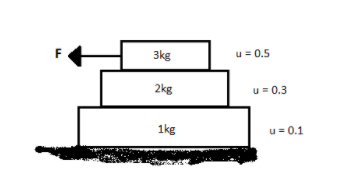
If force F is increasing with time and t=0, F=0, where sliding will start first?
A. between 3Kg and 2Kg
B. between 2Kg and 1Kg
C. between 1Kg and ground
D. both A. and B.
Answer
 Verified
584.4k+ views
Hint: For the initiation of sliding of one surface on another the applied force has to overcome the static friction between the two surfaces. Static friction is defined as the frictional force between two or more surfaces which are static (or not moving).
Formula Used:
${{f}_{s}}=\mu N$
Complete step-by-step answer:
To bring an object from rest into motion a force has to be applied greater than the static frictional force between the two or more surfaces. Static friction is a force between two surfaces when they are in a rest position. Mathematically it is given by:
${{f}_{s}}=\mu N$
Where $\mu $ is the frictional coefficient of the two materials. It depends on the nature of the two surfaces which are in contact and not on the surrounding.
In static friction as the object is at rest, therefore N is the product of mass and acceleration due to gravity acting on the body.
Once an external force equal to or greater than the static friction is applied the surfaces start to slide (move) from their original position.
In consideration of the given question, it is asked which block will start to move first. So the surfaces with the least static friction will start to slide first as it will be easy for externally applied to achieve it first.
For simple calculation consider acceleration due to gravity (g) = 10
So,
Static friction between surface 3 and 2 (3kg and 2kg block) is given as:
$\begin{align}
& {{f}_{32}}={{\mu }_{32}}N \\
& {{f}_{32}}=0.5\times \left( 3 \right)10 \\
& {{f}_{32}}=15N \\
\end{align}$
Static friction between block of 2kg and 1kg:
$\begin{align}
& {{f}_{21}}={{\mu }_{21}}N \\
& {{f}_{21}}=0.3\times (3+2)10 \\
& {{f}_{21}}=15N \\
\end{align}$
Static friction between block of 1kg and ground:
$\begin{align}
& {{f}_{1G}}=0.1\times \left( 1+2+3 \right)10 \\
& {{f}_{1G}}=6N \\
\end{align}$
Thus, from the given explanation and the values of${{f}_{32\ }}$, ${{f}_{21}}$ and ${{f}_{1G}}$ we can conclude that the sliding will first initiate between 1kg block and ground. So the option which satisfies this conclusion is Option C
Note: When the surfaces are at rest they are in influence of the static friction once an applied external force crosses the static friction the body starts to move. When a surface starts to move a kinetic friction acts on the surface which is less than the static friction. It is easy to keep a moving body in motion.
Formula Used:
${{f}_{s}}=\mu N$
Complete step-by-step answer:
To bring an object from rest into motion a force has to be applied greater than the static frictional force between the two or more surfaces. Static friction is a force between two surfaces when they are in a rest position. Mathematically it is given by:
${{f}_{s}}=\mu N$
Where $\mu $ is the frictional coefficient of the two materials. It depends on the nature of the two surfaces which are in contact and not on the surrounding.
In static friction as the object is at rest, therefore N is the product of mass and acceleration due to gravity acting on the body.
Once an external force equal to or greater than the static friction is applied the surfaces start to slide (move) from their original position.
In consideration of the given question, it is asked which block will start to move first. So the surfaces with the least static friction will start to slide first as it will be easy for externally applied to achieve it first.
For simple calculation consider acceleration due to gravity (g) = 10
So,
Static friction between surface 3 and 2 (3kg and 2kg block) is given as:
$\begin{align}
& {{f}_{32}}={{\mu }_{32}}N \\
& {{f}_{32}}=0.5\times \left( 3 \right)10 \\
& {{f}_{32}}=15N \\
\end{align}$
Static friction between block of 2kg and 1kg:
$\begin{align}
& {{f}_{21}}={{\mu }_{21}}N \\
& {{f}_{21}}=0.3\times (3+2)10 \\
& {{f}_{21}}=15N \\
\end{align}$
Static friction between block of 1kg and ground:
$\begin{align}
& {{f}_{1G}}=0.1\times \left( 1+2+3 \right)10 \\
& {{f}_{1G}}=6N \\
\end{align}$
Thus, from the given explanation and the values of${{f}_{32\ }}$, ${{f}_{21}}$ and ${{f}_{1G}}$ we can conclude that the sliding will first initiate between 1kg block and ground. So the option which satisfies this conclusion is Option C
Note: When the surfaces are at rest they are in influence of the static friction once an applied external force crosses the static friction the body starts to move. When a surface starts to move a kinetic friction acts on the surface which is less than the static friction. It is easy to keep a moving body in motion.
Recently Updated Pages
Master Class 11 Computer Science: Engaging Questions & Answers for Success

Master Class 11 Business Studies: Engaging Questions & Answers for Success
Master Class 11 Economics: Engaging Questions & Answers for Success
Master Class 11 English: Engaging Questions & Answers for Success
Master Class 11 Maths: Engaging Questions & Answers for Success
Master Class 11 Biology: Engaging Questions & Answers for Success
Trending doubts
One Metric ton is equal to kg A 10000 B 1000 C 100 class 11 physics CBSE
There are 720 permutations of the digits 1 2 3 4 5 class 11 maths CBSE
Discuss the various forms of bacteria class 11 biology CBSE
Draw a diagram of a plant cell and label at least eight class 11 biology CBSE
State the laws of reflection of light
Explain zero factorial class 11 maths CBSE