




If for the following C-E circuit, $\beta = 100$, ${V_{CE}} = 7V$, \[{V_{BE}}\] is negligible and ${R_C} = 2k\Omega $, then ${i_B}$=?
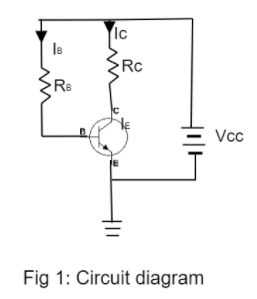
(a) 0.04 mA
(b) 0.03 mA
(c) 0.02 mA
(d) 0.01 mA
Answer
 Verified
639.9k+ views
Hint: The configuration in which the emitter is connected between collector and base is called a C-E (common emitter) configuration. In such a circuit, input is provided between emitter and base whereas the output is taken between emitter and collector. Apply Kirchhoff’s law separately in the arms of the circuit to get relation in current and voltage of that arm or node.
Formula Used:
Ohm's law:
$I = \dfrac{V}{R}$
where,
I is current
V is voltage
R is resistance.
Kirchhoff’s Law:
Total current entering the node is the same as total current exiting through any node ( true for randomly chosen any node).
Current gain through the circuit:
$\beta = \dfrac{{{i_C}}}{{{i_B}}}$ …… (1)
Complete step by step answer:
Given:
1. Current gain $\beta = 100$
2. Voltage ${V_{CE}} = 7V$
3. ${R_C} = 2k\Omega $
To find: Find the current ${i_B}$.
Step 1 of 2:
Apply Kirchhoff’s voltage law to the right-hand arm of the circuit. This gives:
$V = {V_{CE}} + {I_C}{R_C}$
$
15 = 7 + {i_C} \times (2 \times {10^3}) \\
{i_C} = \dfrac{8}{{2 \times {{10}^3}}} \\
{i_C} = 4mA \\
$
Step 2 of 2:
Use eq (1) to find the current gain ${\beta _{AC}}$:
$100 = \dfrac{{4mA}}{{{i_B}}}$ …… (2)
Find ${i_B}$ from eq (2):
$
{i_B} = \dfrac{{4mA}}{{100}} \\
{i_B} = 0.04mA \\
$
Final Answer: In the given circuit, base current ${i_B}$ is (a) 0.04 mA.
Additional Information: In common emitter amplifier circuits, we get large voltage gain and power gain whereas current gain is moderate. This ability of CE transistors is harnessed in developing advanced BJT where we get stable and steady voltage supply, even though there is varying current gain i.e. in the circuit by keeping base biased by DC voltage. Different combinations of these BJT used for making logic gates circuits for computations.
Note: In questions like these, apply Kirchhoff’s voltage law separately for both the arms. Use expression for current gain to find the value of current.
Formula Used:
Ohm's law:
$I = \dfrac{V}{R}$
where,
I is current
V is voltage
R is resistance.
Kirchhoff’s Law:
Total current entering the node is the same as total current exiting through any node ( true for randomly chosen any node).
Current gain through the circuit:
$\beta = \dfrac{{{i_C}}}{{{i_B}}}$ …… (1)
Complete step by step answer:
Given:
1. Current gain $\beta = 100$
2. Voltage ${V_{CE}} = 7V$
3. ${R_C} = 2k\Omega $
To find: Find the current ${i_B}$.
Step 1 of 2:
Apply Kirchhoff’s voltage law to the right-hand arm of the circuit. This gives:
$V = {V_{CE}} + {I_C}{R_C}$
$
15 = 7 + {i_C} \times (2 \times {10^3}) \\
{i_C} = \dfrac{8}{{2 \times {{10}^3}}} \\
{i_C} = 4mA \\
$
Step 2 of 2:
Use eq (1) to find the current gain ${\beta _{AC}}$:
$100 = \dfrac{{4mA}}{{{i_B}}}$ …… (2)
Find ${i_B}$ from eq (2):
$
{i_B} = \dfrac{{4mA}}{{100}} \\
{i_B} = 0.04mA \\
$
Final Answer: In the given circuit, base current ${i_B}$ is (a) 0.04 mA.
Additional Information: In common emitter amplifier circuits, we get large voltage gain and power gain whereas current gain is moderate. This ability of CE transistors is harnessed in developing advanced BJT where we get stable and steady voltage supply, even though there is varying current gain i.e. in the circuit by keeping base biased by DC voltage. Different combinations of these BJT used for making logic gates circuits for computations.
Note: In questions like these, apply Kirchhoff’s voltage law separately for both the arms. Use expression for current gain to find the value of current.
Recently Updated Pages
Master Class 12 Business Studies: Engaging Questions & Answers for Success

Master Class 12 Chemistry: Engaging Questions & Answers for Success
Master Class 12 Biology: Engaging Questions & Answers for Success
Class 12 Question and Answer - Your Ultimate Solutions Guide
Master Class 11 English: Engaging Questions & Answers for Success
Master Class 11 Social Science: Engaging Questions & Answers for Success
Trending doubts
Which are the Top 10 Largest Countries of the World?
The total number of vertebrae in man is a30 b31 c32 class 12 biology CBSE
Draw a labelled sketch of the human eye class 12 physics CBSE
The number of cranial nerves in a frog is A 10 pairs class 12 biology CBSE
Differentiate between homogeneous and heterogeneous class 12 chemistry CBSE
Differentiate between Pyramid of energy and pyramid class 12 biology CBSE