




If $f_{0}=5cm$, $\lambda=600A^{\circ}$, $a=1cm$ for a microscope, then what will be its resolving power.
\[\begin{align}
& A.11.9\times {{10}^{5}}/m \\
& B.10.9\times {{10}^{5}}/m \\
& C.10.9\times {{10}^{4}}/m \\
& D.10.9\times {{10}^{3}}/m \\
\end{align}\]
Answer
 Verified
574.8k+ views
Hint: From the definition of resolving power and the famous Rayleigh criterion, we can solve the question. The resolving power of a microscope is given by the Abbe’s criterion, using the formula and by plugging in the write values in the respective places; we can find the required answer.
Formula: $R.P=\dfrac{1}{\Delta d}$
Complete answer:
Resolving power is the ability of an optical instrument to resolve two points which are close together. Clearly, resolving power depends on the width of the aperture, refractive index of the lens and the wavelength of the incident wavelength. According to Rayleigh criterion, two point sources are said to be just resolved when the principal diffraction maximum of one image coincides with the first minimum of the other. The resolution depends on the ratio of wavelength to the width or how big is the aperture of the optical instrument.
$R.P=\dfrac{1}{\Delta d}$
The resolving power of a microscope is inversely proportional to the distance $\Delta d$ between the two objects which are to be resolved. From Abbe’s criterion, we have $\Delta d = \dfrac{1.22\lambda}{2nsin\theta}$, where $n$ is the refractive index of the lens and $\theta$ is the angle separation, and is as shown below.
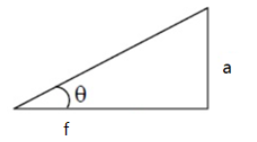
For the given microscope,$f_{0}=5cm$, $\lambda=600A^{\circ}$, $a=1cm$. Let us assume that the refractive index of the lens is $\mu=1$
Clearly, for small angles $tan\theta=sin\theta=\dfrac{a}{f}=\dfrac{1}{5}=0.2$
On substitution,
$\implies R.P=\dfrac{2\times 1\times 0.2}{1.22\times 6\times 10^{-7}}$
$\therefore R.P=10.9\times 10^{5}m^{-1}$ is the required answer.
Note: Resolving power is also the reciprocal of the limit of resolution of the microscope. Also note that, $RP\propto a$ and $RP\propto \dfrac{1}{\lambda}$. The angular resolution is used to resolve small images into two distinct objects; this is the principle behind the human eye, telescope, microscope, and cameras. However the criterion has minor changes with respect to different optical tools used.
Formula: $R.P=\dfrac{1}{\Delta d}$
Complete answer:
Resolving power is the ability of an optical instrument to resolve two points which are close together. Clearly, resolving power depends on the width of the aperture, refractive index of the lens and the wavelength of the incident wavelength. According to Rayleigh criterion, two point sources are said to be just resolved when the principal diffraction maximum of one image coincides with the first minimum of the other. The resolution depends on the ratio of wavelength to the width or how big is the aperture of the optical instrument.
$R.P=\dfrac{1}{\Delta d}$
The resolving power of a microscope is inversely proportional to the distance $\Delta d$ between the two objects which are to be resolved. From Abbe’s criterion, we have $\Delta d = \dfrac{1.22\lambda}{2nsin\theta}$, where $n$ is the refractive index of the lens and $\theta$ is the angle separation, and is as shown below.
For the given microscope,$f_{0}=5cm$, $\lambda=600A^{\circ}$, $a=1cm$. Let us assume that the refractive index of the lens is $\mu=1$
Clearly, for small angles $tan\theta=sin\theta=\dfrac{a}{f}=\dfrac{1}{5}=0.2$
On substitution,
$\implies R.P=\dfrac{2\times 1\times 0.2}{1.22\times 6\times 10^{-7}}$
$\therefore R.P=10.9\times 10^{5}m^{-1}$ is the required answer.
Note: Resolving power is also the reciprocal of the limit of resolution of the microscope. Also note that, $RP\propto a$ and $RP\propto \dfrac{1}{\lambda}$. The angular resolution is used to resolve small images into two distinct objects; this is the principle behind the human eye, telescope, microscope, and cameras. However the criterion has minor changes with respect to different optical tools used.
Recently Updated Pages
Master Class 11 English: Engaging Questions & Answers for Success

Master Class 11 Maths: Engaging Questions & Answers for Success
Master Class 11 Biology: Engaging Questions & Answers for Success
Master Class 11 Social Science: Engaging Questions & Answers for Success
Master Class 11 Physics: Engaging Questions & Answers for Success
Master Class 11 Accountancy: Engaging Questions & Answers for Success
Trending doubts
One Metric ton is equal to kg A 10000 B 1000 C 100 class 11 physics CBSE
Discuss the various forms of bacteria class 11 biology CBSE
Draw a diagram of a plant cell and label at least eight class 11 biology CBSE
State the laws of reflection of light
Explain zero factorial class 11 maths CBSE
10 examples of friction in our daily life