




If events A and B are independent and $P\left( A \right)=0.15,P\left( A\cup B \right)=0.45$ then $P\left( B \right)=$
(a)$\dfrac{6}{13}$
(b)$\dfrac{6}{17}$
(c)$\dfrac{6}{19}$
(d)$\dfrac{6}{23}$
Answer
 Verified
614.1k+ views
Hint: Two events A and B will be independent events of the relation between $P\left( A \right)$ and $P\left( B \right)$ is given as $P\left( A\cap B \right)=P\left( A \right)P\left( B \right)$ .
Now, use the relation among $P\left( A \right),P\left( B \right),P\left( A\cap B \right)$ and $P\left( A\cup B \right)$, which is given as:
$P\left( A\cup B \right)=P\left( A \right)+P\left( B \right)-P\left( A\cap B \right)$ .
Now, put all the known values to the above equation to get the value of $P\left( B \right)$ .
Complete step-by-step answer:
Here, we are given that A and B are two independent events with the relations
$P\left( A \right)=0.15$ ………………… (1)
$P\left( A\cup B \right)=0.45$………………. (2)
And hence, we need to determine the value of $P\left( B \right)$.
Now, as we know A and B can be two independent events if:
$P\left( A\cap B \right)=P\left( A \right)P\left( B \right)$………………………………. (3)
And also, we know the relation among $P\left( A \right),P\left( B \right),P\left( A\cap B \right)$ and $P\left( A\cup B \right)$is given :
$P\left( A\cup B \right)=P\left( A \right)+P\left( B \right)-P\left( A\cap B \right)$…………………. (4)
Now, we can use equations (1), (2), (3) to put the values of $P\left( A \right),P\left( A\cup B \right)$ and $P\left( A\cap B \right)$ to the equation (4) . So, we get the equation (4) as :
$0.45=0.15+P\left( B \right)-P\left( A \right)P\left( B \right)$
As, we know $P\left( A \right)=0.15$from the equation (1) , so, we can rewrite the above equation as:
$0.45=0.15+P\left( B \right)-0.15P\left( B \right)$
Or
$\begin{align}
& 0.45-0.15=P\left( B \right)-0.15P\left( B \right) \\
& 0.30=P\left( B \right)-0.15P\left( B \right) \\
\end{align}$
Now, we can take $P\left( B \right)$ as common from both the terms of the right hand side of the above equation. So, we get $0.30=P\left( B \right)\left( 1-0.15 \right)$
Or
$0.30=P\left( B \right)\times 0.85$
On dividing the above equation by 0.85, we get:
$\dfrac{0.30}{0.85}=P\left( B \right)\times \dfrac{0.85}{0.85}$
Or $P\left( B \right)=\dfrac{0.30}{0.85}$
On multiplying the denominator and numerator by 100, we get:
$\begin{align}
& P\left( B \right)=\dfrac{0.30}{0.85}\times \dfrac{100}{100}=\dfrac{30}{85} \\
& P\left( B \right)=\dfrac{6}{17} \\
\end{align}$
Hence, we get $P\left( B \right)=\dfrac{6}{17}$ . So, option (b) is the correct answer of the problem.
Note: One may use Venn diagram for the relation $P\left( A \right)$ and $P\left( B \right)$ as:
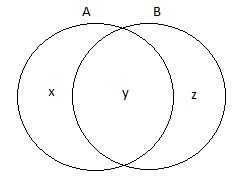
$\begin{align}
& x+y=P\left( A \right) \\
& y+z=P\left( B \right) \\
& y=P\left( A\cap B \right) \\
& x+y+z=P\left( A\cup B \right) \\
\end{align}$
Writing $P\left( A\cap B \right)=P\left( A \right)P\left( B \right)$ is the key point of the problem as A and B are independent events i.e. events A or B are not depending on each other.
Now, use the relation among $P\left( A \right),P\left( B \right),P\left( A\cap B \right)$ and $P\left( A\cup B \right)$, which is given as:
$P\left( A\cup B \right)=P\left( A \right)+P\left( B \right)-P\left( A\cap B \right)$ .
Now, put all the known values to the above equation to get the value of $P\left( B \right)$ .
Complete step-by-step answer:
Here, we are given that A and B are two independent events with the relations
$P\left( A \right)=0.15$ ………………… (1)
$P\left( A\cup B \right)=0.45$………………. (2)
And hence, we need to determine the value of $P\left( B \right)$.
Now, as we know A and B can be two independent events if:
$P\left( A\cap B \right)=P\left( A \right)P\left( B \right)$………………………………. (3)
And also, we know the relation among $P\left( A \right),P\left( B \right),P\left( A\cap B \right)$ and $P\left( A\cup B \right)$is given :
$P\left( A\cup B \right)=P\left( A \right)+P\left( B \right)-P\left( A\cap B \right)$…………………. (4)
Now, we can use equations (1), (2), (3) to put the values of $P\left( A \right),P\left( A\cup B \right)$ and $P\left( A\cap B \right)$ to the equation (4) . So, we get the equation (4) as :
$0.45=0.15+P\left( B \right)-P\left( A \right)P\left( B \right)$
As, we know $P\left( A \right)=0.15$from the equation (1) , so, we can rewrite the above equation as:
$0.45=0.15+P\left( B \right)-0.15P\left( B \right)$
Or
$\begin{align}
& 0.45-0.15=P\left( B \right)-0.15P\left( B \right) \\
& 0.30=P\left( B \right)-0.15P\left( B \right) \\
\end{align}$
Now, we can take $P\left( B \right)$ as common from both the terms of the right hand side of the above equation. So, we get $0.30=P\left( B \right)\left( 1-0.15 \right)$
Or
$0.30=P\left( B \right)\times 0.85$
On dividing the above equation by 0.85, we get:
$\dfrac{0.30}{0.85}=P\left( B \right)\times \dfrac{0.85}{0.85}$
Or $P\left( B \right)=\dfrac{0.30}{0.85}$
On multiplying the denominator and numerator by 100, we get:
$\begin{align}
& P\left( B \right)=\dfrac{0.30}{0.85}\times \dfrac{100}{100}=\dfrac{30}{85} \\
& P\left( B \right)=\dfrac{6}{17} \\
\end{align}$
Hence, we get $P\left( B \right)=\dfrac{6}{17}$ . So, option (b) is the correct answer of the problem.
Note: One may use Venn diagram for the relation $P\left( A \right)$ and $P\left( B \right)$ as:
$\begin{align}
& x+y=P\left( A \right) \\
& y+z=P\left( B \right) \\
& y=P\left( A\cap B \right) \\
& x+y+z=P\left( A\cup B \right) \\
\end{align}$
Writing $P\left( A\cap B \right)=P\left( A \right)P\left( B \right)$ is the key point of the problem as A and B are independent events i.e. events A or B are not depending on each other.
Recently Updated Pages
Basicity of sulphurous acid and sulphuric acid are

Master Class 12 English: Engaging Questions & Answers for Success
Master Class 12 Social Science: Engaging Questions & Answers for Success
Master Class 12 Maths: Engaging Questions & Answers for Success
Master Class 12 Economics: Engaging Questions & Answers for Success
Master Class 12 Physics: Engaging Questions & Answers for Success
Trending doubts
Which are the Top 10 Largest Countries of the World?
Draw a labelled sketch of the human eye class 12 physics CBSE
Give 10 examples of unisexual and bisexual flowers
Coming together federation is practiced in A India class 12 social science CBSE
Write the formula to find the shortest distance between class 12 maths CBSE
Find the foot of the perpendicular from point232to class 12 maths CBSE