




If diagonal of a square is 13cm, then find its side.
Answer
 Verified
598.8k+ views
Hint:
We will use the Pythagoras theorem in the right triangle formed by the sides and diagonal of the square as: ${\text{hypotenus}}{{\text{e}}^2}{\text{ = perpendicula}}{{\text{r}}^2}{\text{ + bas}}{{\text{e}}^2}$ since all angles (vertex) of a square are of ${90^ \circ }$.
Complete step by step solution:
We need to find the length of the side of the square.
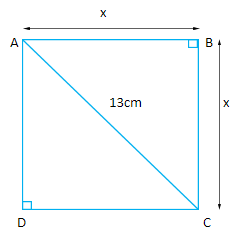
Since all sides of the square are equal, let the sides be of length x cm each. And AC be the diagonal of the square whose length is 13cm.
We know that all the corner angles of a square are of ${90^ \circ }$, therefore, we can use Pythagoras theorem given by: ${\text{hypotenus}}{{\text{e}}^2}{\text{ = perpendicular}}{{\text{r}}^2}{\text{ + bas}}{{\text{e}}^2}$
Using Pythagoras theorem in $\vartriangle ABC$, we get
$
\Rightarrow {\text{hypotenus}}{{\text{e}}^2}{\text{ = perpendicula}}{{\text{r}}^2}{\text{ + bas}}{{\text{e}}^2} \\
\Rightarrow {\left( {AC} \right)^2} = {\left( {AB} \right)^2} + {\left( {BC} \right)^2} \\
$
Substituting the values of AC, AB and BC, we get
$
\Rightarrow {\left( {13} \right)^2} = {\left( x \right)^2} + {\left( x \right)^2} \\
\Rightarrow 169 = 2{x^2} \\
\Rightarrow {x^2} = \dfrac{{169}}{2} \\
\Rightarrow x = \sqrt {\dfrac{{169}}{2}} = \dfrac{{13}}{{\sqrt 2 }} = \dfrac{{6.5 \times 2}}{{\sqrt 2 }} = 6.5\sqrt 2 {\text{cm}} \\
$
Therefore, the side of the square is of length $6.5\sqrt 2 {\text{cm}}$.
Note:
In this question, you can get confused in the calculation of x from the equation obtained after using the Pythagoras theorem. You can calculate it directly by taking the square root of $\dfrac{{169}}{2} = 84.5$for the value of x instead of converting it into the form of $6.5\sqrt 2 $. You can also solve this question by directly applying the formula of relation between the diagonal of the square and its sides given as: Diagonal = $\sqrt 2 a$ , where a is the length of the side of the square, instead of using the Pythagoras theorem. This method will be helpful in MCQs to conserve time and get solutions quickly.
We will use the Pythagoras theorem in the right triangle formed by the sides and diagonal of the square as: ${\text{hypotenus}}{{\text{e}}^2}{\text{ = perpendicula}}{{\text{r}}^2}{\text{ + bas}}{{\text{e}}^2}$ since all angles (vertex) of a square are of ${90^ \circ }$.
Complete step by step solution:
We need to find the length of the side of the square.
Since all sides of the square are equal, let the sides be of length x cm each. And AC be the diagonal of the square whose length is 13cm.
We know that all the corner angles of a square are of ${90^ \circ }$, therefore, we can use Pythagoras theorem given by: ${\text{hypotenus}}{{\text{e}}^2}{\text{ = perpendicular}}{{\text{r}}^2}{\text{ + bas}}{{\text{e}}^2}$
Using Pythagoras theorem in $\vartriangle ABC$, we get
$
\Rightarrow {\text{hypotenus}}{{\text{e}}^2}{\text{ = perpendicula}}{{\text{r}}^2}{\text{ + bas}}{{\text{e}}^2} \\
\Rightarrow {\left( {AC} \right)^2} = {\left( {AB} \right)^2} + {\left( {BC} \right)^2} \\
$
Substituting the values of AC, AB and BC, we get
$
\Rightarrow {\left( {13} \right)^2} = {\left( x \right)^2} + {\left( x \right)^2} \\
\Rightarrow 169 = 2{x^2} \\
\Rightarrow {x^2} = \dfrac{{169}}{2} \\
\Rightarrow x = \sqrt {\dfrac{{169}}{2}} = \dfrac{{13}}{{\sqrt 2 }} = \dfrac{{6.5 \times 2}}{{\sqrt 2 }} = 6.5\sqrt 2 {\text{cm}} \\
$
Therefore, the side of the square is of length $6.5\sqrt 2 {\text{cm}}$.
Note:
In this question, you can get confused in the calculation of x from the equation obtained after using the Pythagoras theorem. You can calculate it directly by taking the square root of $\dfrac{{169}}{2} = 84.5$for the value of x instead of converting it into the form of $6.5\sqrt 2 $. You can also solve this question by directly applying the formula of relation between the diagonal of the square and its sides given as: Diagonal = $\sqrt 2 a$ , where a is the length of the side of the square, instead of using the Pythagoras theorem. This method will be helpful in MCQs to conserve time and get solutions quickly.
Recently Updated Pages
Master Class 9 Social Science: Engaging Questions & Answers for Success

Master Class 9 Science: Engaging Questions & Answers for Success
Master Class 9 Maths: Engaging Questions & Answers for Success
Master Class 9 General Knowledge: Engaging Questions & Answers for Success
Class 9 Question and Answer - Your Ultimate Solutions Guide
Master Class 8 Social Science: Engaging Questions & Answers for Success
Trending doubts
21st March is celebrated as A World environment day class 9 biology CBSE
Find the sum of series 1 + 2 + 3 + 4 + 5 + + 100 class 9 maths CBSE
What is the Full Form of ISI and RAW
Fill the blanks with the suitable prepositions 1 The class 9 english CBSE
Difference Between Plant Cell and Animal Cell
Here 1 km is equal to how many miles class 9 maths CBSE