




If $\cos (\theta ) = \dfrac{3}{5}$ , then what is the value of $\sin (\theta )?$
Answer
 Verified
561k+ views
Hint: In this question we have been given the value of $\cos \theta $ . We will use the basic trigonometric ratio formulas to solve this question. We know that
$\sin \theta = \dfrac{p}{h}$ and the value of
$\cos \theta = \dfrac{b}{h}$ .
So we will first find out the value of perpendicular i.e. $p$ and then we will substitute the values to solve this question.
Complete step-by-step answer:
Here we have been given $\cos (\theta ) = \dfrac{3}{5}$ .
We know that cosine is the ratio of base to hypotenuse of right angled triangle, so it means that we
have
$\dfrac{b}{h} = \dfrac{3}{5}$ , where b is the base and h is the hypotenuse.
We will draw the diagram of a right angled triangles according to the given data:
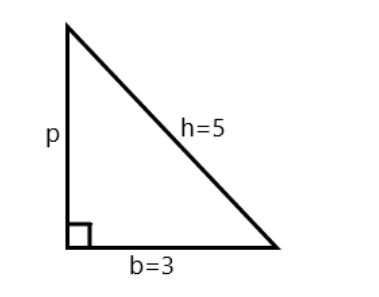
So we will use the Pythagoras theorem to solve the value of perpendicular $(p)$ .
We know that the Pythagoras theorem states that
$(hypotensue) = \sqrt {{{(base)}^2} + {{(pependicular)}^2}} $
Or, it can also be written as
$h = \sqrt {{p^2} + {b^2}} $
Here in this question we have to find the value of $p$, so it can be written as
$\sqrt {{h^2} - {b^2}} $
We will now substitute the values in the formula,
$p = \sqrt {{5^2} - {3^2}} $
On simplifying we have
$\sqrt {25 - 9} = \sqrt {16} $
It gives us value
$p = 4$ .
Now we know that $\sin \theta $can be written as $\dfrac{p}{h}$ .
We have
$p = 4,h = 5$
So by substituting the values, we get
$\dfrac{p}{h} = \dfrac{4}{5}$
So, the correct answer is “ $\sin \theta = \dfrac{4}{5}$”.
Note: We should note that there is an alternative way that we can solve the question. We will apply the trigonometric identity i.e.
${\sin ^2}\theta + {\cos ^2}\theta = 1$ .
We have been given
$\cos (\theta ) = \dfrac{3}{5}$ .
By squaring both the sides we can calculate
${\cos ^2}\theta = {\left( {\dfrac{3}{5}} \right)^2}$ .
It gives us
${\cos ^2}\theta = \dfrac{9}{{25}}$ .
Now by substituting this value in the expression, we have
$\dfrac{9}{{25}} + {\sin ^2}\theta = 1$
We will simplify the value
${\sin ^2}\theta = 1 - \dfrac{9}{{25}}$ .
It gives value:
$\dfrac{{25 - 9}}{{25}} = \dfrac{{16}}{{25}}$ .
It gives
${\sin ^2}\theta = \dfrac{{16}}{{25}}$ .
We will remove the square root from the left hand side by putting the root under to the right hand side.
Now we have expression
$\sin \theta = \sqrt {\dfrac{{16}}{{25}}} $
It gives the value
$\sin \theta = \pm \dfrac{4}{5}$ .
$\sin \theta = \dfrac{p}{h}$ and the value of
$\cos \theta = \dfrac{b}{h}$ .
So we will first find out the value of perpendicular i.e. $p$ and then we will substitute the values to solve this question.
Complete step-by-step answer:
Here we have been given $\cos (\theta ) = \dfrac{3}{5}$ .
We know that cosine is the ratio of base to hypotenuse of right angled triangle, so it means that we
have
$\dfrac{b}{h} = \dfrac{3}{5}$ , where b is the base and h is the hypotenuse.
We will draw the diagram of a right angled triangles according to the given data:
So we will use the Pythagoras theorem to solve the value of perpendicular $(p)$ .
We know that the Pythagoras theorem states that
$(hypotensue) = \sqrt {{{(base)}^2} + {{(pependicular)}^2}} $
Or, it can also be written as
$h = \sqrt {{p^2} + {b^2}} $
Here in this question we have to find the value of $p$, so it can be written as
$\sqrt {{h^2} - {b^2}} $
We will now substitute the values in the formula,
$p = \sqrt {{5^2} - {3^2}} $
On simplifying we have
$\sqrt {25 - 9} = \sqrt {16} $
It gives us value
$p = 4$ .
Now we know that $\sin \theta $can be written as $\dfrac{p}{h}$ .
We have
$p = 4,h = 5$
So by substituting the values, we get
$\dfrac{p}{h} = \dfrac{4}{5}$
So, the correct answer is “ $\sin \theta = \dfrac{4}{5}$”.
Note: We should note that there is an alternative way that we can solve the question. We will apply the trigonometric identity i.e.
${\sin ^2}\theta + {\cos ^2}\theta = 1$ .
We have been given
$\cos (\theta ) = \dfrac{3}{5}$ .
By squaring both the sides we can calculate
${\cos ^2}\theta = {\left( {\dfrac{3}{5}} \right)^2}$ .
It gives us
${\cos ^2}\theta = \dfrac{9}{{25}}$ .
Now by substituting this value in the expression, we have
$\dfrac{9}{{25}} + {\sin ^2}\theta = 1$
We will simplify the value
${\sin ^2}\theta = 1 - \dfrac{9}{{25}}$ .
It gives value:
$\dfrac{{25 - 9}}{{25}} = \dfrac{{16}}{{25}}$ .
It gives
${\sin ^2}\theta = \dfrac{{16}}{{25}}$ .
We will remove the square root from the left hand side by putting the root under to the right hand side.
Now we have expression
$\sin \theta = \sqrt {\dfrac{{16}}{{25}}} $
It gives the value
$\sin \theta = \pm \dfrac{4}{5}$ .
Recently Updated Pages
If x a + bt + ct2 where x is in meters and t is in class 11 physics CBSE

A car covers the first half distance between two places class 11 physics CBSE
The resultant of two vectors overrightarrow P and overrightarrow class 11 physics CBSE
Find the value of cos 135 class 11 maths CBSE
A mass M is held in place by an applied force F and class 11 physics CBSE
A solution of glucose in water is labelled as 10 dfracwv class 11 chemistry CBSE
Trending doubts
One Metric ton is equal to kg A 10000 B 1000 C 100 class 11 physics CBSE
Find the value of the expression given below sin 30circ class 11 maths CBSE
Draw a diagram of nephron and explain its structur class 11 biology CBSE
10 examples of friction in our daily life
Proton was discovered by A Thomson B Rutherford C Chadwick class 11 chemistry CBSE
Bond order ofO2 O2+ O2 and O22 is in order A O2 langle class 11 chemistry CBSE