




If $ \cos \theta =\dfrac{2}{3} $ , then $ 2{{\sec }^{2}}\theta +2{{\tan }^{2}}\theta -7 $ is equal to:
A. 1
B. 0
C. 3
D. 4
Answer
 Verified
596.4k+ views
Hint: First of all apply the trigonometric identity $ 1+{{\tan }^{2}}\theta ={{\sec }^{2}}\theta $ in the given expression. Convert the given expression in terms of $ {{\sec }^{2}}\theta $ . Now, it is given that $ \cos \theta =\dfrac{2}{3} $ and we know that the reciprocal of $ \cos \theta $ is $ \sec \theta $ and then substitute the value of $ \sec \theta $ in the given expression and solve.
Complete step-by-step answer:
The expression given in the question is:
$ 2{{\sec }^{2}}\theta +2{{\tan }^{2}}\theta -7 $
Now, we are going to convert the above expression in terms of $ \sec \theta $ using the trigonometric identity:
$ \begin{align}
& 1+{{\tan }^{2}}\theta ={{\sec }^{2}}\theta \\
& \Rightarrow {{\tan }^{2}}\theta ={{\sec }^{2}}\theta -1 \\
\end{align} $
Substituting the above value of $ {{\tan }^{2}}\theta $ in the given expression we get,
$ \begin{align}
& 2\left( {{\sec }^{2}}\theta +{{\tan }^{2}}\theta \right)-7 \\
& =2\left( {{\sec }^{2}}\theta +{{\sec }^{2}}\theta -1 \right)-7 \\
& =4{{\sec }^{2}}\theta -9 \\
\end{align} $
It is given that:
$ \cos \theta =\dfrac{2}{3} $
As we have converted the given expression in terms of $ \sec \theta $ so we need the value of $ \sec \theta $ . We have given the value of $ \cos \theta $ so from the trigonometry we know that the inverse of $ \cos \theta $ is $ \sec \theta $ . So, taking the reciprocal of $ \cos \theta $ we get,
$ \sec \theta =\dfrac{3}{2} $
Substituting this value of $ \sec \theta $ in the expression $ 4{{\sec }^{2}}\theta -9 $ we get,
$ \begin{align}
& 4{{\left( \dfrac{3}{2} \right)}^{2}}-9 \\
& =4\left( \dfrac{9}{4} \right)-9 \\
& =9-9=0 \\
\end{align} $
From the above calculation, the value of the given expression is 0.
Hence, the correct option is (b).
Note: In the above solution instead of using the identity $ 1+{{\tan }^{2}}\theta ={{\sec }^{2}}\theta $ we can substitute the value of the tan θ in the given expression 2sec2θ + 2tan2θ – 7. Now, we can find the value of tan θ as follows:
$ \cos \theta =\dfrac{2}{3} $
In the below diagram, we have shown a triangle ABC right angled at B along with an angle $ \theta $ .
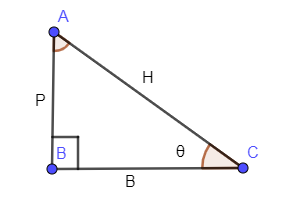
In the above figure, “P” stands for perpendicular with respect to angle θ, “B” stands for the base with respect to angle θ and “H” stands for the hypotenuse with respect to angle θ.
We know that, $ \cos \theta $ is equal to base divided by hypotenuse so using Pythagoras theorem we can find the perpendicular of the triangle.
$ \cos \theta =\dfrac{B}{H} $
$ \begin{align}
& {{H}^{2}}={{B}^{2}}+{{P}^{2}} \\
& \Rightarrow 9=4+{{P}^{2}} \\
& \Rightarrow {{P}^{2}}=5 \\
& \Rightarrow P=\sqrt{5} \\
\end{align} $
From the above calculation, we can find the value of $ \tan \theta $ :
$ \tan \theta =\dfrac{\sqrt{5}}{2} $
Substituting this value of $ \tan \theta $ in the given expression we get,
\[\begin{align}
& 2\left( {{\sec }^{2}}\theta +{{\tan }^{2}}\theta \right)-7 \\
& =2\left( \dfrac{9}{4}+\dfrac{5}{4} \right)-7 \\
& =2\left( \dfrac{14}{4} \right)-7 \\
& =7-7=0 \\
\end{align}\]
Hence, we have got the answer as 0.
Complete step-by-step answer:
The expression given in the question is:
$ 2{{\sec }^{2}}\theta +2{{\tan }^{2}}\theta -7 $
Now, we are going to convert the above expression in terms of $ \sec \theta $ using the trigonometric identity:
$ \begin{align}
& 1+{{\tan }^{2}}\theta ={{\sec }^{2}}\theta \\
& \Rightarrow {{\tan }^{2}}\theta ={{\sec }^{2}}\theta -1 \\
\end{align} $
Substituting the above value of $ {{\tan }^{2}}\theta $ in the given expression we get,
$ \begin{align}
& 2\left( {{\sec }^{2}}\theta +{{\tan }^{2}}\theta \right)-7 \\
& =2\left( {{\sec }^{2}}\theta +{{\sec }^{2}}\theta -1 \right)-7 \\
& =4{{\sec }^{2}}\theta -9 \\
\end{align} $
It is given that:
$ \cos \theta =\dfrac{2}{3} $
As we have converted the given expression in terms of $ \sec \theta $ so we need the value of $ \sec \theta $ . We have given the value of $ \cos \theta $ so from the trigonometry we know that the inverse of $ \cos \theta $ is $ \sec \theta $ . So, taking the reciprocal of $ \cos \theta $ we get,
$ \sec \theta =\dfrac{3}{2} $
Substituting this value of $ \sec \theta $ in the expression $ 4{{\sec }^{2}}\theta -9 $ we get,
$ \begin{align}
& 4{{\left( \dfrac{3}{2} \right)}^{2}}-9 \\
& =4\left( \dfrac{9}{4} \right)-9 \\
& =9-9=0 \\
\end{align} $
From the above calculation, the value of the given expression is 0.
Hence, the correct option is (b).
Note: In the above solution instead of using the identity $ 1+{{\tan }^{2}}\theta ={{\sec }^{2}}\theta $ we can substitute the value of the tan θ in the given expression 2sec2θ + 2tan2θ – 7. Now, we can find the value of tan θ as follows:
$ \cos \theta =\dfrac{2}{3} $
In the below diagram, we have shown a triangle ABC right angled at B along with an angle $ \theta $ .
In the above figure, “P” stands for perpendicular with respect to angle θ, “B” stands for the base with respect to angle θ and “H” stands for the hypotenuse with respect to angle θ.
We know that, $ \cos \theta $ is equal to base divided by hypotenuse so using Pythagoras theorem we can find the perpendicular of the triangle.
$ \cos \theta =\dfrac{B}{H} $
$ \begin{align}
& {{H}^{2}}={{B}^{2}}+{{P}^{2}} \\
& \Rightarrow 9=4+{{P}^{2}} \\
& \Rightarrow {{P}^{2}}=5 \\
& \Rightarrow P=\sqrt{5} \\
\end{align} $
From the above calculation, we can find the value of $ \tan \theta $ :
$ \tan \theta =\dfrac{\sqrt{5}}{2} $
Substituting this value of $ \tan \theta $ in the given expression we get,
\[\begin{align}
& 2\left( {{\sec }^{2}}\theta +{{\tan }^{2}}\theta \right)-7 \\
& =2\left( \dfrac{9}{4}+\dfrac{5}{4} \right)-7 \\
& =2\left( \dfrac{14}{4} \right)-7 \\
& =7-7=0 \\
\end{align}\]
Hence, we have got the answer as 0.
Recently Updated Pages
Master Class 11 Computer Science: Engaging Questions & Answers for Success

Master Class 11 Business Studies: Engaging Questions & Answers for Success
Master Class 11 Economics: Engaging Questions & Answers for Success
Master Class 11 English: Engaging Questions & Answers for Success
Master Class 11 Maths: Engaging Questions & Answers for Success
Master Class 11 Biology: Engaging Questions & Answers for Success
Trending doubts
One Metric ton is equal to kg A 10000 B 1000 C 100 class 11 physics CBSE
There are 720 permutations of the digits 1 2 3 4 5 class 11 maths CBSE
Discuss the various forms of bacteria class 11 biology CBSE
Draw a diagram of a plant cell and label at least eight class 11 biology CBSE
State the laws of reflection of light
Explain zero factorial class 11 maths CBSE