




If \[\cos \alpha = \dfrac{1}{2}\left( {x + \dfrac{1}{x}} \right)\] and \[\cos \beta = \dfrac{1}{2}\left( {y + \dfrac{1}{y}} \right)\]. Evaluate\[\cos \left( {\alpha - \beta } \right)\].
Answer
 Verified
655.2k+ views
Hint: We know formula for \[\cos \left( {\alpha - \beta } \right) = \cos \alpha \cos \beta + \sin \alpha \sin \beta \].But we have values of cos function only. So we need to find values of sin function using given data and trigonometric functions.
Complete step-by-step answer:
Given that,
\[
\cos \alpha = \dfrac{1}{2}\left( {x + \dfrac{1}{x}} \right) \\
\Rightarrow \cos \alpha = \left( {\dfrac{{{x^2} + 1}}{{2x}}} \right) \\
\cos \beta = \dfrac{1}{2}\left( {y + \dfrac{1}{y}} \right) \\
\Rightarrow \cos \beta = \left( {\dfrac{{{y^2} + 1}}{{2y}}} \right) \\
\]
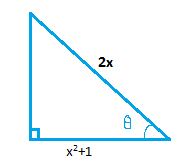
In figure alongside if \[\theta \] is the angle then cos of that angle will be the ratio of adjacent side to hypotenuse. Using that and the theorem of Pythagoras we will find sin function.
According to theorem of Pythagoras,
\[
hyp{t^2} = bas{e^2} + heigh{t^2} \\
height = \sqrt {hyp{t^2} - bas{e^2}} \\
\Rightarrow \sqrt {{{\left( {2x} \right)}^2} - {{\left( {{x^2} + 1} \right)}^2}} \\
\Rightarrow \sqrt {4{x^2} - \left( {{x^4} + 2{x^2} + 1} \right)} \\
\Rightarrow \sqrt {4{x^2} - {x^4} - 2{x^2} - 1} \\
\Rightarrow \sqrt { - {x^4} + 2{x^2} - 1} \\
\Rightarrow \sqrt { - \left( {{x^4} - 2{x^2} + 1} \right)} \\
\Rightarrow \sqrt {{i^2}{{\left( {{x^2} - 1} \right)}^2}} \\
\Rightarrow \left( {{x^2} - 1} \right)i \\
\]
This is the value of the side opposite to the angle that is the height of the triangle.
Now sin function is the ratio of opposite sides to hypotenuses. So sin function is given by
\[\dfrac{{\left( {{x^2} - 1} \right)i}}{{2x}}\]
Now for respective angles just replace the variables.
\[\cos \left( {\alpha - \beta } \right) = \cos \alpha \cos \beta + \sin \alpha \sin \beta \]
Putting the values,
\[
\Rightarrow \left( {\dfrac{{{x^2} + 1}}{{2x}}} \right)\left( {\dfrac{{{y^2} + 1}}{{2y}}} \right) + \left( {\dfrac{{\left( {{x^2} - 1} \right)i}}{{2x}}} \right)\left( {\dfrac{{\left( {{y^2} - 1} \right)i}}{{2y}}} \right) \\
\Rightarrow \dfrac{{\left( {{x^2} + 1} \right)\left( {{y^2} + 1} \right)}}{{4xy}} + \dfrac{{\left( {\left( {{x^2} - 1} \right)i} \right)\left( {\left( {{y^2} - 1} \right)i} \right)}}{{4xy}} \\
\]
Multiplying the brackets separately,
\[ \Rightarrow \dfrac{{{x^2}{y^2} + {x^2} + {y^2} + 1}}{{4xy}} + \dfrac{{({x^2}{y^2} - {x^2} - {y^2} + 1){i^2}}}{{4xy}}\]
Putting the value of \[{i^2}\]=-1
\[ \Rightarrow \dfrac{{{x^2}{y^2} + {x^2} + {y^2} + 1}}{{4xy}} - \dfrac{{({x^2}{y^2} - {x^2} - {y^2} + 1)}}{{4xy}}\]
Multiplying the second term with minus sign,
\[ \Rightarrow \dfrac{{{x^2}{y^2} + {x^2} + {y^2} + 1 - {x^2}{y^2} + {x^2} + {y^2} - 1}}{{4xy}}\]
Cancelling the opposite sign terms and rewriting the equation,
\[
\Rightarrow \dfrac{{2({x^2} + {y^2})}}{{4xy}} \\
\Rightarrow \dfrac{1}{2}\left( {\dfrac{{{x^2}}}{{xy}} + \dfrac{{{y^2}}}{{xy}}} \right) \\
\Rightarrow \dfrac{1}{2}\left( {\dfrac{x}{y} + \dfrac{y}{x}} \right) \\
\]
This is the final value of \[\cos \left( {\alpha - \beta } \right)\].
Note: Using any other trigonometric identity student might get the answer but that will be tedious so use Pythagoras theorem for convenience. Always pay attention towards the signs of terms. Go step by step because skipping a single step might confuse a student.
Complete step-by-step answer:
Given that,
\[
\cos \alpha = \dfrac{1}{2}\left( {x + \dfrac{1}{x}} \right) \\
\Rightarrow \cos \alpha = \left( {\dfrac{{{x^2} + 1}}{{2x}}} \right) \\
\cos \beta = \dfrac{1}{2}\left( {y + \dfrac{1}{y}} \right) \\
\Rightarrow \cos \beta = \left( {\dfrac{{{y^2} + 1}}{{2y}}} \right) \\
\]
In figure alongside if \[\theta \] is the angle then cos of that angle will be the ratio of adjacent side to hypotenuse. Using that and the theorem of Pythagoras we will find sin function.
According to theorem of Pythagoras,
\[
hyp{t^2} = bas{e^2} + heigh{t^2} \\
height = \sqrt {hyp{t^2} - bas{e^2}} \\
\Rightarrow \sqrt {{{\left( {2x} \right)}^2} - {{\left( {{x^2} + 1} \right)}^2}} \\
\Rightarrow \sqrt {4{x^2} - \left( {{x^4} + 2{x^2} + 1} \right)} \\
\Rightarrow \sqrt {4{x^2} - {x^4} - 2{x^2} - 1} \\
\Rightarrow \sqrt { - {x^4} + 2{x^2} - 1} \\
\Rightarrow \sqrt { - \left( {{x^4} - 2{x^2} + 1} \right)} \\
\Rightarrow \sqrt {{i^2}{{\left( {{x^2} - 1} \right)}^2}} \\
\Rightarrow \left( {{x^2} - 1} \right)i \\
\]
This is the value of the side opposite to the angle that is the height of the triangle.
Now sin function is the ratio of opposite sides to hypotenuses. So sin function is given by
\[\dfrac{{\left( {{x^2} - 1} \right)i}}{{2x}}\]
Now for respective angles just replace the variables.
\[\cos \left( {\alpha - \beta } \right) = \cos \alpha \cos \beta + \sin \alpha \sin \beta \]
Putting the values,
\[
\Rightarrow \left( {\dfrac{{{x^2} + 1}}{{2x}}} \right)\left( {\dfrac{{{y^2} + 1}}{{2y}}} \right) + \left( {\dfrac{{\left( {{x^2} - 1} \right)i}}{{2x}}} \right)\left( {\dfrac{{\left( {{y^2} - 1} \right)i}}{{2y}}} \right) \\
\Rightarrow \dfrac{{\left( {{x^2} + 1} \right)\left( {{y^2} + 1} \right)}}{{4xy}} + \dfrac{{\left( {\left( {{x^2} - 1} \right)i} \right)\left( {\left( {{y^2} - 1} \right)i} \right)}}{{4xy}} \\
\]
Multiplying the brackets separately,
\[ \Rightarrow \dfrac{{{x^2}{y^2} + {x^2} + {y^2} + 1}}{{4xy}} + \dfrac{{({x^2}{y^2} - {x^2} - {y^2} + 1){i^2}}}{{4xy}}\]
Putting the value of \[{i^2}\]=-1
\[ \Rightarrow \dfrac{{{x^2}{y^2} + {x^2} + {y^2} + 1}}{{4xy}} - \dfrac{{({x^2}{y^2} - {x^2} - {y^2} + 1)}}{{4xy}}\]
Multiplying the second term with minus sign,
\[ \Rightarrow \dfrac{{{x^2}{y^2} + {x^2} + {y^2} + 1 - {x^2}{y^2} + {x^2} + {y^2} - 1}}{{4xy}}\]
Cancelling the opposite sign terms and rewriting the equation,
\[
\Rightarrow \dfrac{{2({x^2} + {y^2})}}{{4xy}} \\
\Rightarrow \dfrac{1}{2}\left( {\dfrac{{{x^2}}}{{xy}} + \dfrac{{{y^2}}}{{xy}}} \right) \\
\Rightarrow \dfrac{1}{2}\left( {\dfrac{x}{y} + \dfrac{y}{x}} \right) \\
\]
This is the final value of \[\cos \left( {\alpha - \beta } \right)\].
Note: Using any other trigonometric identity student might get the answer but that will be tedious so use Pythagoras theorem for convenience. Always pay attention towards the signs of terms. Go step by step because skipping a single step might confuse a student.
Recently Updated Pages
If x a + bt + ct2 where x is in meters and t is in class 11 physics CBSE

A car covers the first half distance between two places class 11 physics CBSE
The resultant of two vectors overrightarrow P and overrightarrow class 11 physics CBSE
Find the value of cos 135 class 11 maths CBSE
A mass M is held in place by an applied force F and class 11 physics CBSE
A solution of glucose in water is labelled as 10 dfracwv class 11 chemistry CBSE
Trending doubts
One Metric ton is equal to kg A 10000 B 1000 C 100 class 11 physics CBSE
Find the value of the expression given below sin 30circ class 11 maths CBSE
What do you mean by retardation What is its SI uni class 11 physics CBSE
Draw a diagram of nephron and explain its structur class 11 biology CBSE
10 examples of friction in our daily life
Difference between physical and chemical change class 11 chemistry CBSE