




If ${\mathrm{tan\mathrm\theta}}_1{\mathrm{tan\mathrm\theta}}_2=-\dfrac{\mathrm a^2}{\mathrm b^2}$, then the chord joining two points ${\mathrm\theta}_1\;\mathrm{and}\;{\mathrm\theta}_2$ on the ellipse $\dfrac{\mathrm x^2}{\mathrm a^2}+\dfrac{\mathrm y^2}{\mathrm b^2}=1$ will subtend a right angle at-
a)Focus
b)Centre
c)End of major axis
d)End of minor axis
Answer
 Verified
608.4k+ views
Hint: To solve this problem, one should have knowledge about the parametric form of an ellipse. The parametric form of a general ellipse at point $\mathrm\theta$ is given by-
$\left(\mathrm{acos\mathrm\theta},\;\mathrm{bsin\mathrm\theta}\right)$
The focus is the point about which a conic section is constructed. An ellipse has two foci. The centre is the geometrical centre inside the ellipse. The end of the major axis is the end point of the longer diameter of the ellipse. The end of the minor axis is the end point of the shorter diameter.
Complete step-by-step answer:
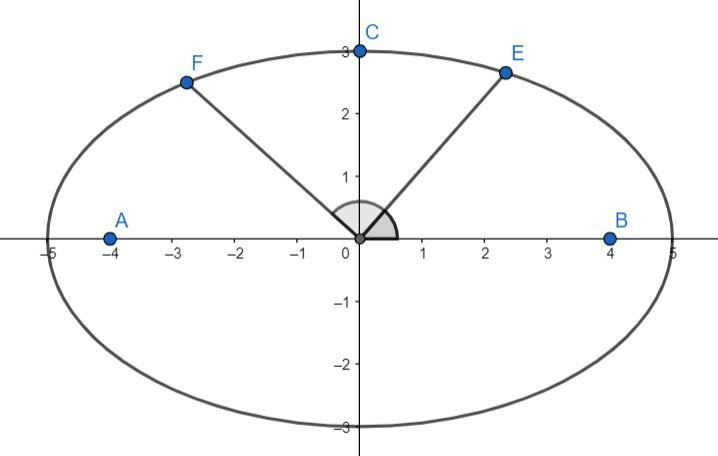
This is the ellipse with equation $\dfrac{\mathrm x^2}{\mathrm a^2}+\dfrac{\mathrm y^2}{\mathrm b^2}=1$. Let the point E and F be at an angle ${\mathrm\theta}_1\;\mathrm{and}\;{\mathrm\theta}_2$ respectively.
By parametric form of ellipse, the coordinates of point E and F are-
$\mathrm E\left({\mathrm{acos\mathrm\theta}}_1,\;{\mathrm{bsin\mathrm\theta}}_1\right)\\\mathrm F\left({\mathrm{acos\mathrm\theta}}_2,\;{\mathrm{bsin\mathrm\theta}}_2\right)$
The slope of a point(p,q) with respect to origin is given by-
$\mathrm m=\dfrac{\mathrm q-0}{\mathrm p-0}=\dfrac{\mathrm q}{\mathrm p}$
So, the slopes of points E and F with respect to origin are-
${\mathrm m}_{\mathrm E}=\dfrac{{\mathrm{bsin\mathrm\theta}}_1}{{\mathrm{acos\mathrm\theta}}_1}=\dfrac{\mathrm b}{\mathrm a}{\mathrm{tan\mathrm\theta}}_1\\{\mathrm m}_{\mathrm F}=\dfrac{{\mathrm{bsin\mathrm\theta}}_2}{{\mathrm{acos\mathrm\theta}}_2}=\dfrac{\mathrm b}{\mathrm a}{\mathrm{tan\mathrm\theta}}_2$
If we multiply $m_E$ and $m_F$, the result should be-
${\mathrm m}_{\mathrm E}\times{\mathrm m}_{\mathrm F}=\dfrac{\mathrm b}{\mathrm a}{\mathrm{tan\mathrm\theta}}_1\times\dfrac{\mathrm b}{\mathrm a}{\mathrm{tan\mathrm\theta}}_2\\=\dfrac{\mathrm b^2}{\mathrm a^2}{\mathrm{tan\mathrm\theta}}_1{\mathrm{tan\mathrm\theta}}_2$
It is given in the question that ${\mathrm{tan\mathrm\theta}}_1{\mathrm{tan\mathrm\theta}}_2=-\dfrac{\mathrm a^2}{\mathrm b^2}$, on substituting the value-
$m_E\times m_F=\dfrac{b^2}{a^2}\times-\dfrac{a^2}{b^2}=-1$
If the product of slopes of two lines is -1, then the lines are perpendicular to each other. Hence, the two points E and F subtend a right angle at the centre of the ellipse.
The correct option is B. Centre
Note: To solve this problem, one should have knowledge about an ellipse as well as the slope of a line. The parametric form of a conic is very useful in solving problems as it reduces the number of variables and the calculation. If it is required to prove two lines to be perpendicular it is sufficient to prove the product of their slopes to be -1.
$\left(\mathrm{acos\mathrm\theta},\;\mathrm{bsin\mathrm\theta}\right)$
The focus is the point about which a conic section is constructed. An ellipse has two foci. The centre is the geometrical centre inside the ellipse. The end of the major axis is the end point of the longer diameter of the ellipse. The end of the minor axis is the end point of the shorter diameter.
Complete step-by-step answer:
This is the ellipse with equation $\dfrac{\mathrm x^2}{\mathrm a^2}+\dfrac{\mathrm y^2}{\mathrm b^2}=1$. Let the point E and F be at an angle ${\mathrm\theta}_1\;\mathrm{and}\;{\mathrm\theta}_2$ respectively.
By parametric form of ellipse, the coordinates of point E and F are-
$\mathrm E\left({\mathrm{acos\mathrm\theta}}_1,\;{\mathrm{bsin\mathrm\theta}}_1\right)\\\mathrm F\left({\mathrm{acos\mathrm\theta}}_2,\;{\mathrm{bsin\mathrm\theta}}_2\right)$
The slope of a point(p,q) with respect to origin is given by-
$\mathrm m=\dfrac{\mathrm q-0}{\mathrm p-0}=\dfrac{\mathrm q}{\mathrm p}$
So, the slopes of points E and F with respect to origin are-
${\mathrm m}_{\mathrm E}=\dfrac{{\mathrm{bsin\mathrm\theta}}_1}{{\mathrm{acos\mathrm\theta}}_1}=\dfrac{\mathrm b}{\mathrm a}{\mathrm{tan\mathrm\theta}}_1\\{\mathrm m}_{\mathrm F}=\dfrac{{\mathrm{bsin\mathrm\theta}}_2}{{\mathrm{acos\mathrm\theta}}_2}=\dfrac{\mathrm b}{\mathrm a}{\mathrm{tan\mathrm\theta}}_2$
If we multiply $m_E$ and $m_F$, the result should be-
${\mathrm m}_{\mathrm E}\times{\mathrm m}_{\mathrm F}=\dfrac{\mathrm b}{\mathrm a}{\mathrm{tan\mathrm\theta}}_1\times\dfrac{\mathrm b}{\mathrm a}{\mathrm{tan\mathrm\theta}}_2\\=\dfrac{\mathrm b^2}{\mathrm a^2}{\mathrm{tan\mathrm\theta}}_1{\mathrm{tan\mathrm\theta}}_2$
It is given in the question that ${\mathrm{tan\mathrm\theta}}_1{\mathrm{tan\mathrm\theta}}_2=-\dfrac{\mathrm a^2}{\mathrm b^2}$, on substituting the value-
$m_E\times m_F=\dfrac{b^2}{a^2}\times-\dfrac{a^2}{b^2}=-1$
If the product of slopes of two lines is -1, then the lines are perpendicular to each other. Hence, the two points E and F subtend a right angle at the centre of the ellipse.
The correct option is B. Centre
Note: To solve this problem, one should have knowledge about an ellipse as well as the slope of a line. The parametric form of a conic is very useful in solving problems as it reduces the number of variables and the calculation. If it is required to prove two lines to be perpendicular it is sufficient to prove the product of their slopes to be -1.
Recently Updated Pages
Master Class 11 Computer Science: Engaging Questions & Answers for Success

Master Class 11 Business Studies: Engaging Questions & Answers for Success
Master Class 11 Economics: Engaging Questions & Answers for Success
Master Class 11 English: Engaging Questions & Answers for Success
Master Class 11 Maths: Engaging Questions & Answers for Success
Master Class 11 Biology: Engaging Questions & Answers for Success
Trending doubts
One Metric ton is equal to kg A 10000 B 1000 C 100 class 11 physics CBSE
There are 720 permutations of the digits 1 2 3 4 5 class 11 maths CBSE
Discuss the various forms of bacteria class 11 biology CBSE
Draw a diagram of a plant cell and label at least eight class 11 biology CBSE
State the laws of reflection of light
Explain zero factorial class 11 maths CBSE