




If both the roots of $a{x^2} + bx + c = 0$ are negative, then
$
{\text{A}}{\text{. }}\Delta {\text{ > 0,ab > 0,bc < 0}} \\
{\text{B}}{\text{. }}\Delta {\text{ > 0,a,b,c,have same sign}} \\
{\text{C}}{\text{. }}\Delta {\text{ < 0,ab > 0,ac < 0}} \\
{\text{D}}{\text{. }}\Delta {\text{ < 0,ab > 0,bc > 0}} \\
$
Answer
 Verified
636.9k+ views
Hint:- To solve this question we have to make diagram to understand clearly and here two diagram is possible for both roots negative one will be upward parabola and another will be downward parabola depending on value of a that means on coefficient of ${x^2}$.
Complete step-by-step solution -
We have,
$a{x^2} + bx + c = 0$
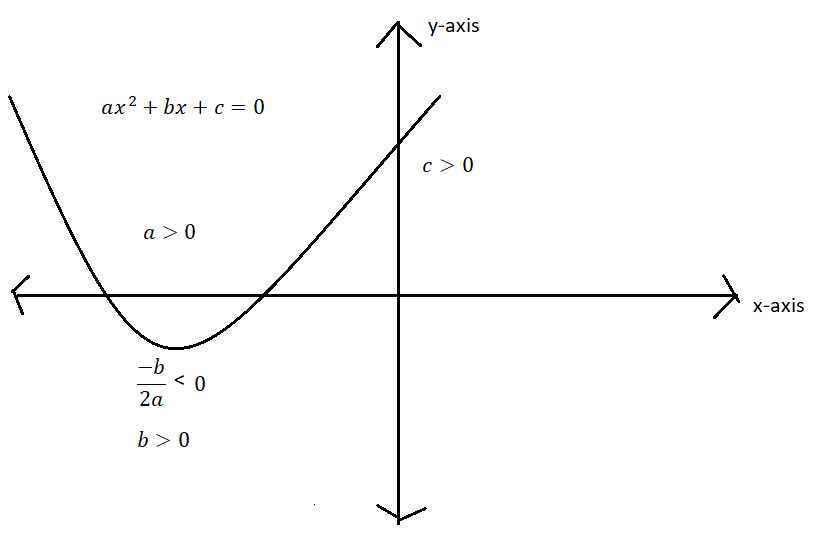
Since both roots are negative, then the diagram of equation $a{x^2} + bx + c = 0$ that is parabola lies to the left of y-axis. Now, here two cases are possible: one will be an upward parabola for(a>0) and another will be the downward parabola(a<0).
Consider the case in which $a{x^2} + bx + c = 0$ is upward parabola because it depends on the coefficient
of ${x^2}$that is a > 0. On forming its diagram as seen below we can observe that the y intercept i.e. when x=0 the equation gives us the c>0. And the point where differentiation of equation $a{x^2} + bx + c = 0$ is equal to gives us the condition that $\dfrac{{ - b}}{{2a}} < 0$. Since a>0 then b>0. Since, the diagram of $a{x^2} + bx + c = 0$ cuts the x-axis at two real points then $\Delta > 0$.
From above discussion we can write that
$a > 0,b > 0,c > 0{\text{ and }}\Delta > 0$ eq.1
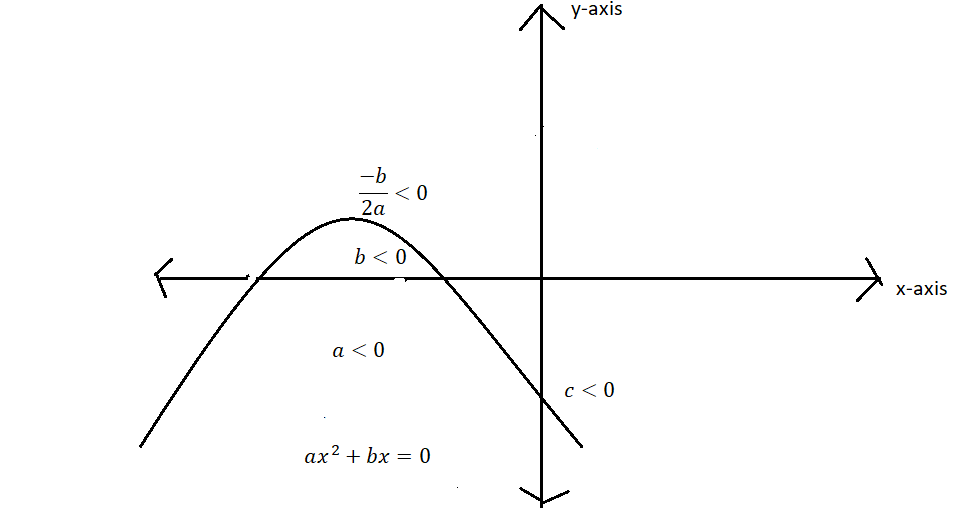
Now, consider the second case in which $a{x^2} + bx + c = 0$ is downward parabola because it depends on the coefficient of ${x^2}$that is a < 0. On forming its diagram as seen below we can observe that the y intercept i.e. when x=0 the equation gives us a condition that c<0 . And the point where differentiation of equation $a{x^2} + bx + c = 0$ is equal to zero gives us the condition that $\dfrac{{ - b}}{{2a}} < 0$. Since, a < 0 then b < 0. Since, the diagram of $a{x^2} + bx + c = 0$ cuts the x-axis at two real points then $\Delta > 0$.
From above discussion we can write that
$a < 0,b < 0,c < 0{\text{ and }}\Delta > 0$ eq.2
From, eq.1 and eq.2 we can write that
$\Delta > 0,{\text{ }}a,b,c{\text{ have the same sign}}$.
Hence, option B. is correct.
Note:- Whenever you get this type of question the key concept to solve this is to learn the different diagrams of equation $a{x^2} + bx + c = 0$ under different conditions. And one more thing to be remember is that if graph of some equation intersect y-axis below x-axis then y-intercept is negative and if intersect y-axis above x-axis then y-intercept is positive.
Complete step-by-step solution -
We have,
$a{x^2} + bx + c = 0$
Since both roots are negative, then the diagram of equation $a{x^2} + bx + c = 0$ that is parabola lies to the left of y-axis. Now, here two cases are possible: one will be an upward parabola for(a>0) and another will be the downward parabola(a<0).
Consider the case in which $a{x^2} + bx + c = 0$ is upward parabola because it depends on the coefficient
of ${x^2}$that is a > 0. On forming its diagram as seen below we can observe that the y intercept i.e. when x=0 the equation gives us the c>0. And the point where differentiation of equation $a{x^2} + bx + c = 0$ is equal to gives us the condition that $\dfrac{{ - b}}{{2a}} < 0$. Since a>0 then b>0. Since, the diagram of $a{x^2} + bx + c = 0$ cuts the x-axis at two real points then $\Delta > 0$.
From above discussion we can write that
$a > 0,b > 0,c > 0{\text{ and }}\Delta > 0$ eq.1
Now, consider the second case in which $a{x^2} + bx + c = 0$ is downward parabola because it depends on the coefficient of ${x^2}$that is a < 0. On forming its diagram as seen below we can observe that the y intercept i.e. when x=0 the equation gives us a condition that c<0 . And the point where differentiation of equation $a{x^2} + bx + c = 0$ is equal to zero gives us the condition that $\dfrac{{ - b}}{{2a}} < 0$. Since, a < 0 then b < 0. Since, the diagram of $a{x^2} + bx + c = 0$ cuts the x-axis at two real points then $\Delta > 0$.
From above discussion we can write that
$a < 0,b < 0,c < 0{\text{ and }}\Delta > 0$ eq.2
From, eq.1 and eq.2 we can write that
$\Delta > 0,{\text{ }}a,b,c{\text{ have the same sign}}$.
Hence, option B. is correct.
Note:- Whenever you get this type of question the key concept to solve this is to learn the different diagrams of equation $a{x^2} + bx + c = 0$ under different conditions. And one more thing to be remember is that if graph of some equation intersect y-axis below x-axis then y-intercept is negative and if intersect y-axis above x-axis then y-intercept is positive.
Recently Updated Pages
Master Class 11 English: Engaging Questions & Answers for Success

Master Class 11 Maths: Engaging Questions & Answers for Success
Class 11 Question and Answer - Your Ultimate Solutions Guide
Master Class 11 Biology: Engaging Questions & Answers for Success
Master Class 11 Physics: Engaging Questions & Answers for Success
Master Class 11 Accountancy: Engaging Questions & Answers for Success
Trending doubts
Explain the Treaty of Vienna of 1815 class 10 social science CBSE
Who Won 36 Oscar Awards? Record Holder Revealed
What is the median of the first 10 natural numbers class 10 maths CBSE
Why is it 530 pm in india when it is 1200 afternoon class 10 social science CBSE
Why is there a time difference of about 5 hours between class 10 social science CBSE
What is the full form of POSCO class 10 social science CBSE