




If ${{b}^{2}}-4ac=0$ then the graph of $y=a{{x}^{2}}+bx+c$
(a) Cuts x – axis in two real points.
(b) Touches x – axis.
(c) Lies entirely above the x – axis.
(d) Cannot be determined.
Answer
 Verified
564.3k+ views
Hint: Here we will understand the three different cases related to the values of the discriminant of a quadratic equation. They are D < 0, D > 0 and in the end D = 0, where D is called the discriminant given as $D={{b}^{2}}-4ac$. Further, we will see the nature of the graph in the three cases and the number of solutions they have.
Complete step-by-step solution:
Here we have been provided with the function $y=a{{x}^{2}}+bx+c$ and we are asked to find the nature of the graph of this curve if we have the condition ${{b}^{2}}-4ac=0$. Let us check all the cases related to the value of the discriminant one by one.
We know that the solution of a quadratic equation $a{{x}^{2}}+bx+c=0$ is given by the discriminant formula as $x=\dfrac{-b\pm \sqrt{{{b}^{2}}-4ac}}{2a}$. Here ${{b}^{2}}-4ac=D$ where D denotes the discriminant value. Now three cases arise for the value of D, let us check them one by one.
(1) When we have D < 0, i.e. ${{b}^{2}}-4ac<0$.
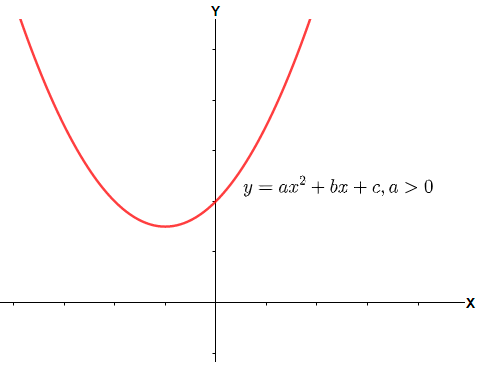
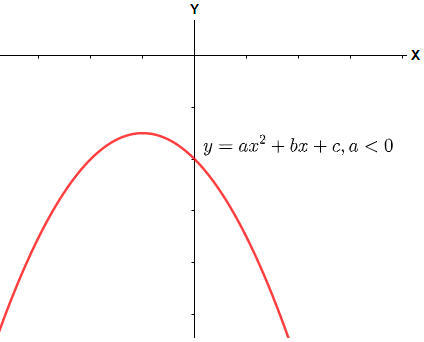
Now, in such a case we have the term inside the square root sign negative that means we have two complex roots of the equation and that cannot be represented on a real plane. Therefore the curve will lie either entirely above the x – axis (for a > 0) or entirely below the x – axis (for a < 0). The graphs can be shown as below.
Graph for a > 0.
Graph for a < 0.
(2) When we have D > 0, i.e. ${{b}^{2}}-4ac>0$.
Now, in such a case we have two different roots of the quadratic equation because one time we have to consider positive sign and the other time the negative sign in the solution $x=\dfrac{-b\pm \sqrt{{{b}^{2}}-4ac}}{2a}$. Therefore, the graph of the equation will cut the cut x – axis at two different places which can be shown below.

(3) When we have D = 0, i.e. ${{b}^{2}}-4ac=0$.
Now, in such a case we have only one root of the quadratic equation and that will be $x=\dfrac{-b}{2a}$. Therefore, the graph of the equation will cut the cut x – axis at one point, in other words it will touch the x – axis, which can be shown below.
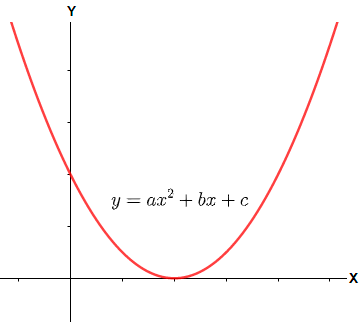
Hence, option (b) is the correct answer.
Note: Note that the nature of the concavity of the parabola depends completely on the value of ‘a’. In case ‘a’ is less than 0 then parabola opens downwards and in case ‘a’ is greater than 0 then parabola opens upward. There is another type of parabola given as $x=a{{y}^{2}}+by+c$ that opens sideways (either leftward or rightward). You must remember all the cases that we have discussed above.
Complete step-by-step solution:
Here we have been provided with the function $y=a{{x}^{2}}+bx+c$ and we are asked to find the nature of the graph of this curve if we have the condition ${{b}^{2}}-4ac=0$. Let us check all the cases related to the value of the discriminant one by one.
We know that the solution of a quadratic equation $a{{x}^{2}}+bx+c=0$ is given by the discriminant formula as $x=\dfrac{-b\pm \sqrt{{{b}^{2}}-4ac}}{2a}$. Here ${{b}^{2}}-4ac=D$ where D denotes the discriminant value. Now three cases arise for the value of D, let us check them one by one.
(1) When we have D < 0, i.e. ${{b}^{2}}-4ac<0$.
Now, in such a case we have the term inside the square root sign negative that means we have two complex roots of the equation and that cannot be represented on a real plane. Therefore the curve will lie either entirely above the x – axis (for a > 0) or entirely below the x – axis (for a < 0). The graphs can be shown as below.
Graph for a > 0.
Graph for a < 0.
(2) When we have D > 0, i.e. ${{b}^{2}}-4ac>0$.
Now, in such a case we have two different roots of the quadratic equation because one time we have to consider positive sign and the other time the negative sign in the solution $x=\dfrac{-b\pm \sqrt{{{b}^{2}}-4ac}}{2a}$. Therefore, the graph of the equation will cut the cut x – axis at two different places which can be shown below.
(3) When we have D = 0, i.e. ${{b}^{2}}-4ac=0$.
Now, in such a case we have only one root of the quadratic equation and that will be $x=\dfrac{-b}{2a}$. Therefore, the graph of the equation will cut the cut x – axis at one point, in other words it will touch the x – axis, which can be shown below.
Hence, option (b) is the correct answer.
Note: Note that the nature of the concavity of the parabola depends completely on the value of ‘a’. In case ‘a’ is less than 0 then parabola opens downwards and in case ‘a’ is greater than 0 then parabola opens upward. There is another type of parabola given as $x=a{{y}^{2}}+by+c$ that opens sideways (either leftward or rightward). You must remember all the cases that we have discussed above.
Recently Updated Pages
Master Class 11 English: Engaging Questions & Answers for Success

Master Class 11 Social Science: Engaging Questions & Answers for Success
Master Class 11 Maths: Engaging Questions & Answers for Success
Master Class 11 Biology: Engaging Questions & Answers for Success
Master Class 11 Physics: Engaging Questions & Answers for Success
Master Class 11 Chemistry: Engaging Questions & Answers for Success
Trending doubts
One Metric ton is equal to kg A 10000 B 1000 C 100 class 11 physics CBSE
What is cell theory Who formulated it class 11 biology CBSE
Phyllotaxy is the arrangement of ALeaflets BLeaves class 11 biology CBSE
Difference Between Prokaryotic Cells and Eukaryotic Cells
The symbiotic association of fungi and algae is called class 11 biology CBSE
Cell theory was formulated by A Schleiden and Schwann class 11 biology CBSE