




If $b$ and $c$ are lengths of the segments of the focal chord of a parabola\[{y^2} = 4ax\], then the length of the latus rectum is
A. \[\dfrac{{bc}}{{(b + c)}}\]
B. \[\sqrt {bc} \]
C. \[\dfrac{{(b + c)}}{2}\]
D. \[\dfrac{{2bc}}{{(b + c)}}\]
Answer
 Verified
489.9k+ views
Hint: This question is based on the properties of the curve parabola.Concepts like parametric point, focus, and focal chords are used to solve this question. The basics about focal chords must be clear, and the formula should be remembered.
Complete step by step answer:
The chord of the parabola which passes through the focus is called the focal chord.And chord to \[{y^2} = 4ax\] which passes through the focus is called a focal chord of the parabola \[{y^2} = 4ax\].
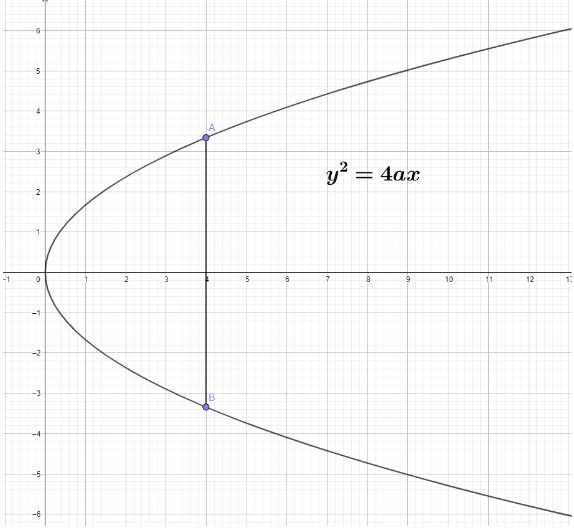
Let \[{y^2} = 4ax\] be the equation of a parabola and \[(at_1^2,2a{t_1})\] a point P on it. Suppose the coordinates of the other extremity Q of the focal chord through P are \[(at_2^2,2a{t_2})\]
Then, PS and SQ, where S is the focus \[(a,0)\], have the same slopes
\[ \Rightarrow \dfrac{{2a{t_1} - 0}}{{a{t_1}^2 - a}} = \dfrac{{2a{t_2} - 0}}{{a{t_2}^2 - a}}\]
Simplifying the equation and cross-multiplying gives
\[ \Rightarrow {t_1}{t_2}^2 - {t_1} = {t_2}{t_1}^2 - {t_2}\]
\[ \Rightarrow {t_1}{t_2}({t_2} - {t_1}) = - ({t_2} - {t_1})\]
So, we have a relation between the focal points
\[ \Rightarrow {t_1}{t_2} = - 1\]
Hence, \[{t_2} = \dfrac{{ - 1}}{{{t_1}}}\], i.e., the point Q is \[(\dfrac{a}{{{t_1}^2}}, - \dfrac{{2a}}{{{t_1}}})\].
The extremities of a focal chord of the parabola \[{y^2} = 4ax\]may be taken as the points \[{t_1}\] and \[\dfrac{{ - 1}}{{{t_1}}}\].
Now, calculating the length of the segment of the focal chord as shown below
\[ \Rightarrow {l_1} = \sqrt {{{(at_1^2 - a)}^2} + {{(2a{t_1} - 0)}^2}} \]
\[ \Rightarrow {l_1} = at_1^2 + a\]
Now, calculating the length of the segment of the focal chord as shown below,
\[ \Rightarrow {l_2} = \sqrt {{{(\dfrac{a}{{{t_1}^2}} - a)}^2} + {{( - \dfrac{{2a}}{{{t_1}}} - 0)}^2}}\]
\[ \Rightarrow {l_2} = (\dfrac{a}{{{t_1}^2}} + a)\]
Now, calculating the length of the focal chord
\[ \Rightarrow l = \sqrt {{{(at_1^2 - \dfrac{a}{{{t_1}^2}})}^2} + {{(2a{t_1} - ( - \dfrac{{2a}}{{{t_1}}}))}^2}} \]
\[ \Rightarrow l = a{({t_1} + \dfrac{1}{{{t_1}}})^2}\]
Now, deriving a relation between the length of the focal chord and the segments of the focal chord
\[ \Rightarrow l = \dfrac{{4{l_1}{l_2}}}{{({l_1} + {l_2})}}\]
Thus, the length of the semi-major axis can be given as,
\[ \Rightarrow s = \dfrac{1}{2}l\]
Or the length of the semi-major axis is the harmonic mean of the segments of the focal chord. Thus, if $b$ and $c$ are the lengths of the segments of the focal chord, then the length of the semi-major axis is given by:
\[ \therefore s = \dfrac{{2bc}}{{(b + c)}}\]
Thus, option D is the correct answer.
Note: Latus rectum of a parabola is a line segment passing through its focus and perpendicular to its axis. Length of the latus rectum of the parabola is always equal to four times its focal length or the distance between the vertex of the parabola and focus point. The relation between the length of the focal chord and its segment can be used as a direct result in a variety of other questions.
Complete step by step answer:
The chord of the parabola which passes through the focus is called the focal chord.And chord to \[{y^2} = 4ax\] which passes through the focus is called a focal chord of the parabola \[{y^2} = 4ax\].
Let \[{y^2} = 4ax\] be the equation of a parabola and \[(at_1^2,2a{t_1})\] a point P on it. Suppose the coordinates of the other extremity Q of the focal chord through P are \[(at_2^2,2a{t_2})\]
Then, PS and SQ, where S is the focus \[(a,0)\], have the same slopes
\[ \Rightarrow \dfrac{{2a{t_1} - 0}}{{a{t_1}^2 - a}} = \dfrac{{2a{t_2} - 0}}{{a{t_2}^2 - a}}\]
Simplifying the equation and cross-multiplying gives
\[ \Rightarrow {t_1}{t_2}^2 - {t_1} = {t_2}{t_1}^2 - {t_2}\]
\[ \Rightarrow {t_1}{t_2}({t_2} - {t_1}) = - ({t_2} - {t_1})\]
So, we have a relation between the focal points
\[ \Rightarrow {t_1}{t_2} = - 1\]
Hence, \[{t_2} = \dfrac{{ - 1}}{{{t_1}}}\], i.e., the point Q is \[(\dfrac{a}{{{t_1}^2}}, - \dfrac{{2a}}{{{t_1}}})\].
The extremities of a focal chord of the parabola \[{y^2} = 4ax\]may be taken as the points \[{t_1}\] and \[\dfrac{{ - 1}}{{{t_1}}}\].
Now, calculating the length of the segment of the focal chord as shown below
\[ \Rightarrow {l_1} = \sqrt {{{(at_1^2 - a)}^2} + {{(2a{t_1} - 0)}^2}} \]
\[ \Rightarrow {l_1} = at_1^2 + a\]
Now, calculating the length of the segment of the focal chord as shown below,
\[ \Rightarrow {l_2} = \sqrt {{{(\dfrac{a}{{{t_1}^2}} - a)}^2} + {{( - \dfrac{{2a}}{{{t_1}}} - 0)}^2}}\]
\[ \Rightarrow {l_2} = (\dfrac{a}{{{t_1}^2}} + a)\]
Now, calculating the length of the focal chord
\[ \Rightarrow l = \sqrt {{{(at_1^2 - \dfrac{a}{{{t_1}^2}})}^2} + {{(2a{t_1} - ( - \dfrac{{2a}}{{{t_1}}}))}^2}} \]
\[ \Rightarrow l = a{({t_1} + \dfrac{1}{{{t_1}}})^2}\]
Now, deriving a relation between the length of the focal chord and the segments of the focal chord
\[ \Rightarrow l = \dfrac{{4{l_1}{l_2}}}{{({l_1} + {l_2})}}\]
Thus, the length of the semi-major axis can be given as,
\[ \Rightarrow s = \dfrac{1}{2}l\]
Or the length of the semi-major axis is the harmonic mean of the segments of the focal chord. Thus, if $b$ and $c$ are the lengths of the segments of the focal chord, then the length of the semi-major axis is given by:
\[ \therefore s = \dfrac{{2bc}}{{(b + c)}}\]
Thus, option D is the correct answer.
Note: Latus rectum of a parabola is a line segment passing through its focus and perpendicular to its axis. Length of the latus rectum of the parabola is always equal to four times its focal length or the distance between the vertex of the parabola and focus point. The relation between the length of the focal chord and its segment can be used as a direct result in a variety of other questions.
Recently Updated Pages
Master Class 11 Computer Science: Engaging Questions & Answers for Success

Master Class 11 Business Studies: Engaging Questions & Answers for Success
Master Class 11 Economics: Engaging Questions & Answers for Success
Master Class 11 English: Engaging Questions & Answers for Success
Master Class 11 Maths: Engaging Questions & Answers for Success
Master Class 11 Biology: Engaging Questions & Answers for Success
Trending doubts
One Metric ton is equal to kg A 10000 B 1000 C 100 class 11 physics CBSE
There are 720 permutations of the digits 1 2 3 4 5 class 11 maths CBSE
Discuss the various forms of bacteria class 11 biology CBSE
Draw a diagram of a plant cell and label at least eight class 11 biology CBSE
State the laws of reflection of light
Explain zero factorial class 11 maths CBSE