



If arg \[\left( {\dfrac{{z - 2i}}{{z + 2i}}} \right) = \dfrac{\pi }{6}\] then which of the following options gives the correct locus of z?
A.
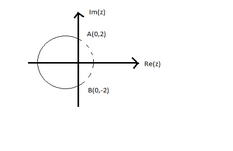
B.
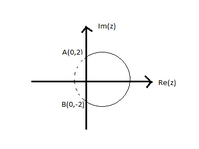
C.
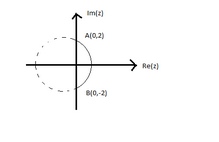
D.
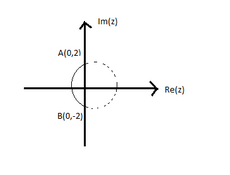
Answer
 Verified
542.4k+ views
Hint: A locus is a set of all points (commonly, a line, a line segment, a curve or a surface), whose location satisfies or is determined by one or more specified conditions and for each point on the plane, arg is the function which returns the angle and here in the given options we can see that the coordinates are given with respect to real and imaginary axis with complex number z.
Complete step-by-step answer:
Let A have the coordinates \[\left( {0,2} \right)\] and B have the coordinates \[\left( {0, - 2} \right)\] on the Argand plane.
Let P be the point represented by the complex number z.
\[z - 2i\] represents the ray AP, while \[z + 2i\] represents the ray BP.
Now, the argument of
\[\left( {\dfrac{{z - 2i}}{{z + 2i}}} \right) = \dfrac{\pi }{6}\]
Hence, when the ray BP is rotated in the anti-clockwise direction by \[\dfrac{\pi }{6}\] about point A, we should get ray AP.
In other words, angle BPA is always \[\dfrac{\pi }{6}\] .
Hence, BA must subtend a central angle of \[\dfrac{\pi }{3}\] on a circle.
Now, there are two possibilities, the centre can lie on the right or the left of the y axis. Since, the rotation has to be anti-clockwise, the centre has to be on the left side of the y axis.
Hence, the locus of P would be part of a circle whose centre is on the left side of the y axis.
Now, only the major arc AB will be the locus as points on the minor arc would subtend an obtuse angle.
Hence, option A is correct.
So, the correct answer is “Option A”.
Note: If you're given two points, and you're asked to find the locus of points equidistant from these two points, you'll always find the same thing: that the locus of points is actually the perpendicular bisector of the segment that joins the two points. two complex numbers are equal if and only if their real parts are equal and their imaginary parts are equal.
Complete step-by-step answer:
Let A have the coordinates \[\left( {0,2} \right)\] and B have the coordinates \[\left( {0, - 2} \right)\] on the Argand plane.
Let P be the point represented by the complex number z.
\[z - 2i\] represents the ray AP, while \[z + 2i\] represents the ray BP.
Now, the argument of
\[\left( {\dfrac{{z - 2i}}{{z + 2i}}} \right) = \dfrac{\pi }{6}\]
Hence, when the ray BP is rotated in the anti-clockwise direction by \[\dfrac{\pi }{6}\] about point A, we should get ray AP.
In other words, angle BPA is always \[\dfrac{\pi }{6}\] .
Hence, BA must subtend a central angle of \[\dfrac{\pi }{3}\] on a circle.
Now, there are two possibilities, the centre can lie on the right or the left of the y axis. Since, the rotation has to be anti-clockwise, the centre has to be on the left side of the y axis.
Hence, the locus of P would be part of a circle whose centre is on the left side of the y axis.
Now, only the major arc AB will be the locus as points on the minor arc would subtend an obtuse angle.
Hence, option A is correct.
So, the correct answer is “Option A”.
Note: If you're given two points, and you're asked to find the locus of points equidistant from these two points, you'll always find the same thing: that the locus of points is actually the perpendicular bisector of the segment that joins the two points. two complex numbers are equal if and only if their real parts are equal and their imaginary parts are equal.
Recently Updated Pages
Master Class 11 Computer Science: Engaging Questions & Answers for Success

Master Class 11 Business Studies: Engaging Questions & Answers for Success
Master Class 11 Economics: Engaging Questions & Answers for Success
Master Class 11 English: Engaging Questions & Answers for Success
Master Class 11 Maths: Engaging Questions & Answers for Success
Master Class 11 Biology: Engaging Questions & Answers for Success
Trending doubts
One Metric ton is equal to kg A 10000 B 1000 C 100 class 11 physics CBSE
There are 720 permutations of the digits 1 2 3 4 5 class 11 maths CBSE
Discuss the various forms of bacteria class 11 biology CBSE
Draw a diagram of a plant cell and label at least eight class 11 biology CBSE
State the laws of reflection of light
Explain zero factorial class 11 maths CBSE