




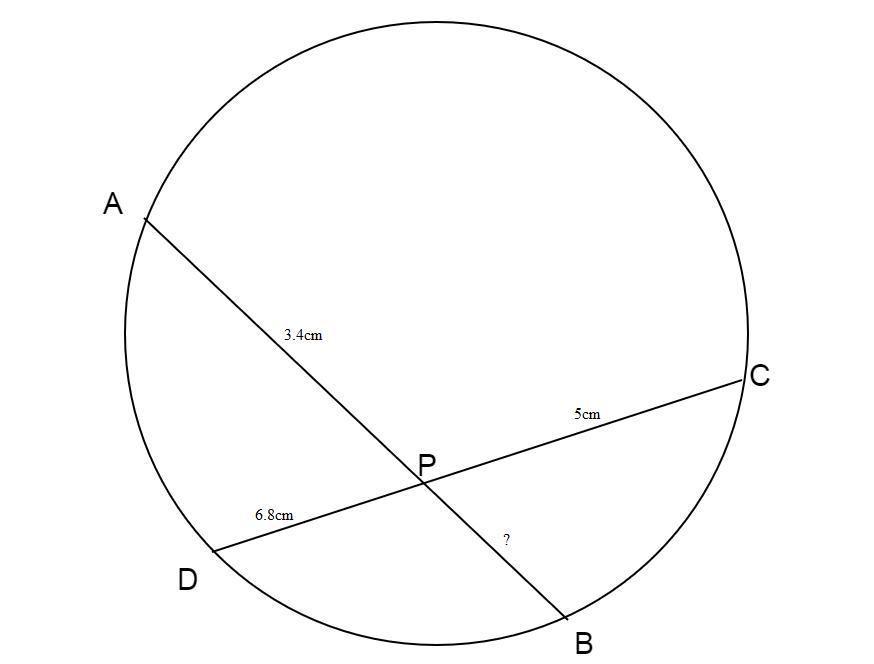
If AP = 3.4cm, CP = 5cm and DP = 6.8cm, then PB is equal to
A. \[8\] cm
B. \[9\] cm
C. \[10\] cm
D. \[12\] cm
Answer
 Verified
654k+ views
Hint:
Here we use the property of intersection of two chords which gives us formula for lengths of line segments formed by intersection of two chords i.e. If two chords in a circle intersect at a point, then the product of length of line segments of one chord is equal to the product of length of line segments of other chord.
* In a circle chord is a line joining two points lying on the circumference of the circle. Therefore chords may/may not have different lengths.
Complete step by step solution:
Given, \[AB\]and \[CD\]are two chords which intersect at point \[P\] gives us four line segments \[AP,PB,CP,DP\].
Also, \[AB = AP + PB,CD = CP + PD\]
Therefore, intersection at point \[P\] gives
\[AP = 3.4cm,{\text{ }}CP = 5cm{\text{ ,}}DP = 6.8cm\] From the property of intersection of chords, If two chords in a circle intersect at a point, then the product of length of line segments of one chord is equal to the product of length of line segments of other chord.
Therefore, lengths \[AP \times PB = CP \times PD\].
Substitute value of lengths of line segments AP=3.4cm, CP=5cm and DP=6.8cm in equation \[AP \cdot PB = CP \cdot PD\]
\[3.4 \times PB = 5 \times 6.8\]
Divide both sides of the equation by 3.4
\[\dfrac{{3.4 \times PB}}{{3.4}} = \dfrac{{5 \times 6.8}}{{3.4}}\]
Factor out the common factors from both sides.
\[PB = 5 \times 2\]
Perform multiplication to obtain the length of PB.
\[PB = 10\,\,cm\]
Therefore, PB=10cm. So,Option C is correct.
Note:
Similar situation may arise when the chords intersect outside the circle. The approach to these would be the same. Using the product of line segments of chords lengths of unknown segments can be obtained irrespective of where the chords intersect.
* In a circle, diameter is the longest chord that can be drawn from one point on the circumference to another point. Also, diameter is twice the length of the radius.
Here we use the property of intersection of two chords which gives us formula for lengths of line segments formed by intersection of two chords i.e. If two chords in a circle intersect at a point, then the product of length of line segments of one chord is equal to the product of length of line segments of other chord.
* In a circle chord is a line joining two points lying on the circumference of the circle. Therefore chords may/may not have different lengths.
Complete step by step solution:
Given, \[AB\]and \[CD\]are two chords which intersect at point \[P\] gives us four line segments \[AP,PB,CP,DP\].
Also, \[AB = AP + PB,CD = CP + PD\]
Therefore, intersection at point \[P\] gives
\[AP = 3.4cm,{\text{ }}CP = 5cm{\text{ ,}}DP = 6.8cm\] From the property of intersection of chords, If two chords in a circle intersect at a point, then the product of length of line segments of one chord is equal to the product of length of line segments of other chord.
Therefore, lengths \[AP \times PB = CP \times PD\].
Substitute value of lengths of line segments AP=3.4cm, CP=5cm and DP=6.8cm in equation \[AP \cdot PB = CP \cdot PD\]
\[3.4 \times PB = 5 \times 6.8\]
Divide both sides of the equation by 3.4
\[\dfrac{{3.4 \times PB}}{{3.4}} = \dfrac{{5 \times 6.8}}{{3.4}}\]
Factor out the common factors from both sides.
\[PB = 5 \times 2\]
Perform multiplication to obtain the length of PB.
\[PB = 10\,\,cm\]
Therefore, PB=10cm. So,Option C is correct.
Note:
Similar situation may arise when the chords intersect outside the circle. The approach to these would be the same. Using the product of line segments of chords lengths of unknown segments can be obtained irrespective of where the chords intersect.
* In a circle, diameter is the longest chord that can be drawn from one point on the circumference to another point. Also, diameter is twice the length of the radius.
Recently Updated Pages
Class 10 Question and Answer - Your Ultimate Solutions Guide

Master Class 10 Computer Science: Engaging Questions & Answers for Success
Master Class 10 General Knowledge: Engaging Questions & Answers for Success
Master Class 12 Economics: Engaging Questions & Answers for Success
Master Class 12 Social Science: Engaging Questions & Answers for Success
Master Class 12 English: Engaging Questions & Answers for Success
Trending doubts
Explain the Treaty of Vienna of 1815 class 10 social science CBSE
The slogan Jai Hind was given by A Lal Bahadur Shastri class 10 social science CBSE
10 examples of evaporation in daily life with explanations
What is the full form of POSCO class 10 social science CBSE
Identify the feminine form of noun nephew a shenephew class 10 english CBSE
CSIR full form?