




If angles P, Q, R and S of the quadrilateral PQRS, taken in order, are in the ratio $3:7:6:4$ then PQRS is
(a) rhombus
(b) parallelogram
(c) trapezoid
(d) kite
Answer
 Verified
622.5k+ views
Hint: First, we will find the sum of ratio of angles by adding the measures of ratio. Then we will find a measure of individual angle by using the formula $\dfrac{\text{ratio of that angle}}{\text{sum of the ratio}}\times 360{}^\circ $ . Thus, after getting all the measures of each angle we will check with the option given to us and then we will select the correct answer.
Complete step-by-step answer:
Here, we know that summation of all the interior angles of any quadrilateral is $360{}^\circ $ .
So, if we draw the figure as per the question having measure of all angles different, we will get as
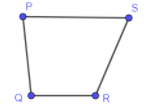
Now, we will so summation of the ratio of 4 angles given to us i.e. $3:7:6:4$ we get as
Sum of all the ratio of angles $=3+7+6+4=20$
Now, to find a measure of individual angle, we will use the formula $\dfrac{\text{ratio of that angle}}{\text{sum of the ratio}}\times 360{}^\circ $ .
So, on finding measure of angle P we get as
$\angle P=\dfrac{3}{20}\times 360{}^\circ $
On solving we get as,
$\angle P=54{}^\circ $ ……………….(1)
We will find for angle Q, we get as
$\angle Q=\dfrac{7}{20}\times 360{}^\circ $
On solving we get measure as,
$\angle Q=126{}^\circ $ …………………..(2)
Similarly, for angle R
$\angle R=\dfrac{6}{20}\times 360{}^\circ =108{}^\circ $ ………………………..(3)
Now, for angle S, we get as
$\angle S=\dfrac{4}{20}\times 360{}^\circ =72{}^\circ $ ………………………(4)
We get diagram as per angles something like this,
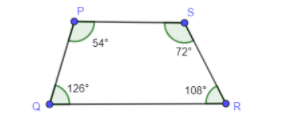
Now, as we can see that all the angles are of different measure. So, we will take each option and understand its properties regarding angles and then we will select the answer.
Taking rhombus: In this, opposite angles are equal. But as we can see none of the angles have the same measure so, this is not the correct answer.
Taking parallelogram: Also, in this opposite angles are equal. So, this is not the correct answer.
Taking trapezium: Sum of adjacent angles of non- parallel side is $180{}^\circ $ . On doing this we will get the sum of angle P, Q and R, S to be $180{}^\circ $ . This is the correct answer.
Taking a kite: One pair of opposite angles is equal. This is not the correct answer.
Thus, option (c) is the correct answer.
Note: Students should know all the properties regarding trapezium, rhombus, parallelogram, kite and any other quadrilateral then only it will be easy to solve and correct answers will be obtained. Otherwise there are chances of getting answers wrong. So, it is important to remember all the properties and then try to solve it.
Complete step-by-step answer:
Here, we know that summation of all the interior angles of any quadrilateral is $360{}^\circ $ .
So, if we draw the figure as per the question having measure of all angles different, we will get as
Now, we will so summation of the ratio of 4 angles given to us i.e. $3:7:6:4$ we get as
Sum of all the ratio of angles $=3+7+6+4=20$
Now, to find a measure of individual angle, we will use the formula $\dfrac{\text{ratio of that angle}}{\text{sum of the ratio}}\times 360{}^\circ $ .
So, on finding measure of angle P we get as
$\angle P=\dfrac{3}{20}\times 360{}^\circ $
On solving we get as,
$\angle P=54{}^\circ $ ……………….(1)
We will find for angle Q, we get as
$\angle Q=\dfrac{7}{20}\times 360{}^\circ $
On solving we get measure as,
$\angle Q=126{}^\circ $ …………………..(2)
Similarly, for angle R
$\angle R=\dfrac{6}{20}\times 360{}^\circ =108{}^\circ $ ………………………..(3)
Now, for angle S, we get as
$\angle S=\dfrac{4}{20}\times 360{}^\circ =72{}^\circ $ ………………………(4)
We get diagram as per angles something like this,
Now, as we can see that all the angles are of different measure. So, we will take each option and understand its properties regarding angles and then we will select the answer.
Taking rhombus: In this, opposite angles are equal. But as we can see none of the angles have the same measure so, this is not the correct answer.
Taking parallelogram: Also, in this opposite angles are equal. So, this is not the correct answer.
Taking trapezium: Sum of adjacent angles of non- parallel side is $180{}^\circ $ . On doing this we will get the sum of angle P, Q and R, S to be $180{}^\circ $ . This is the correct answer.
Taking a kite: One pair of opposite angles is equal. This is not the correct answer.
Thus, option (c) is the correct answer.
Note: Students should know all the properties regarding trapezium, rhombus, parallelogram, kite and any other quadrilateral then only it will be easy to solve and correct answers will be obtained. Otherwise there are chances of getting answers wrong. So, it is important to remember all the properties and then try to solve it.
Recently Updated Pages
Master Class 10 English: Engaging Questions & Answers for Success

Master Class 10 Social Science: Engaging Questions & Answers for Success
Master Class 10 Computer Science: Engaging Questions & Answers for Success
Class 10 Question and Answer - Your Ultimate Solutions Guide
Master Class 10 General Knowledge: Engaging Questions & Answers for Success
Master Class 10 Maths: Engaging Questions & Answers for Success
Trending doubts
What is the full form of NDA a National Democratic class 10 social science CBSE
Explain the Treaty of Vienna of 1815 class 10 social science CBSE
Who Won 36 Oscar Awards? Record Holder Revealed
Bharatiya Janata Party was founded in the year A 1979 class 10 social science CBSE
What is the median of the first 10 natural numbers class 10 maths CBSE
Why is it 530 pm in india when it is 1200 afternoon class 10 social science CBSE