




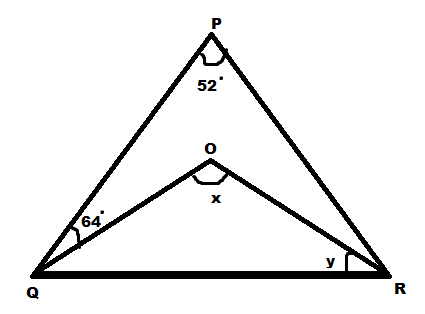
If $\angle P = {52^ \circ }$ and $\angle PQO = {64^ \circ }$ . If QO and RO are bisectors of $\angle PQR{\text{ and }}\angle PRQ$ respectively, then the value of $\angle x$ exists but the value of $\angle y$ does not exist?
a.True
b.False
Answer
 Verified
586.2k+ views
Hint: We are given that OQ and OR are angle bisectors from which we get $\angle PQO = \angle OQR$ and $\angle PRO = \angle ORQ$ and by using the angle sum property of a triangle we can find that y does not exist and using the same property in the triangle OQR we can see that the value of x exists as the value of y does not exist.
Complete step-by-step answer:
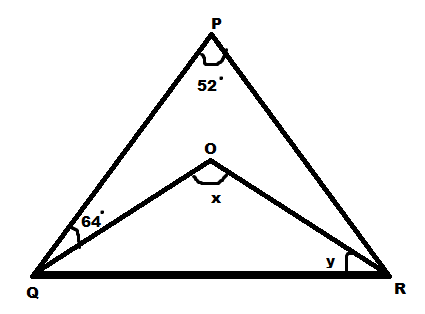
We are given that OQ is the angle bisector of $\angle PQR$
From that we have $\angle PQO = \angle OQR$
We are given that $\angle PQO = {64^ \circ }$
Hence $\angle OQR = {64^ \circ }$
We are given that OR is the angle bisector of $\angle PRQ$
From that we have $\angle PRO = \angle ORQ$
We are given that $\angle ORQ = y$
Hence $\angle PRO = y$
We know that the sum of the angles of a triangle is equal to ${180^ \circ }$
\[
\Rightarrow \angle P + \angle Q + \angle R = {180^ \circ } \\
\Rightarrow {52^ \circ } + (\angle PQO + \angle OQR) + (\angle PRO + \angle ORQ) = {180^ \circ } \\
\Rightarrow {52^ \circ } + ({64^ \circ } + {64^ \circ }) + (y + y) = {180^ \circ } \\
\Rightarrow {180^ \circ } + 2y = {180^ \circ } \\
\Rightarrow 2y = {180^ \circ } - {180^ \circ } = 0 \\
\]
Therefore from this we get that y does not exists
Now in triangle OQR ,
\[
\Rightarrow \angle QOR + \angle OQR + \angle ORQ = {180^ \circ } \\
\Rightarrow x + {64^ \circ } + y = {180^ \circ } \\
\Rightarrow x + y = {180^ \circ } - {64^ \circ } \\
\Rightarrow x + y = {116^ \circ } \\
\\
\]
Therefore here we get that the value of x exists only when the value of y does not exist.
Therefore the statement is true.
The correct option is a.
Note: An acute triangle is one in which each of the three angles is acute – less than 90 degrees. A right triangle is one in which it has one right angle – 90degrees. An obtuse triangle is defined as a triangle that has one obtuse angle – more than 90 degrees.
Complete step-by-step answer:
We are given that OQ is the angle bisector of $\angle PQR$
From that we have $\angle PQO = \angle OQR$
We are given that $\angle PQO = {64^ \circ }$
Hence $\angle OQR = {64^ \circ }$
We are given that OR is the angle bisector of $\angle PRQ$
From that we have $\angle PRO = \angle ORQ$
We are given that $\angle ORQ = y$
Hence $\angle PRO = y$
We know that the sum of the angles of a triangle is equal to ${180^ \circ }$
\[
\Rightarrow \angle P + \angle Q + \angle R = {180^ \circ } \\
\Rightarrow {52^ \circ } + (\angle PQO + \angle OQR) + (\angle PRO + \angle ORQ) = {180^ \circ } \\
\Rightarrow {52^ \circ } + ({64^ \circ } + {64^ \circ }) + (y + y) = {180^ \circ } \\
\Rightarrow {180^ \circ } + 2y = {180^ \circ } \\
\Rightarrow 2y = {180^ \circ } - {180^ \circ } = 0 \\
\]
Therefore from this we get that y does not exists
Now in triangle OQR ,
\[
\Rightarrow \angle QOR + \angle OQR + \angle ORQ = {180^ \circ } \\
\Rightarrow x + {64^ \circ } + y = {180^ \circ } \\
\Rightarrow x + y = {180^ \circ } - {64^ \circ } \\
\Rightarrow x + y = {116^ \circ } \\
\\
\]
Therefore here we get that the value of x exists only when the value of y does not exist.
Therefore the statement is true.
The correct option is a.
Note: An acute triangle is one in which each of the three angles is acute – less than 90 degrees. A right triangle is one in which it has one right angle – 90degrees. An obtuse triangle is defined as a triangle that has one obtuse angle – more than 90 degrees.

Recently Updated Pages
Master Class 8 Social Science: Engaging Questions & Answers for Success

Master Class 8 English: Engaging Questions & Answers for Success
Class 8 Question and Answer - Your Ultimate Solutions Guide
Master Class 8 Maths: Engaging Questions & Answers for Success
Master Class 8 Science: Engaging Questions & Answers for Success
Master Class 7 English: Engaging Questions & Answers for Success
Trending doubts
What is BLO What is the full form of BLO class 8 social science CBSE
Citizens of India can vote at the age of A 18 years class 8 social science CBSE
Full form of STD, ISD and PCO
Advantages and disadvantages of science
Right to vote is a AFundamental Right BFundamental class 8 social science CBSE
What are the 12 elements of nature class 8 chemistry CBSE