




If an equilateral triangle, having centroid at the origin, has a side along the line, $x+y=2$, then the area (in sq. units) of this triangle is:
A. $6$
B. $6\sqrt{3}$
C. $\dfrac{9}{2}\sqrt{3}$
D. $3\sqrt{6}$
Answer
 Verified
613.2k+ views
Hint: In this question we have to find out the area of the equilateral triangle, so, first of all we have to find out the side of the triangle. Once we find the length of triangle we can find the area of equilateral triangle by using the formula $A=\dfrac{\sqrt{3}}{4}{{a}^{2}}$ where $a$is the length of side of triangle .
Its origin is the centroid of the equilateral triangle so here we use the property that centroid divides the median in $2:1$ ratio. Also use perpendicular distance formula to find the perpendicular distance between centroid and the side of triangle using the formula, if $ax+by+c=0$ be any straight line and $\left( \alpha ,\beta \right)$be any point then perpendicular distance is given by
$d=\dfrac{a\alpha +b\beta +c}{\sqrt{{{a}^{2}}+{{b}^{2}}}}$
Complete step-by-step answer:
First we draw the figure as below
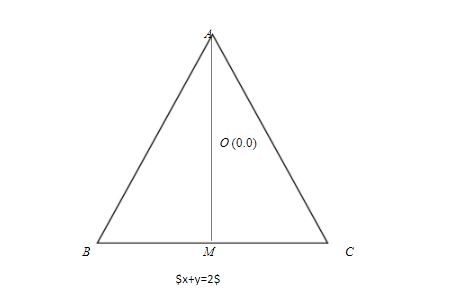
Let AB, BC, AC be the sides of the equilateral triangle. Let $AB=BC=CA=a$. Let O is the origin of the triangle and side BC is along the straight line $x+y=2$, OM is the perpendicular distance from O to BC, so we can find OM by using the formula
$d=\left| \dfrac{a\alpha +b\beta +c}{\sqrt{{{a}^{2}}+{{b}^{2}}}} \right|$
As we have equation of straight line $x+y-2=0$ and $\left( \alpha ,\beta \right)$is $(0,0)$
So, we have $a=1,\text{ }b=1,\text{ }c=-1$
Hence, we have
$\begin{align}
& d=\left| \dfrac{1.(0)+1(0)-2}{\sqrt{{{1}^{2}}+{{1}^{2}}}} \right| \\
& d=\left| \dfrac{-2}{\sqrt{2}} \right| \\
& d=\sqrt {2} \\
\end{align}$
So here we find OM
As we know that centroid divides the median AM in $2:1$ratio
Hence, we can write
$\dfrac{AO}{OM}=\dfrac{2}{1}$
Adding both side 1 we have
\[\begin{align}
& \dfrac{AO}{OM}+1=\dfrac{2}{1}+1 \\
& \dfrac{AO+OM}{OM}=3 \\
& \dfrac{AM}{OM}=3 \\
& AM=3OM \\
& AM=3\sqrt{2} \\
\end{align}\]
As we Median AM bisect the side of the equilateral triangle, also median AM is perpendicular to the side of triangle BC.
So, we can write,
\[BM=MC=\dfrac{a}{2}\]
And in right angle triangle AMC, we can use Pythagora's theorem in order to find the side AC. Hence, we can write
$\begin{align}
& A{{C}^{2}}=A{{M}^{2}}+M{{C}^{2}} \\
& {{a}^{2}}={{\left( 3\sqrt{2} \right)}^{2}}+{{\left( \dfrac{a}{2} \right)}^{2}} \\
& {{a}^{2}}-\dfrac{{{a}^{2}}}{4}=18 \\
& \dfrac{4{{a}^{2}}-{{a}^{2}}}{4}=9 \\
& 3{{a}^{2}}=(18)(4) \\
& {{a}^{2}}=24-------(a) \\
\end{align}$
As we know that area of equilateral triangle is given by
$A=\dfrac{\sqrt{3}}{4}{{a}^{2}}$
So, putting the value of ${{a}^{2}}=24$ from equation $(a)$ we can find the area of triangle
\[\begin{align}
& A=\dfrac{\sqrt{3}}{4}(24) \\
& A=6\sqrt{3} \\
\end{align}\]
Hence, we find the area of the equilateral triangle is $6\sqrt{3}$square unit.
Hence, option B is correct.
Note: Line joining the vertices and centroid of triangle bisect the angle so $\angle OCM=30{}^\circ $. we can find OM by using trigonometry also. Centroid is the point of intersection of median. Median is the line joining of midpoint of side and opposite vertices. So, centroid of a triangle always lies inside the triangle. In an equilateral triangle centroid, incentre, orthocentre all are same points.
Its origin is the centroid of the equilateral triangle so here we use the property that centroid divides the median in $2:1$ ratio. Also use perpendicular distance formula to find the perpendicular distance between centroid and the side of triangle using the formula, if $ax+by+c=0$ be any straight line and $\left( \alpha ,\beta \right)$be any point then perpendicular distance is given by
$d=\dfrac{a\alpha +b\beta +c}{\sqrt{{{a}^{2}}+{{b}^{2}}}}$
Complete step-by-step answer:
First we draw the figure as below
Let AB, BC, AC be the sides of the equilateral triangle. Let $AB=BC=CA=a$. Let O is the origin of the triangle and side BC is along the straight line $x+y=2$, OM is the perpendicular distance from O to BC, so we can find OM by using the formula
$d=\left| \dfrac{a\alpha +b\beta +c}{\sqrt{{{a}^{2}}+{{b}^{2}}}} \right|$
As we have equation of straight line $x+y-2=0$ and $\left( \alpha ,\beta \right)$is $(0,0)$
So, we have $a=1,\text{ }b=1,\text{ }c=-1$
Hence, we have
$\begin{align}
& d=\left| \dfrac{1.(0)+1(0)-2}{\sqrt{{{1}^{2}}+{{1}^{2}}}} \right| \\
& d=\left| \dfrac{-2}{\sqrt{2}} \right| \\
& d=\sqrt {2} \\
\end{align}$
So here we find OM
As we know that centroid divides the median AM in $2:1$ratio
Hence, we can write
$\dfrac{AO}{OM}=\dfrac{2}{1}$
Adding both side 1 we have
\[\begin{align}
& \dfrac{AO}{OM}+1=\dfrac{2}{1}+1 \\
& \dfrac{AO+OM}{OM}=3 \\
& \dfrac{AM}{OM}=3 \\
& AM=3OM \\
& AM=3\sqrt{2} \\
\end{align}\]
As we Median AM bisect the side of the equilateral triangle, also median AM is perpendicular to the side of triangle BC.
So, we can write,
\[BM=MC=\dfrac{a}{2}\]
And in right angle triangle AMC, we can use Pythagora's theorem in order to find the side AC. Hence, we can write
$\begin{align}
& A{{C}^{2}}=A{{M}^{2}}+M{{C}^{2}} \\
& {{a}^{2}}={{\left( 3\sqrt{2} \right)}^{2}}+{{\left( \dfrac{a}{2} \right)}^{2}} \\
& {{a}^{2}}-\dfrac{{{a}^{2}}}{4}=18 \\
& \dfrac{4{{a}^{2}}-{{a}^{2}}}{4}=9 \\
& 3{{a}^{2}}=(18)(4) \\
& {{a}^{2}}=24-------(a) \\
\end{align}$
As we know that area of equilateral triangle is given by
$A=\dfrac{\sqrt{3}}{4}{{a}^{2}}$
So, putting the value of ${{a}^{2}}=24$ from equation $(a)$ we can find the area of triangle
\[\begin{align}
& A=\dfrac{\sqrt{3}}{4}(24) \\
& A=6\sqrt{3} \\
\end{align}\]
Hence, we find the area of the equilateral triangle is $6\sqrt{3}$square unit.
Hence, option B is correct.
Note: Line joining the vertices and centroid of triangle bisect the angle so $\angle OCM=30{}^\circ $. we can find OM by using trigonometry also. Centroid is the point of intersection of median. Median is the line joining of midpoint of side and opposite vertices. So, centroid of a triangle always lies inside the triangle. In an equilateral triangle centroid, incentre, orthocentre all are same points.
Recently Updated Pages
Master Class 11 Social Science: Engaging Questions & Answers for Success

Master Class 11 Physics: Engaging Questions & Answers for Success
Master Class 11 Maths: Engaging Questions & Answers for Success
Master Class 11 Economics: Engaging Questions & Answers for Success
Master Class 11 Computer Science: Engaging Questions & Answers for Success
Master Class 11 Chemistry: Engaging Questions & Answers for Success
Trending doubts
One Metric ton is equal to kg A 10000 B 1000 C 100 class 11 physics CBSE
There are 720 permutations of the digits 1 2 3 4 5 class 11 maths CBSE
1 Quintal is equal to a 110 kg b 10 kg c 100kg d 1000 class 11 physics CBSE
State and prove Bernoullis theorem class 11 physics CBSE
Difference Between Prokaryotic Cells and Eukaryotic Cells
Discuss the various forms of bacteria class 11 biology CBSE